

I didn’t expect to take Pixels this seriously.
At first glance, it’s still what most people think it is. A simple farming game. You plant, you harvest, you craft a few things, maybe trade a little, log off. Nothing about it screams “next big thing.”
But that surface view misses what’s actually changing underneath.
Because Pixels right now feels less like a game trying to reward you… and more like a system slowly teaching you how to operate inside it.
That shift is subtle, but it changes everything.
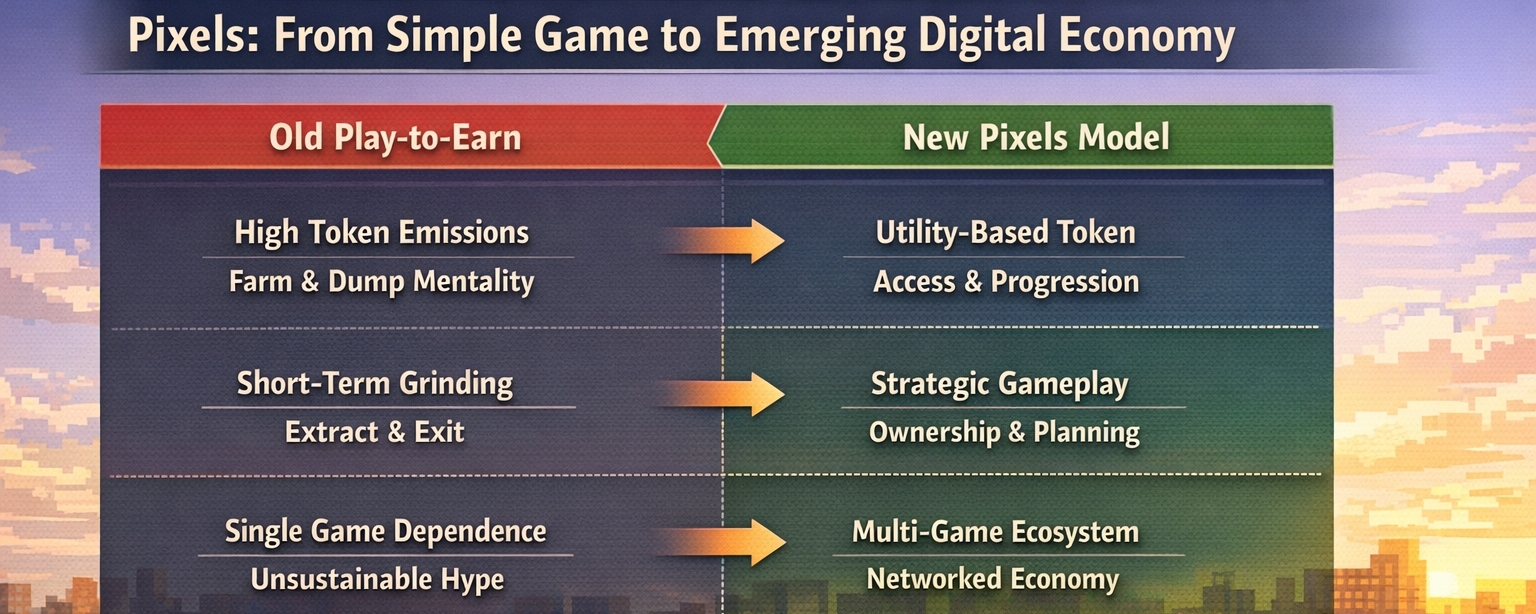
What stands out immediately is how the project has moved away from the old play-to-earn mindset without making a big announcement about it. There’s no aggressive push of rewards to pull users in. No artificial hype cycles designed to spike activity for a few weeks and then fade out.
Instead, the economy is tightening.
$PIXEL is no longer just something you farm and dump. It’s becoming something you need if you actually want to progress. Access to better production, stronger positioning, and long-term advantages is starting to depend on how you interact with the system, not just how much time you spend grinding.
That alone changes behavior.
You stop thinking in terms of extraction. You start thinking in terms of positioning.
And that’s where things start to feel different.
Another layer that doesn’t get enough attention is how access itself is evolving. It’s no longer guaranteed. Land ownership, slot mechanics, and time-based access have introduced a level of scarcity that forces decisions. You can’t just unlock everything and sit on it forever. You need to stay active, stay strategic, and actually think ahead.
That’s a very different dynamic from earlier Web3 games where once you had an advantage, you could just hold it passively.
Here, advantages decay.
And that creates movement inside the system.
You start seeing different types of players emerge. Some focus on grinding. Others focus on ownership. Some position themselves around production. Others lean into trading and coordination.
That split is where real economies begin to form.
What makes this even more interesting is that Pixels is no longer acting like a single game. It’s slowly positioning itself as something broader. There’s a clear direction toward expanding beyond one core experience, with multiple gameplay loops and systems starting to connect back to the same token and the same economy.
If that continues, $PIXEL stops being tied to one game loop.
It becomes tied to activity across an entire network.
And that’s a completely different level of demand.
The part that really caught my attention though is how the system handles rewards now. It doesn’t feel random anymore. It feels measured. Almost like every reward has to justify its existence.
That kind of design doesn’t happen by accident.
It suggests that the team is thinking in terms of sustainability instead of short-term growth. Instead of asking how to bring users in quickly, they’re asking how to keep them without breaking the economy.
And you can actually see that in player behavior.
People are still playing even when rewards aren’t at their peak. That’s rare in Web3. Usually, once incentives drop, activity disappears almost instantly.
Here, the loop is holding on its own.
That doesn’t mean everything is solved.
There are still risks. Token supply dynamics can create pressure. Liquidity isn’t deep enough yet to absorb large moves without volatility. And scaling from one successful game into a full ecosystem is something very few projects have managed to pull off cleanly.
Execution still matters a lot from here.
But what’s different is that Pixels doesn’t feel like it’s relying on hype to get there.
It feels like it’s building quietly, adjusting the system piece by piece, and letting the behavior of players validate whether it’s working or not.
And honestly, that’s a better signal than any announcement.
Because real systems don’t need constant noise to prove they’re alive.
They just keep running.
Right now, Pixels feels like it’s crossing that line where it stops being just a game you try for a few days… and starts becoming a place where time, access, and decisions actually mean something over the long run.
And if that continues, then what we’re looking at isn’t just another GameFi project.
It’s the early version of a digital economy that people are slowly learning how to live inside.