
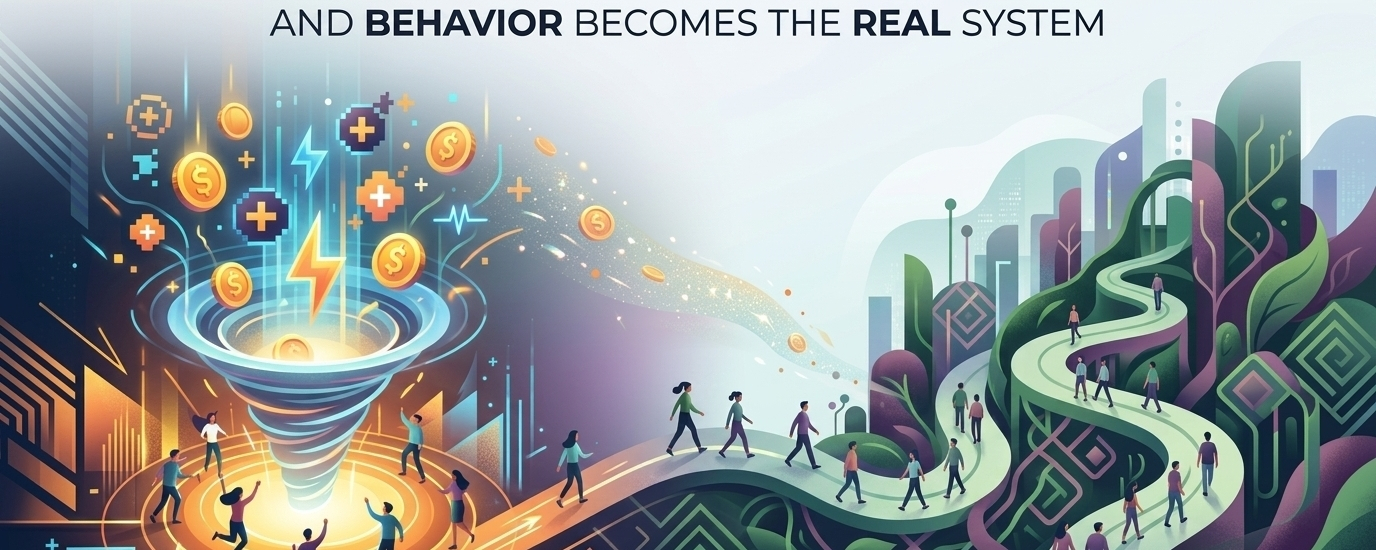
When I look at @Pixels , I don’t really see incentives as the main engine anymore. They matter, of course, but only at the beginning. They explain why someone enters the system, not why they stay inside it.
At some point, every incentive-driven system reaches a quiet turning point. Users stop consciously responding to rewards and start repeating actions out of familiarity. What was once a structured loop slowly becomes a personal routine.
And that transition is more important than it looks.
Because incentives are designed for clarity. They tell you exactly what to do and what you get in return. That works well in early stages, when everything is still being learned. But once behavior stabilizes, clarity is no longer enough to sustain attention. People begin to operate on patterns, not instructions.
That’s where the real difference between systems becomes visible.
Some platforms remain permanently dependent on incentives. Every action needs reinforcement. Every return needs a reason. The moment rewards weaken, engagement follows.
Others begin to shift into something more subtle — behavior starts to carry itself. Users return without fully calculating why. The system becomes part of their rhythm rather than their decision-making.
With $PIXEL , what matters over time is not how strong the incentives are today, but whether the system can evolve beyond them. Whether participation eventually feels less like a response to rewards and more like a natural continuation of past actions.
That’s a difficult transition to achieve because it cannot be forced. It has to emerge through repetition, consistency, and perceived value that extends beyond immediate gain. Most systems never fully cross that line. They remain stuck optimizing incentives instead of evolving behavior.
And that’s where long-term sustainability actually lives not in how users are attracted, but in how they quietly stay without needing to be convinced every time.
In the end, the question is not whether #pixel can create engagement. That part is relatively straightforward in this space.
The real question is whether engagement slowly turns into habit, and whether habit becomes strong enough to exist even when incentives are no longer the primary driver.
Because once a system reaches that point, it stops feeling like something users interact with.
It sarts feeling like something they naturally return to.