Market felt weirdly quiet this morning. Not the usual blood-red panic, just this flat, bored kind of stillness where everyone’s refreshing the same charts and muttering about how Web3 gaming “still hasn’t figured it out.” I was supposed to be reviewing my positions like a responsible trader, but honestly I was over it. Grabbed my phone, opened Pixels out of pure muscle memory from last year’s grind sessions, and started tapping through the daily stuff while my coffee went cold.
Out of curiosity I tapped on this banner that kept showing up—something called Stacked. Figured it was just another mini-event or whatever. Wasn’t planning to write anything, wasn’t hunting for the next 10x narrative. Just killing time.
And that’s when it clicked. Wait… we’ve all been looking at rewarded game economies completely wrong.
I always thought the trap was obvious: either you don’t give enough rewards and players bounce, or you give too many and the token dumps, bots swarm, economy dies in six weeks. Classic cycle I lived through myself—farmed one project so hard in early 2024 that I made a couple grand, watched the chart crater, and never went back. So the fix, in my head, was always “better distribution” or “smarter tokenomics” or whatever buzzword was trending that month. More rules, bigger airdrops, tighter vesting. Same game, just painted differently.
But Stacked isn’t doing any of that.
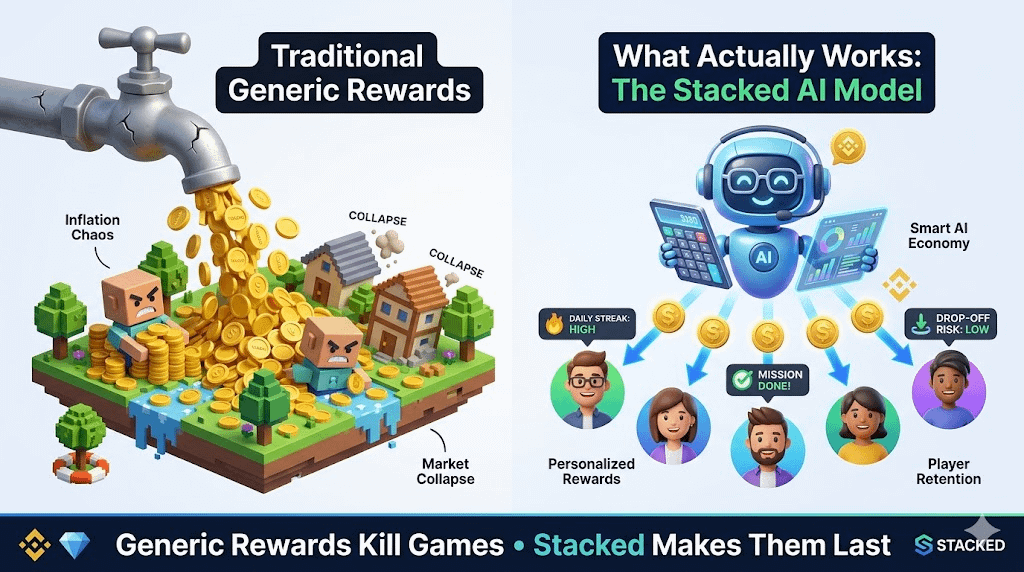
What people assume is you set some static missions, spray tokens like confetti, and hope the good times last. What actually happens inside Stacked is quieter and honestly a little uncomfortable once you sit with it. There’s this live ops layer running underneath everything, with an AI game economist watching real player behavior in real time—your streaks, your drop-off patterns, how you actually play instead of how the devs wish you would. Then it quietly decides the right reward for the right person at the exact right second. Not blanket farming quests that every bot figures out by day two. Not generic loyalty points. Targeted nudges that actually move the needle on whether someone sticks around or ghosts.
I caught myself hesitating hard when I read that part. I thought, “Hold on, this sounds like turning games into some creepy optimization machine—where’s the fun if an AI is basically reading your mind and handing out carrots?” But then I remembered raging in a group chat literally last month about another title where everyone was doing the exact same three quests until the rewards dried up and the Discord went silent. Generic always collapses. This approach… doesn’t feel generic.
Here’s the part that still doesn’t sit right with me, though—and it’s the thing that keeps me thinking about it at 2 a.m. What if this precision gets too good? What if the AI starts quietly steering rewards toward the players who spend the most or play the longest in ways that feel manipulative instead of fair? Or what if every studio just plugs into the same backend and we end up with this weird monoculture where one model decides what “good engagement” even means across the entire industry? I’m not fully convinced it holds up once the numbers get really big and the incentives get really twisted. Feels like we might be trading the old obvious rug pulls for something sneakier that’s harder to see coming.
Still, it’s hard to shake why this actually matters right now. For someone like me—who jumps between three or four games but always ends up frustrated when the economy feels like a slot machine rigged against retention—this means rewards that finally feel personal instead of pointless. You’re not just grinding for the sake of it; the system notices when you’re about to check out and gives you a reason to stay that actually fits how you play. For the studios grinding in the background, it’s the first time they’ve had something that handles the ugly stuff—fraud detection, attribution, live balancing—without them having to babysit their own token death spiral every weekend. Pixels already proved it at scale: millions of players, hundreds of millions of rewards distributed, real revenue that didn’t just evaporate into sell pressure. Now they’re opening the doors so other games can plug in too. Quietly turning what used to be a one-off experiment into the default infrastructure.
I thought this was just the Pixels team protecting their own backyard at first. But actually… it feels like the moment the whole rewarded gaming conversation shifts from “how do we make play-to-earn not die” to “this is just how good games are supposed to work now.” No more pretending the problem was the rewards themselves. The problem was always how dumb and blunt we were about handing them out.
Anyway, market’s still doing that flatline shuffle out there. I’ll probably hop back into a mission in a bit, see if one of those targeted drops actually lands differently now that I’m paying attention. Might cash a little something out. Might just keep playing for the streak. I don’t know. We’ll see how it plays out.