
I’ve been around enough Web3 games to recognize the pattern almost instinctively. A new title launches, token drops, hype floods in, numbers spike… and then slowly, everything bleeds out. I’ve seen it happen over and over. So when I first looked at PIXEL inside Pixels, I expected the same script. But something felt… slightly off. Not in a bad way just different.
I remember trying the game early on, thinking I’d casually farm, extract some value, and move on. But I noticed something unusual. If I wanted to progress seriously craft better items, unlock meaningful upgrades, I actually needed PIXEL. It wasn’t just sitting there as a speculative badge. It was embedded into the gameplay loop. That small design choice changes everything. Demand wasn’t coming from promises. It was coming from friction inside the game itself.
That’s a subtle but powerful shift.
Now fast forward, and we enter what I think is the real experiment: Stacked.
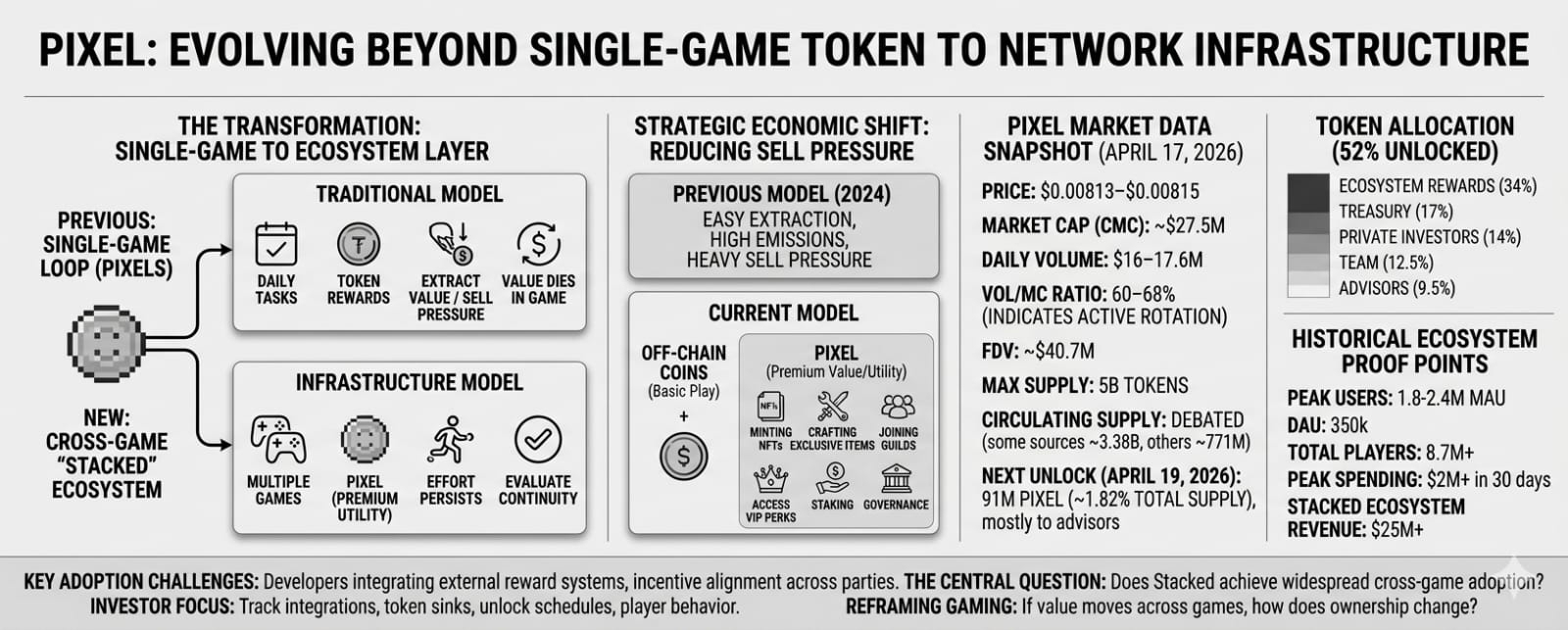
The first time I understood what Stacked was trying to do, it clicked in a very practical way. I imagined this: I grind in one game, earn rewards in PIXEL, and then instead of that value dying there, I carry it into another experience. That continuity? It’s rare. In traditional gaming, switching games usually resets everything your progress, your identity, your rewards. Here, the idea is different. Your effort persists across environments.
That’s where things start to feel less like a “game token” and more like an “ecosystem currency.”
But let’s ground this in reality, because narratives are cheap.
As of April 17, 2026, PIXEL is trading around $0.00813–$0.00815. Market cap sits roughly at $27.5M (CMC), though some trackers lag closer to $6.3M due to circulating supply discrepancies. Daily volume is surprisingly high about $16–17.6M which puts the volume-to-market-cap ratio in the 60–68% range. That’s not normal for a “dead” token. It suggests active rotation, speculation, or repositioning.
Fully diluted valuation is about $40.7M, with a fixed max supply of 5B tokens. Circulating supply is debated some sources say ~3.38B, others around 771M but unlock data shows roughly 52% already released. And here’s something I’m watching closely: the next unlock on April 19, 2026 about 91M PIXEL (~1.82% of total supply), mostly going to advisors.
That matters. Unlock pressure is real.
Token distribution is also telling. 34% is allocated to ecosystem rewards that’s huge. It signals long-term incentive design. Treasury holds 17%, private investors 14%, team 12.5%, advisors 9.5%. The structure is standard, but the execution will define everything.
What I find more interesting is the shift in economic model.
Back in 2024, Pixels leaned heavily into farming loops. Daily tasks, repeatable actions, easy extraction. I did that too. It worked until it didn’t. Sell pressure built up fast. So they pivoted. Now, most daily activities reward off-chain Coins, not PIXEL. The token itself is reserved for premium actions minting NFTs, crafting exclusive items, joining guilds, accessing VIP perks, staking, and eventually governance.
This separation is intentional. It reduces constant dumping and reframes PIXEL as a higher-tier asset.
I tested this myself. At one point, I tried to “play efficiently” without spending PIXEL. Progress slowed dramatically. It forced a decision either stay casual or commit resources. That tension is by design. And honestly, it’s healthier than infinite emission models.
But all of this leads back to the central question: does Stacked actually get adopted?
Because without adoption, none of this matters.
Stacked is essentially infrastructure. A cross-game reward layer. If multiple studios plug into it, PIXEL gains context beyond Pixels itself. More contexts = more utility surfaces. More utility surfaces = stronger demand foundation.
But if adoption stalls? Then we’re back to square one. A single-game token with improved mechanics but still limited scope.
And I’ve seen promising infrastructure fail before, not because the idea was bad, but because distribution wasn’t strong enough. Developers are conservative. Integrating external reward systems isn’t trivial. Incentives need to align across multiple parties.
That’s the real bottleneck.
Still, early signals aren’t weak. Historical data shows Pixels hitting 1.8–2.4M monthly users at peak, around 350k DAU, and over 8.7M total players. There was even a period where $2M+ at the time) was spent in just 30 days. The broader Stacked ecosystem reportedly generated $25M+ in revenue.
So the foundation isn’t theoretical. It’s been tested at least partially.
But let’s not ignore the other side.
PIXEL is down over 99% from its ATH of $1.02 (March 2024). That’s not a small drawdown. That’s a full reset. The chart already priced in hype, speculation, and then punished it hard. What’s left now is closer to reality no noise, just structure.
Personally, I find this phase more interesting than the hype phase.
Because now the question becomes: can design outperform speculation?
If Stacked works, PIXEL becomes something rare, a token that survives beyond a single game loop. If it doesn’t, then we’ve simply witnessed another iteration of the same cycle, just packaged more elegantly.
So I approach this carefully.
If you’re looking at PIXEL, don’t just track price. Track integrations. Track how many games actually use Stacked. Watch how token sinks evolve. Monitor unlock schedules. And most importantly, observe player behavior are they holding, spending, or extracting?
Because in the end, tokens don’t derive value from narratives. They derive it from repeated, meaningful use.
And right now, PIXEL is standing at that exact intersection.
So I’ll leave you with this:
If value can truly move across games, does that change how we define ownership in gaming?
And if Stacked succeeds, are we looking at the first real “gaming currency”… or just another experiment that almost made it?

$ORDI $MBOX #CharlesSchwabtoRollOutSpotCryptoTrading #USInitialJoblessClaimsBelowForecast #BitcoinPriceTrends #CZ’sBinanceSquareAMA