
A few nights ago, I was sitting with a couple of friends arguing about why most Web3 games still feel empty after the hype fades. Someone brought up Pixels almost casually, and the tone of the conversation shifted. Instead of the usual “token pump then dump” criticism, we started picking it apart more seriously—what it’s trying to do, why it’s actually working for now, and whether it has a real future beyond speculation.
At its core, Pixels is trying to solve a very simple but stubborn problem in crypto gaming: people don’t stick around. Most blockchain games attract users with tokens, not gameplay. Players show up for rewards, not because they enjoy being there. When rewards drop, so does the user base. Pixels flips that idea slightly. It doesn’t start with “how do we reward users,” but rather “how do we make a game people would play anyway, and then layer ownership on top.”
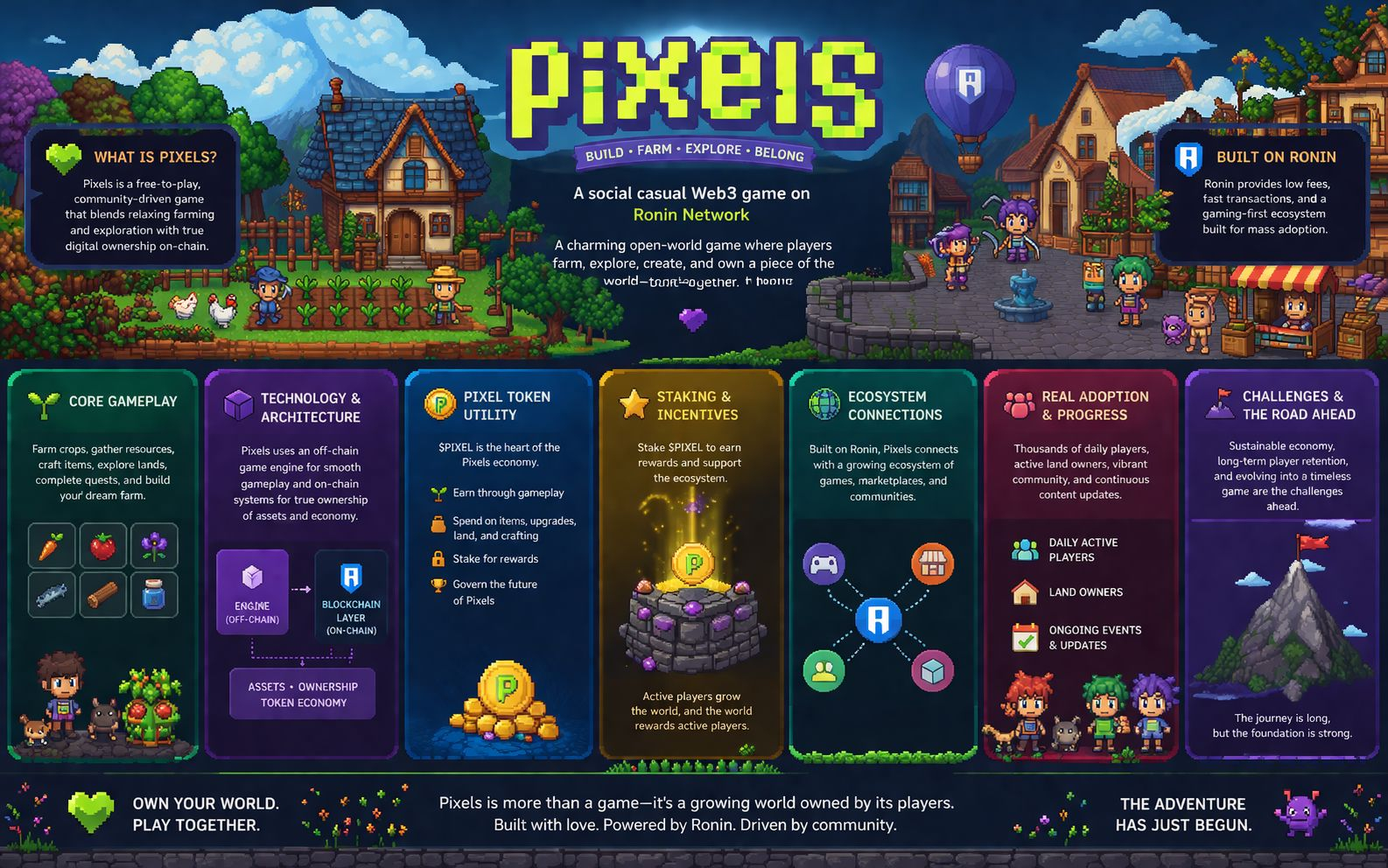
The game itself feels familiar on purpose. Farming, gathering, exploring, crafting—these are mechanics people already understand from traditional games. That familiarity is not laziness; it’s strategy. Instead of forcing players to learn both a new game and a new financial system at the same time, Pixels keeps the gameplay intuitive and lets the blockchain layer sit quietly underneath.
This is where Ronin Network comes in. Ronin was originally built to support large-scale games, and it’s optimized for speed and low transaction costs. In simple terms, Pixels runs on infrastructure that doesn’t constantly remind you it’s blockchain-based. You don’t feel the friction of gas fees or slow confirmations every time you plant a crop or trade an item. That’s important, because if players notice the tech too much, it usually means something is wrong.
Under the hood, the architecture is not complicated in concept. The game logic mostly runs off-chain so that gameplay stays smooth and fast. The blockchain layer is used for ownership, assets, and the PIXEL token economy. This separation matters. It means the game can scale like a normal online game, while still giving players real ownership of items and currency when needed. Think of it like this: you play the game in a normal environment, but when something has value—land, items, tokens—that’s when blockchain steps in to record it.
Now the token side is where things get interesting, and also where things can go wrong if not handled carefully. The PIXEL token acts as the main economic layer inside the game. Players earn it through gameplay activities like farming, completing tasks, or participating in the ecosystem. They spend it on upgrades, crafting, land usage, and various in-game utilities. This creates a loop: play → earn → spend → progress → repeat.
The key question is whether that loop is sustainable. If players are only earning tokens without meaningful sinks, inflation kills the economy. Pixels tries to balance this by tying progression and efficiency to spending. If you want to grow faster, optimize your land, or access better tools, you need to use your tokens. That creates demand, not just supply.
Staking and incentives are designed to keep players and investors aligned, at least in theory. Holding or staking tokens can unlock benefits, but more importantly, active participation in the game itself is positioned as the primary way to gain value. This is a subtle but important shift from older Web3 models where passive holding was often more profitable than actually playing.
Where Pixels connects to the broader crypto ecosystem is through its choice of network and its approach to assets. Because it’s on Ronin, it’s already part of a growing gaming-focused ecosystem. That means shared users, shared liquidity, and potential interoperability down the line. NFTs, tokens, and identities can theoretically move across games within the same network, which opens up possibilities that traditional games can’t offer.
But beyond theory, what actually matters is adoption. Pixels has shown something rare for a Web3 game: people actually log in daily. Not just for rewards, but because the gameplay loop is simple and somewhat relaxing. It doesn’t try to be overly complex or “revolutionary.” Instead, it leans into being accessible. That has allowed it to reach a wider audience, including players who are not deeply involved in crypto.
We’ve also seen integrations and collaborations that hint at a broader strategy. Instead of building in isolation, Pixels is positioning itself as part of a larger gaming environment. That includes partnerships within the Ronin ecosystem and gradual expansion of features that keep players engaged over time.
Still, there are real challenges, and ignoring them would be naive. The biggest one is sustainability of the economy. No matter how well-designed the sinks are, if too many players are extracting value without enough demand being created, the system weakens. This is not unique to Pixels—it’s a fundamental issue in almost every token-based game.
Another concern is player motivation. Right now, a portion of the user base is still driven by earnings. If those earnings drop significantly, will they stay? That depends on how strong the gameplay becomes over time. If Pixels can evolve from “a good Web3 game” into “a genuinely good game,” then it has a chance. Otherwise, it risks following the same cycle as others before it.
There’s also the question of competition. Traditional game studios are slowly exploring blockchain elements, and they bring years of experience in game design. If they enter this space seriously, projects like Pixels will need to step up both technically and creatively.
Looking ahead, the future of Pixels depends on how well it balances three things: fun, fairness, and economics. Lean too hard into financial incentives, and it becomes extractive. Focus only on gameplay, and the Web3 layer becomes irrelevant. The sweet spot is somewhere in between, and it’s not easy to maintain.
What makes Pixels worth watching is not that it has solved everything—it clearly hasn’t—but that it’s one of the few projects actually trying to bridge the gap between gaming and crypto in a practical way. It doesn’t feel like a demo or an experiment. It feels like something that’s still being figured out in real time, with real users, real money, and real stakes.
And maybe that’s why that conversation with friends didn’t end with the usual conclusion of “this won’t last.” Instead, it ended with something more uncertain but more interesting: “This might actually work… if they don’t mess it up.”