
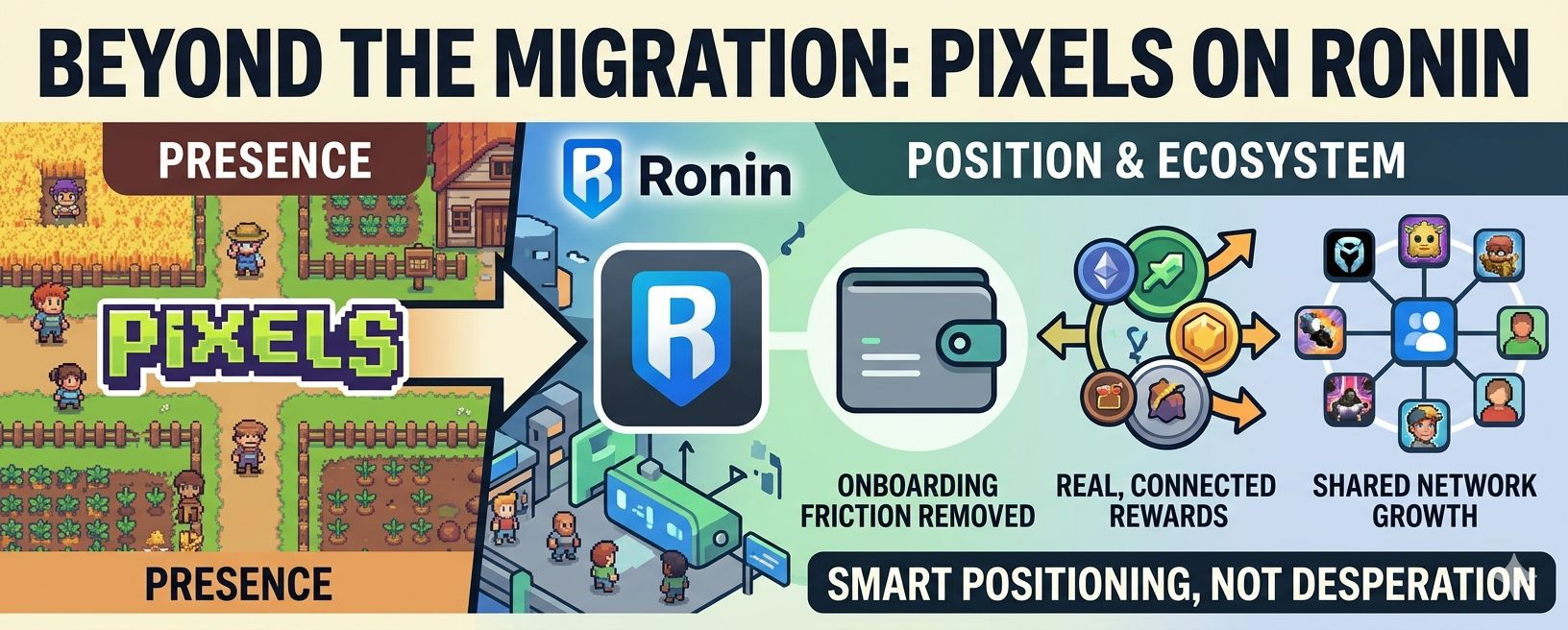

What looked like a simple chain migration was never that simple.
I have noticed that when people talk about crypto gaming, they usually reduce everything to the obvious surface details. Lower fees. Faster transactions. Better infrastructure. That is the easy version. But the way I see it, Pixels did not move to Ronin just because Ronin was technically better for a game. It moved because Ronin offered a much stronger environment for growth. That is a different thing entirely. Infrastructure matters, of course, but environment matters more. One helps a game function. The other helps it spread, retain attention, and become part of something bigger than itself.
That is what stands out to me here.
Pixels was not making this move from a place of weakness. That part matters. A lot. It already had real activity, real users, real momentum. So when a project like that decides to migrate, I do not read it as desperation. I read it as positioning. I read it as a team looking ahead and deciding that the next stage of growth will not come from staying comfortable. In my view, that says more than any marketing thread ever could.
The deeper story was never just about switching chains. It was about switching context.
I have spent enough time watching this space to know that games do not scale because of token talk alone, and they definitely do not survive because of nice-looking announcements. They scale when the user experience becomes easier, when incentives start feeling real, and when the ecosystem around the game begins doing some of the growth work for them. That is where Ronin came in. Ronin was already shaping itself as a gaming-first network, not just a place where games happen to exist. That difference sounds small, but it changes how players behave and how projects build.
What Pixels gained was not just another blockchain. It gained a home that already understood gamer behavior.
That becomes very clear when you look at wallet access. Most people underestimate how much friction hides inside onboarding. They think a wallet is just a wallet. It is not. It is the front door. It is the first feeling. It is the difference between curiosity continuing and curiosity dying in two minutes. I am watching this closely in every Web3 game because onboarding is still where so many projects quietly fail. They do not lose users because the idea is bad. They lose users because the path into the game feels annoying, unfamiliar, or fragmented.
Pixels moving into the Ronin environment changed that.
Players could connect through a wallet system that already made sense inside a gaming ecosystem. New users had a cleaner path in. Existing users had a more natural way to plug into the broader network. That may sound like a minor operational detail, but I do not think it is minor at all. Cleaner wallet access does more than simplify login. It gives players continuity. It makes identity, assets, rewards, and participation feel connected instead of scattered across disconnected tools and steps. And when that happens, engagement tends to go deeper.
That is where the migration starts to look smart rather than merely practical.
Then there is the rewards layer, which to me is where the whole move becomes much more interesting. Web3 games love talking about rewards, but most of the time those rewards feel trapped inside their own little closed loop. Players earn something, but it feels abstract. There is no smooth path between effort and utility. No clear bridge between in-game activity and broader ecosystem value. That disconnect kills trust faster than most teams realize.
Pixels had the chance to narrow that gap on Ronin.
The game’s reward structure was no longer sitting in isolation. It became connected to a larger ecosystem where assets could move, be traded, be seen, and actually matter outside the immediate gameplay loop. That changes player psychology. A reward feels very different when it is not just theoretical. When people can earn, hold, swap, use, and integrate those assets into a broader network, the experience starts feeling more real. Not perfect. Not magically sustainable. But more real.
And real matters.
I think this is one of the biggest things people miss when they analyze Web3 gaming. They spend too much time asking whether the token model is exciting and not enough time asking whether the reward path feels believable. Those are not the same question. Excitement is easy to manufacture. Believability is much harder. In my view, Pixels strengthened that believability by moving into a place where the economic loop had more visible exits, more infrastructure around it, and more reasons for players to stay engaged beyond the game screen itself.
That has a direct effect on behavior.
When players feel that what they earn has mobility, they play differently. When they feel their time leads somewhere tangible, they commit differently. When the wallet, marketplace, and ecosystem all start working together, the project stops feeling like a closed experiment and starts feeling like a living network. That is a major shift. And I have noticed that these shifts are often more important than flashy feature updates, because they shape habit formation. They change how often people come back. They change whether a game becomes part of someone’s routine or just another thing they tried for a week.
The ecosystem angle matters just as much.
Pixels did not only gain from Ronin. Ronin gained from Pixels too. That is part of why the move worked. Good migrations are not one-sided. They create mutual reinforcement. Ronin was trying to grow beyond a single flagship identity and prove it could become a broader home for serious Web3 games. Pixels arrived with momentum, visibility, and actual user activity. That gave Ronin more credibility. At the same time, Ronin gave Pixels a stronger network effect, a gaming-native audience, and infrastructure that matched the game’s direction more naturally.
That kind of alignment is rare.
Usually, one side needs the other more. Here, both sides had something to prove, and both sides had something to gain. To me, that is why the move felt structurally stronger than the average “partnership” headline people scroll past every day. It was not empty symbolism. It was ecosystem design. It was a game looking for better growth conditions and a chain looking for stronger gaming legitimacy. When those incentives meet properly, the result tends to be more durable than people expect.
And I think durability is the real word here.
Not hype. Not noise. Not trend.
Durability.
Because what Pixels really expanded through Ronin was not just wallet access or gameplay rewards in the narrow sense. It expanded its ability to live inside a larger system. That is the part I keep coming back to. Easier access brought more usable entry points. Better reward connectivity made player effort feel less isolated. Stronger ecosystem integration gave the game more room to grow, more visibility, and more reasons for users to remain attached over time.
That does not mean everything is automatically solved. It never is.
I am always skeptical of clean narratives in crypto, especially the ones that make every strategic move sound visionary in hindsight. Markets are messy. Player behavior is inconsistent. Ecosystems can look strong one quarter and fragile the next. So I do not see the Pixels migration as some flawless masterstroke that guarantees long-term success forever. That is not how this space works. But the way I see it, this move did reflect something rare: a team understanding that growth is not only about building more content, but about choosing the right environment for that content to matter.
And honestly, that is where a lot of projects still get it wrong.
They obsess over features while ignoring distribution. They talk about rewards while ignoring usability. They speak endlessly about community while building systems full of friction. Then they wonder why attention disappears.
Pixels, at least in this case, seemed to understand the deeper game. It was not just trying to exist on-chain. It was trying to exist where player behavior, rewards, identity, and ecosystem momentum could reinforce each other. That is a much smarter ambition.
What stays with me is this: the migration mattered because it made the game easier to enter, easier to benefit from, and easier to place inside a bigger gaming economy. That is the real story. Not the headline version. Not the polished version. The real one. And in my view, that is exactly why this move deserves attention. Not because it was dramatic, but because it was practical in the kind of way that often ends up mattering most.
A lot of projects in this space still confuse presence with position. Pixels did not just move its presence. It improved its position. And that is usually where real growth begins.
