The "GameFi is dead" narrative was the dominant theme of late 2025. We saw hundreds of projects collapse under the weight of hyper-inflationary tokenomics and ghost-town user bases. But while the industry was mourning, Pixels ($PIXEL) on the Ronin Network was quietly building a financial fortress.
As we cross into mid-April 2026, the data suggests that PIXEL isn't just a "farming game"—it is a masterclass in modern digital asset management. Here is the deep-dive analysis of why this token is currently the most important asset in the gaming sector.
1. The Tokenomics Maturation: The 66% Milestone 📈
In professional accounting and asset management, we look at the "supply overhang." Most gaming tokens fail because early investors and teams dump millions of tokens onto the market years after launch.
$PIXEL has officially moved past its most dangerous dilution phase. With approximately 66% of its 5 billion total supply now in circulation (3.38B PIXEL), the market has successfully absorbed the bulk of the venture capital and team unlocks. When you remove the threat of a sudden, massive supply shock, the price action begins to reflect real utility demand rather than inflationary fear. We are seeing a shift from speculative volatility to structural accumulation.
2. The Revenue Engine: Real Cash Flow vs. Hype 💸
The fatal flaw of GameFi 1.0 was relying on "New User Entry Fees" to pay "Old User Rewards"—the classic definition of a Ponzi-style economic loop. Pixels broke this loop.
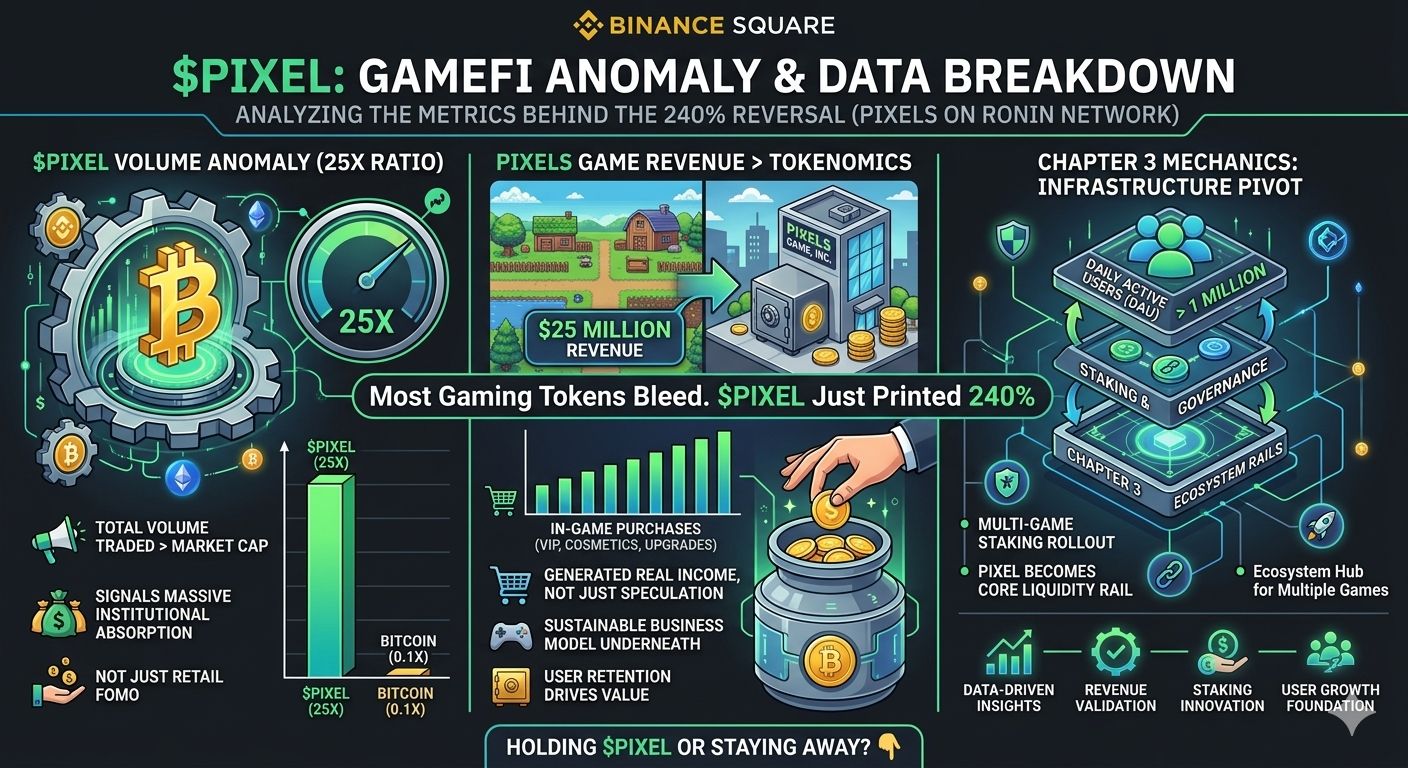
The project recently reported over $25 Million in revenue generated purely from in-game micro-transactions:
VIP Battle Passes: Providing a recurring revenue stream similar to traditional SaaS models.
Premium Enhancements: Players spending PIXEL for energy boosts, speed-ups, and cosmetics.
Guild Mechanics: Financial stakes in social coordination.
When a Web3 project generates eight-figure revenue from consumption rather than speculation, it moves from a "project" to a "business."
3. Chapter 3: The Passive Reward Revolution 🏗️
The launch of Chapter 3 in April 2026 has introduced the most sophisticated staking model we’ve seen. By allowing players to earn passive rewards through PIXEL staking—further boosted by holding Farmland NFTs—the team is effectively locking up liquidity.
Each Farmland NFT now provides a 10% staking bonus. For high-net-worth players, this creates a "Yield Stacking" effect that incentivizes long-term holding over short-term flipping. By turning land into a yield-generating productive asset, they have created a "digital real estate" market that actually makes sense on a balance sheet.
4. The Ronin Ecosystem & Multi-Game Utility 🌐 Pixel is no longer a single-game token. Under the Sky Mavis infrastructure, it is pivoting into a Cross-Game Utility Token. With the integration of "Pixel Dungeons" and 4-5 other upcoming titles on Ronin, $PIXEL is becoming the "reserve currency" of a gaming nation.
If one game loses popularity, the token’s value is protected by its utility in the other games in the ecosystem. This "Portfolio Effect" is what will give PIXEL the staying power that Axie Infinity lacked in its early years.
5. The "Farmer Fee" and Strategic Risks ⚠️
As an analyst, I must be candid: the economy isn't without friction. The Farmer Fee—a 20% to 50% penalty on direct $PIXEL withdrawals—is a controversial but brilliant piece of "soft-lock" tokenomics. It discourages mercenary capital from extracting value too quickly, forcing players to reinvest in the ecosystem.
While this protects the price floor, it creates a "Retention Wall" that could frustrate casual players. The long-term success of $PIXEL depends on whether the gameplay remains fun enough for users to ignore the exit friction.
📝 The Verdict PIXEL is currently trading near a critical technical inflection point of $0.0082. With 1 million Daily Active Users (DAU) and a matured supply schedule, the "Fundamental Value" is finally catching up to the "Market Value."
We aren't just watching a game; we are watching the birth of a sustainable digital economy.
Are you a PIXEL maximalist, or are you waiting for Chapter 4 before you commit? Let’s analyze the strategy in the comments! 👇