

I’ve spent enough time around crypto projects to recognize the familiar rhythm: a bold claim about “redefining ownership,” a token model that promises sustainability, and a community narrative that leans heavily on optimism. So when I first came across Pixels, I didn’t approach it with excitement. I approached it with a kind of cautious curiosity—the kind that comes from having seen similar ideas rise quickly and disappear just as fast.
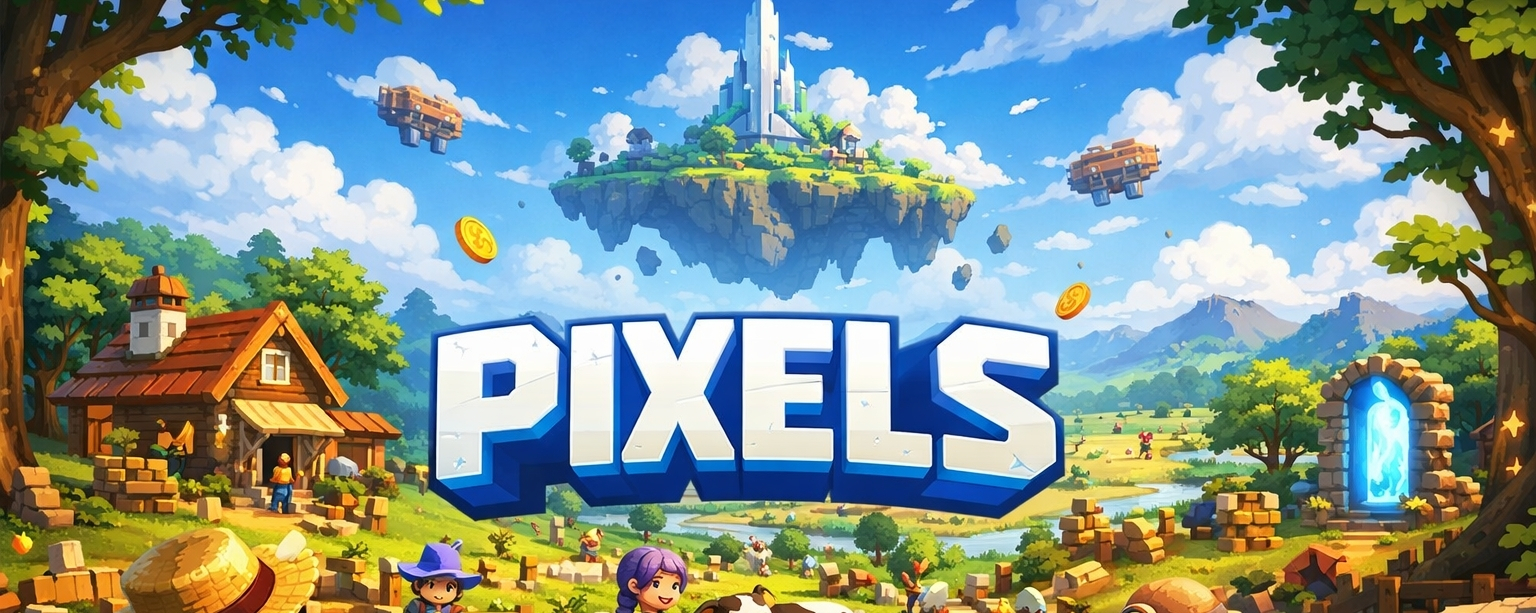
At first glance, Pixels presents itself as a casual social game built around farming, exploration, and interaction. That alone isn’t particularly new. We’ve seen farming mechanics repackaged countless times, both in traditional gaming and in Web3. What caught my attention, though, wasn’t the surface-level gameplay. It was the choice to build something intentionally simple, almost understated, on top of a blockchain infrastructure that’s usually associated with complexity and speculation.
There’s something interesting about that contrast. Most crypto games try to prove how advanced they are—complex tokenomics, layered economies, governance systems that look impressive on paper but rarely function in practice. Pixels, on the other hand, feels like it’s trying to disappear behind the experience. The blockchain is there, but it’s not constantly demanding attention. And that immediately raises a question: is this a deliberate design philosophy, or just a softer entry point into the same underlying dynamics?
As I spent more time looking into it, I started to think about the core idea behind Pixels. At its heart, it’s trying to blend persistent virtual worlds with real digital ownership in a way that doesn’t overwhelm the player. That’s a subtle but important shift. In many Web3 games, the “ownership” aspect becomes the main feature, often at the expense of actual gameplay. Players are encouraged to think like investors first and participants second. Pixels seems to be nudging that balance in the opposite direction—or at least attempting to.
The architecture reflects that intention. Built on a network designed for gaming scalability, it leans into lower transaction costs and smoother interactions. That’s not revolutionary in itself, but it addresses one of the more practical barriers that has quietly held back Web3 gaming: friction. If every action feels like a transaction, the illusion of a game breaks down. Pixels seems aware of that, and it tries to minimize the visible edges of the blockchain.
Still, the real question isn’t whether the technology works. It’s whether the problem it claims to solve is actually meaningful.
And that’s where things get more nuanced.
The project implicitly positions itself as a response to the disconnect between players and the games they invest time in. In traditional gaming, you don’t own your assets. Your progress, your items, your virtual identity—they’re all locked within a centralized system. Web3, in theory, offers a way out of that. It gives players ownership, portability, and potentially even economic upside.
But here’s the part I keep coming back to: how many players are actually asking for that?
In crypto circles, it’s easy to assume that ownership is inherently valuable. But outside of that bubble, the priorities are often different. Most players care about experience first—how a game feels, how it engages them, how it fits into their lives. Ownership is only meaningful if it enhances that experience, not if it complicates it.
Pixels seems to recognize this tension, at least partially. By focusing on casual gameplay and social interaction, it avoids the trap of turning everything into a financial instrument. The farming mechanics, the exploration, the sense of a shared world—they’re familiar enough to feel accessible. And that familiarity might actually be one of its strongest features.
Because if there’s one thing the crypto gaming space consistently gets wrong, it’s overestimating how much novelty players want. Not every game needs to reinvent the wheel. Sometimes, the real challenge is integrating new technology into existing patterns in a way that feels natural.
That said, familiarity can also be a limitation. If the gameplay doesn’t evolve beyond what we’ve already seen in traditional games, then the blockchain layer risks feeling unnecessary. It becomes an added complexity rather than a meaningful enhancement. And that’s a delicate line to walk.
Another aspect that stands out to me is the social dimension. Pixels isn’t just about individual progression; it leans into community interaction. In theory, that aligns well with the ethos of decentralized systems—shared spaces, collective experiences, emergent economies.
But again, I find myself questioning how this plays out in practice.
Crypto communities often start with genuine enthusiasm, but they can quickly shift toward speculation. When tokens are involved, the focus tends to drift from participation to profit. Even in games that try to prioritize fun, the presence of financial incentives changes behavior. Players start optimizing, extracting, and strategizing in ways that aren’t always aligned with the intended experience.
Pixels doesn’t escape that dynamic. It can’t, really. Any Web3 game exists within a broader ecosystem where value is constantly being measured, traded, and compared. The challenge isn’t eliminating that influence—it’s managing it.
What I find somewhat refreshing is that Pixels doesn’t lean too heavily into grand narratives about “changing the future of gaming.” It feels more grounded, more experimental. Almost like it’s testing a hypothesis rather than making a declaration.
And maybe that’s what makes it worth paying attention to.
Because the broader crypto industry has a tendency to move in cycles. We see waves of innovation followed by waves of repetition. Ideas get recycled, repackaged, and rebranded, often without addressing the underlying issues. In gaming, those issues are particularly persistent: unsustainable economies, shallow gameplay, and a disconnect between what developers build and what players actually want.
Pixels doesn’t solve all of that. It probably doesn’t even try to. But it does seem to approach the problem from a slightly different angle. Instead of building a complex system and hoping players adapt, it starts with a simpler experience and layers in blockchain elements more gradually.
Whether that approach works is still an open question.
There are obvious challenges ahead. Retention is one of them. Casual games can attract users quickly, but keeping them engaged over time is much harder. Without deeper mechanics or evolving content, the initial novelty can wear off. And in a space where attention is constantly shifting, that’s a real risk.
Then there’s the economic layer. Even if it’s not the primary focus, it’s still there. Balancing incentives, preventing exploitation, and maintaining long-term stability—these are problems that have plagued nearly every Web3 game. There’s no easy solution, and Pixels will likely have to navigate the same trade-offs.
I also wonder about the long-term vision. Is this meant to remain a relatively simple social game, or is it a foundation for something more complex? And if it evolves, how does it maintain the balance between accessibility and depth?
These aren’t criticisms as much as they are open-ended concerns. Because at this stage, it’s less about judging the project and more about observing how it develops.
What I keep coming back to, though, is a broader reflection on the space itself.
Web3 gaming has spent years trying to prove its legitimacy, often by mimicking traditional gaming while adding layers of financialization. But maybe that approach has been backwards. Maybe the real opportunity isn’t in making games more like markets, but in making markets less visible within games.
Pixels, in its own quiet way, seems to be exploring that idea. It doesn’t eliminate the economic layer, but it doesn’t put it front and center either. It creates a space where players can engage without constantly thinking about tokens, even if those tokens are still part of the system.
That might not sound like a big innovation. But in the context of crypto, it actually is.
Because sometimes, progress isn’t about adding more features or more complexity. Sometimes, it’s about knowing what to leave out.
I’m not convinced that Pixels will redefine Web3 gaming. That’s a high bar, and the industry has a way of humbling even the most promising projects. But I do think it represents a shift in mindset—a move away from the louder, more speculative narratives toward something quieter and potentially more sustainable.
And maybe that’s enough, at least for now.
It’s not a revolution. It’s an experiment. And in a space that often mistakes ambition for execution, there’s something oddly reassuring about that.