
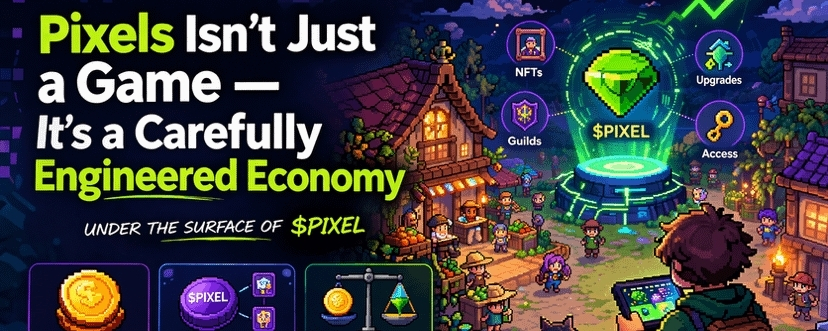

I'll be honest with you. When I first heard "play-to-earn farming game on blockchain," I rolled my eyes. Hard. The whole genre had earned its bad reputation — inflate tokens, dump on players, ghost the community. Rinse, repeat. So when Pixels started gaining serious traction, my default assumption was: meme coin with a farm aesthetic slapped on top. I was wrong. Embarrassingly wrong.
What changed my mind wasn't the price chart. It was watching what people actually *do* inside the game.
---
**The Problem Nobody Wants to Admit**
Most blockchain games treat their token like a lottery ticket. You "play," you "earn," you sell — and the whole system collapses the moment new players stop entering. The token isn't tied to anything real. There's no underlying economy. It's speculation cosplaying as a game.
This is the trap that killed hundreds of Web3 gaming projects between 2021 and 2023. The token pump was the product. When the pump ended, so did the game.
Pixels looked that failure in the face and built something structurally different.
---
**What Actually Makes Pixels Different**
Here's what nobody tells you about $PIXEL: it's not a reward. It's a currency — and there's a meaningful difference.
Inside Pixels, $PIXEL functions as genuine economic infrastructure. You spend it. You craft with it. You access premium land, upgrade tools, unlock areas. The token circulates through a living in-game economy where demand is generated by *doing things*, not just by holding and hoping.
The farming mechanics aren't decorative — they're the engine. Players plant crops, harvest resources, build businesses, sell goods to other players. Every transaction creates organic demand. What struck me when I dug into this was how intentional the design is. Inflation isn't an accident or an oversight — it's managed through utility sinks that actually absorb token supply rather than just printing and praying.
Land ownership layers another dimension on top. Owning land in Pixels isn't a jpeg flex — it's productive capital. Landowners can host other players, generate yields from activity on their plots, and participate in the broader resource economy. It's closer to commercial real estate than it is to an NFT collection. That framing matters.
---
**The Community Is the Moat**
Look — technology can be copied. Tokenomics can be forked. What's genuinely hard to replicate is a community that actually *likes* being in the world you've built.
Pixels has that. The daily active engagement, the guilds, the cooperative farming, the player-driven markets — these aren't metrics manufactured by airdrop farming. People keep logging in because the game is fun, and the economy rewards participation in a way that feels fair rather than extractive.
Governance is maturing too. The shift toward community input on game direction isn't just optics — it aligns long-term player incentives with protocol health. When the people playing the game have a stake in its design, churn drops. Quality improves. The feedback loop runs in the right direction.
---
**Where I Think This Is Heading**
I'll admit — the skeptic in me still watches token metrics carefully. No project is immune to macro pressure, and the play-to-earn space has scar tissue from too many collapses. But here's my honest take: Pixels is building toward something structurally resilient in a way most Web3 games aren't even attempting.
The infrastructure-first approach — economy before speculation, utility before hype — is the right foundation. If the team executes on expanding the world, deepening the resource chains, and continuing to treat $PIXEL as economic lubricant rather than casino chips, this project has a genuine long-term thesis.
Gaming as a category will onboard more users into crypto than almost any other vertical. The question is which games survive long enough to matter.
---
**The heartbeat analogy is real.** $PIXEL isn't pumping because people are excited. It's pumping because the world it powers is alive — and alive worlds need currency, not speculation.
That's a different thing entirely. And it's worth paying attention to. @Pixels #pixel