
Most projects in this space start to blur together after a while. The language changes, the features sound new, but the structure underneath usually doesn’t. There’s always a loop, always some version of “play, earn, repeat,” and for a while it works—until it doesn’t. Attention spikes, activity follows, and then things slowly thin out. It ends up feeling like momentum is driven more by noise than by anything that actually holds.
Pixels didn’t feel different to me at first. It looked like another polished loop—farming, crafting, task boards, smooth off-chain flow, everything working the way you’d expect. And to be fair, it still works like that on the surface. You log in, you move around, you plant, you craft, Coins stack quietly in the background. Nothing feels broken. Nothing even feels complicated.
But the longer you sit with it, the harder it becomes to ignore something slightly off about how value shows up.
Some days feel alive. The Task Board connects, outputs matter, loops seem to lead somewhere. There’s a sense that if you stay in it, you might actually reach something meaningful—something tied to real value, not just Coins cycling back into themselves. Other days feel empty in a way that’s hard to explain. Same map, same actions, same time spent—but nothing really connects. You produce things that don’t seem needed, tasks feel thin, and everything just… runs.
At first it’s easy to call that randomness. Or bad luck. Or just how games are.
But it doesn’t behave like randomness.
It feels like something upstream changed.
Because the deeper you look, the less it feels like Pixels is rewarding what you’re doing in the moment, and the more it feels like you’re stepping into parts of the system where value has already been decided. Like the important part of the game didn’t happen when you logged in—it happened before that.
The map is local. The reward logic isn’t.
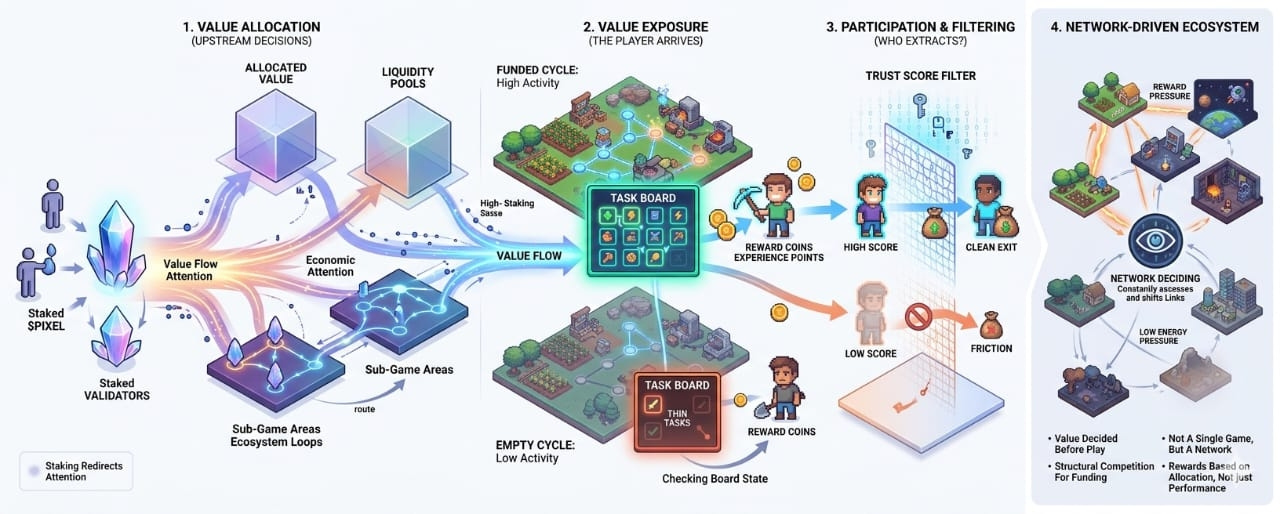
That’s the piece that shifts everything. Once you start thinking about staking—not as passive earning, but as something that actually redirects where value flows—it stops looking like a normal game economy. When Pixels gets staked into validator games, it’s not just sitting there. It’s influencing which parts of the ecosystem get attention, which loops get reinforced, which reward pools actually have weight behind them.
So by the time you enter the game, a lot of the outcome is already shaped.
That’s why two identical sessions can feel completely different. It’s not just about what you did. It’s about whether that part of the system was “fed” when you got there. Some areas feel like they have pressure behind them—tasks link up, outputs matter, things keep pulling forward. Other areas feel hollow, even though nothing is technically wrong. They still function, they still let you play, but there’s no real value attached to what you’re doing.
Same systems. Same player. Different weight.
And that’s when it stops feeling like one game.
The Task Board starts to look different too. It doesn’t feel like it’s generating content—it feels like it’s exposing whatever value currently exists in that part of the system. When it’s full and connected, it’s because something behind it is funded. When it feels empty, it’s not just a dry reset—it might mean there’s nothing being routed there at all.
So you’re not really checking the board. You’re checking the state of allocation.
That’s a heavier idea than it seems. Because it means when things feel dead, it’s not necessarily because you played badly or missed something. It might be because that part of Pixels simply isn’t receiving enough economic attention to matter right now. It’s active enough to keep you busy, but not active enough to reward you in a meaningful way.
And once you see that, the whole “sub-games” idea changes too. It stops feeling like expansion and starts feeling like quiet competition. Not obvious competition, not something you can track on a leaderboard—but structural competition. Which game gets liquidity. Which loops get pushed. Which experiences actually get to matter in a given cycle.
Some loops aren’t weak. They’re just not being fed.
That’s what makes the system feel different. It’s not distributing value evenly. It’s allocating it unevenly, and then letting players move through whatever ends up being funded.
And even then, it doesn’t stop there.
Because after value is routed and surfaced, there’s still another layer—Trust Score—deciding whether what you touched can actually leave cleanly. So it’s not just about where liquidity exists, it’s about who gets to access it without friction.
That makes the whole thing more selective than it first appears.
Which is probably why Pixels doesn’t collapse the way simpler systems do. It’s not just handing out rewards and hoping it balances later. It’s controlling where value goes, how it appears, and who can extract it. It’s structured in layers—allocation first, then exposure, then participation, then filtering.
From the outside, that sounds smart.
From the inside, it feels uncertain.
Because now it’s hard to tell what actually mattered. Did something work because you played well? Or because you happened to be in the part of the system that already had value flowing through it? Did you make the right decisions, or did you just arrive at the right time?
That question doesn’t really go away once it shows up.
And maybe that’s the real shift with Pixels. It doesn’t feel like a single game anymore. It feels like a network constantly deciding which parts of itself deserve to be alive in a meaningful way, while everything else keeps running just enough to stay visible.
So when you’re inside it, farming, crafting, moving through loops—it starts to feel less like you’re creating value, and more like you’re stepping into places where value has already been placed.
And sometimes you hit it.
And sometimes you don’t.
And you’re never fully sure which one it was.
