
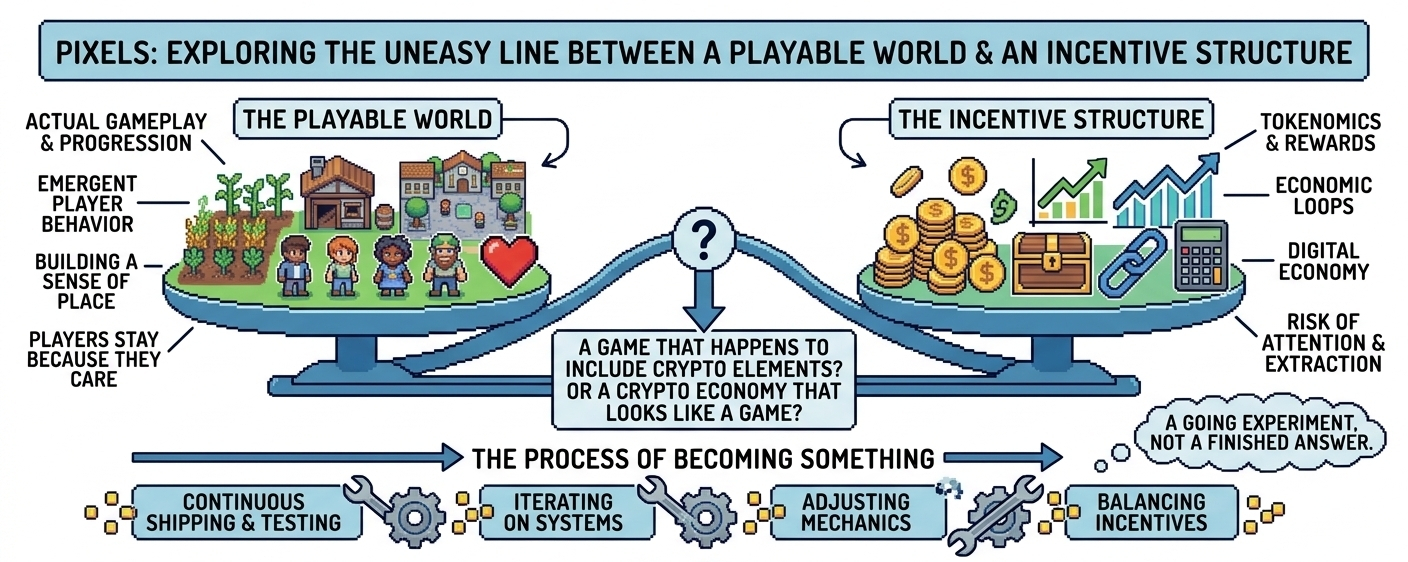

Pixels is interesting to me because it does not feel like one of those crypto games that appears, creates a wave of excitement, and then disappears once the incentive loop gets weaker. It feels more like a project that is actually trying to build something in public. Not perfectly, not without friction, but with a real willingness to keep shipping, keep testing, and keep learning from what works and what does not.
That already separates it from a lot of crypto gaming. Too many projects in this space have treated the game itself as secondary, almost like a wrapper around token activity. The language is usually about community, ownership, and digital economies, but the actual product often feels thin. Pixels, at least from the outside, gives a different impression. It feels like the team understands that if people are going to stay, the world has to function as more than a financial layer. It has to feel alive enough for players to care about what they are doing inside it.
What makes it worth paying attention to is not that it has solved the Web3 gaming problem. I do not think it has, and I do not think anyone really has yet. The deeper question is whether Pixels is building a game that happens to include crypto elements, or building a crypto economy that happens to look like a game. That tension still sits at the center of almost every blockchain game. And honestly, it is still here too. You can feel that uncertainty in the whole category.
But Pixels seems more grounded than most projects in the way it approaches that problem. It does not just rely on big promises. It keeps iterating on systems, loops, and progression. That matters because real building is usually less dramatic than people want it to be. It is repetitive work. It is balancing incentives, adjusting mechanics, watching behavior, and slowly figuring out what players actually value when the initial novelty wears off.
That is probably the part I find most compelling. Not the hype cycle, not the token narrative, but the fact that Pixels feels like an ongoing experiment in what crypto games become when teams keep shipping instead of just talking. Some of those lessons will probably be uncomfortable. Some mechanics will work better than expected, others will expose the usual weaknesses around attention, extraction, and retention. But that is still more useful than empty ambition.
So I would not frame Pixels as proof that crypto gaming has finally arrived. That feels too easy. I see it more as a project worth watching because it is still in the process of becoming something, and that process tells you a lot. Sometimes the most valuable signal is not whether builders already have the answer. It is whether they are building seriously enough for the mistakes, adjustments, and improvements to teach us something. With Pixels, that is the part that deserves attention.