
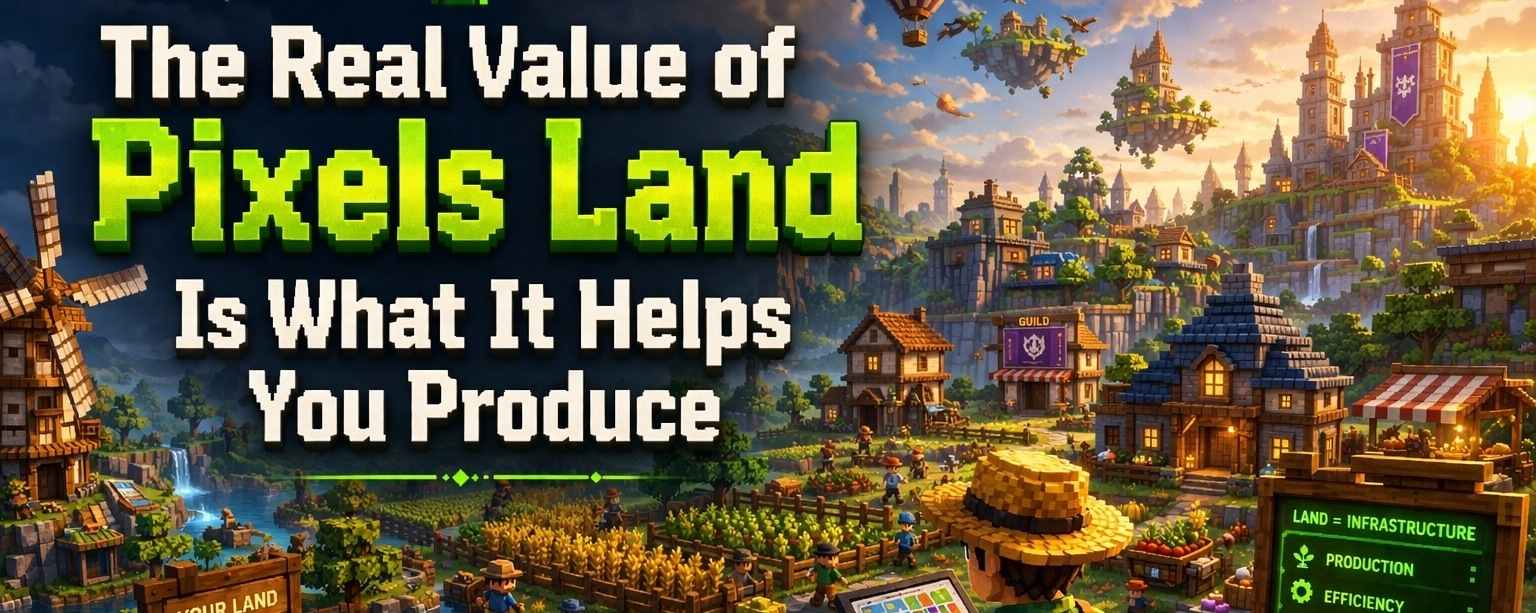

The more I look at Pixels, the less I think its land should be valued like digital real estate.
That is the old crypto instinct. See land, assume scarcity, then jump straight to floor price logic. But Pixels keeps nudging me toward a different reading. Land here does not feel most important as a thing you possess. It feels important as a system you operate.
That shift is subtle, but I think it explains a lot about why Pixels’ economy has held attention longer than many tokenized game worlds. Land ownership feeds directly into mechanics that improve economic throughput. Owning land can help your reputation score, and reputation matters because it gates key economic permissions like withdrawals, marketplace activity, guild creation, and lower farmer fees. Pixels’ own help docs also say land gives extra in game staking power through the landowner benefit, while discoverability and Farm Charm points can raise a farm’s visibility and surplus drop rate. In other words, land is tied to capital efficiency, user flow, and reward extraction, not just symbolism.
That is why I do not see Pixels land as a house. I see it more like a workshop, a storefront, or even a logistics node inside a small online economy.
What changed my mind is that the value of land in Pixels seems to come less from being scarce and more from being useful. A plot can be linked to guild access, which turns land into social infrastructure. It can affect staking outcomes, which turns land into financial infrastructure. It can improve discoverability and surplus drops, which turns land into distribution infrastructure. Once one asset starts doing all three, calling it “real estate” almost undersells what it actually is.
Even the recent direction of the game reinforces this reading. Pixels’ October 2024 update tied land more explicitly into its economic design by listing land ownership as a contributor to reputation, increasing land surplus to 4 to 6 percent based on associated map skill, and preserving stronger utility for existing wineries on NFT lands compared with the basic public version added in Terra Villa. More recently, the staking system formalized a direct landowner boost for in game staking, with each Farm Land NFT adding 10 percent staking power up to the published cap. That does not look like passive scenery. It looks like the game gradually turning land into productive capital.
I also think one overlooked detail says a lot. Pixels separates land ownership from item ownership on that land. Items placed on a plot can still belong to the player who placed them, even if the land changes hands. To me, that is a very telling design choice. It implies the plot is the base layer, but not the whole business. The value is created by what gets built, coordinated, and produced on top of it. That is much closer to infrastructure than to pure property.
So my view is this: people who price Pixels land like collectors may keep missing what the game is actually doing. The smarter lens is operator logic. Not “how rare is this plot?” but “how much economic activity can this plot organize?” If Pixels keeps moving in this direction, land will matter not because it was scarce first, but because it became useful enough to sit underneath the rest of the economy.