
I used to think one of the biggest limitations in Web3 games was how isolated everything felt. You could play, earn, maybe trade a little, but most of your activity stayed within your own experience. Even when markets existed, they often felt disconnected from actual gameplay. It was less of an ecosystem and more of a collection of individual actions happening side by side.
So when I first looked at @Pixels , I assumed it would follow a similar pattern. A farming game with some trading mechanics layered on top. Something where you manage your land, collect resources, and occasionally interact with others through a marketplace. Useful, but still largely individual.
But the more I paid attention, the more I realized something different was happening beneath the surface—liquidity inside gameplay itself.
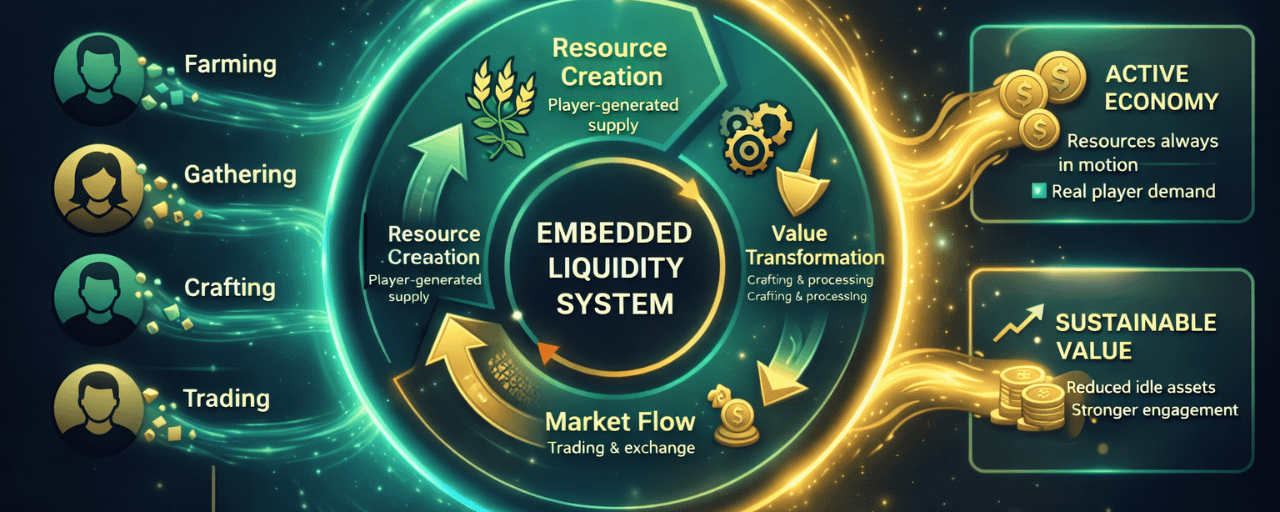
In most systems, liquidity is external. You earn tokens or items, then go to a marketplace to sell them. The economy lives outside the core experience. But in Pixels, liquidity feels embedded into the game world. Resources, items, and outputs don’t just sit in your inventory—they are constantly part of a flow.
What you produce isn’t just for you. It’s part of a larger circulation.
For example, when a player farms a crop, that output doesn’t exist in isolation. It immediately has potential utility for someone else—another player who might need it for crafting, upgrading, or completing tasks. That demand creates movement. Instead of assets being static, they become active components in a system where exchange is expected, not optional.
This creates something closer to in-game liquidity loops.
Resources move from producers to processors, from processors to traders, and from traders back into the hands of players who need them. Each step adds value, but more importantly, each step depends on the previous one. That dependency is what transforms simple gameplay into a functioning system.
And because this flow is continuous, it changes how players think.
You’re not just farming to accumulate. You’re farming with the awareness that what you produce has immediate relevance beyond your own progress. Timing starts to matter. Volume starts to matter. Even consistency starts to matter. Because being part of the flow is more valuable than just holding assets.
This is where the feature becomes powerful.
Liquidity is no longer something you access occasionally—it’s something you participate in constantly.
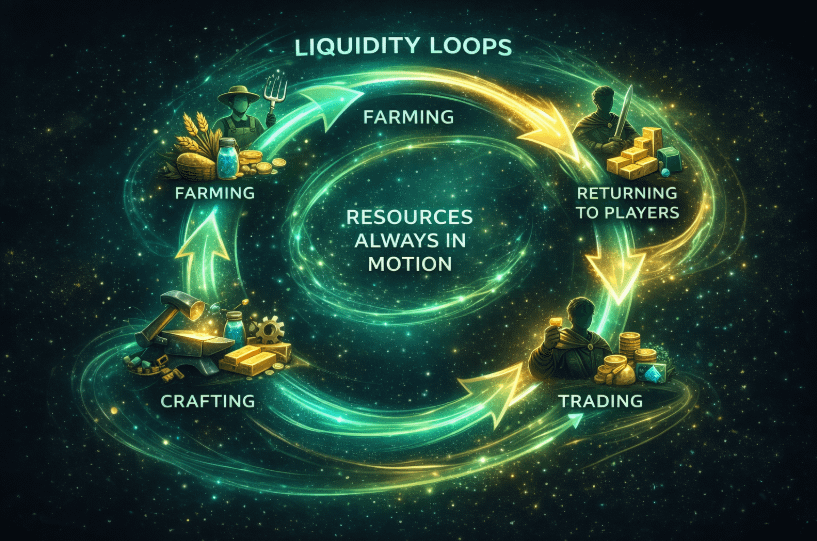
The effect of this is subtle at first, but it builds over time. Markets feel more responsive because they are tied directly to player activity. Supply isn’t artificially injected—it’s created through gameplay. Demand isn’t theoretical—it’s driven by real needs within the system.
And because of that, pricing and value begin to reflect actual behavior rather than speculation alone.
Another important layer is how this reduces friction.
In many Web3 environments, moving assets, finding buyers, or converting value can feel like a separate process. It interrupts the experience. But when liquidity is integrated into the core loop, those steps become natural extensions of gameplay. You produce, you exchange, you reinvest—all without leaving the system.
That continuity keeps players engaged in a different way.
It’s no longer about stepping in and out of the economy. You’re always inside it.
Over time, this leads to stronger retention. Not because players are forced to stay, but because their actions are constantly connected to something larger. When your output feeds into other players’ progress, and their output feeds into yours, the system starts to reinforce itself.
That’s where Pixels begins to feel less like a game and more like a circulating network of value.
Of course, this kind of system isn’t easy to maintain. Liquidity needs balance. If supply overwhelms demand, value drops. If demand outpaces supply, accessibility becomes an issue. Keeping that flow stable requires careful design and constant adjustment.
But the direction itself is what stands out.
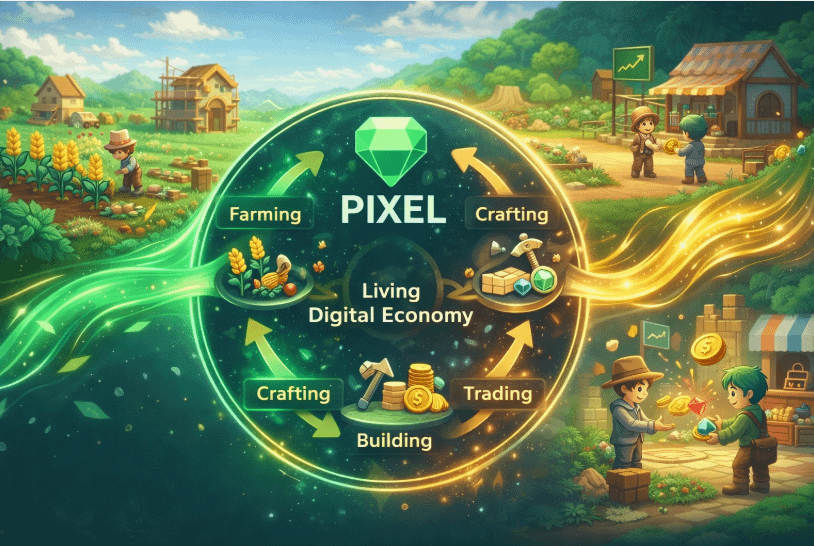
Instead of treating the economy as a separate layer, Pixels integrates it into the core experience. It turns production into participation, and participation into movement.
Looking at it this way, the feature isn’t just about trading or markets. It’s about how value moves.
And that movement changes everything.
It shifts the experience from static ownership to active circulation. From isolated progress to shared dependency. From occasional interaction to continuous participation.
It’s not fully perfected, and it will likely evolve over time. But even in its current form, it points toward something bigger—a model where gameplay and liquidity are not separate systems, but parts of the same structure.
And if that continues to develop, it could redefine how digital economies function inside games.
Not as places where value is stored, but as systems where value is constantly in motion.
#pixel $PIXEL
