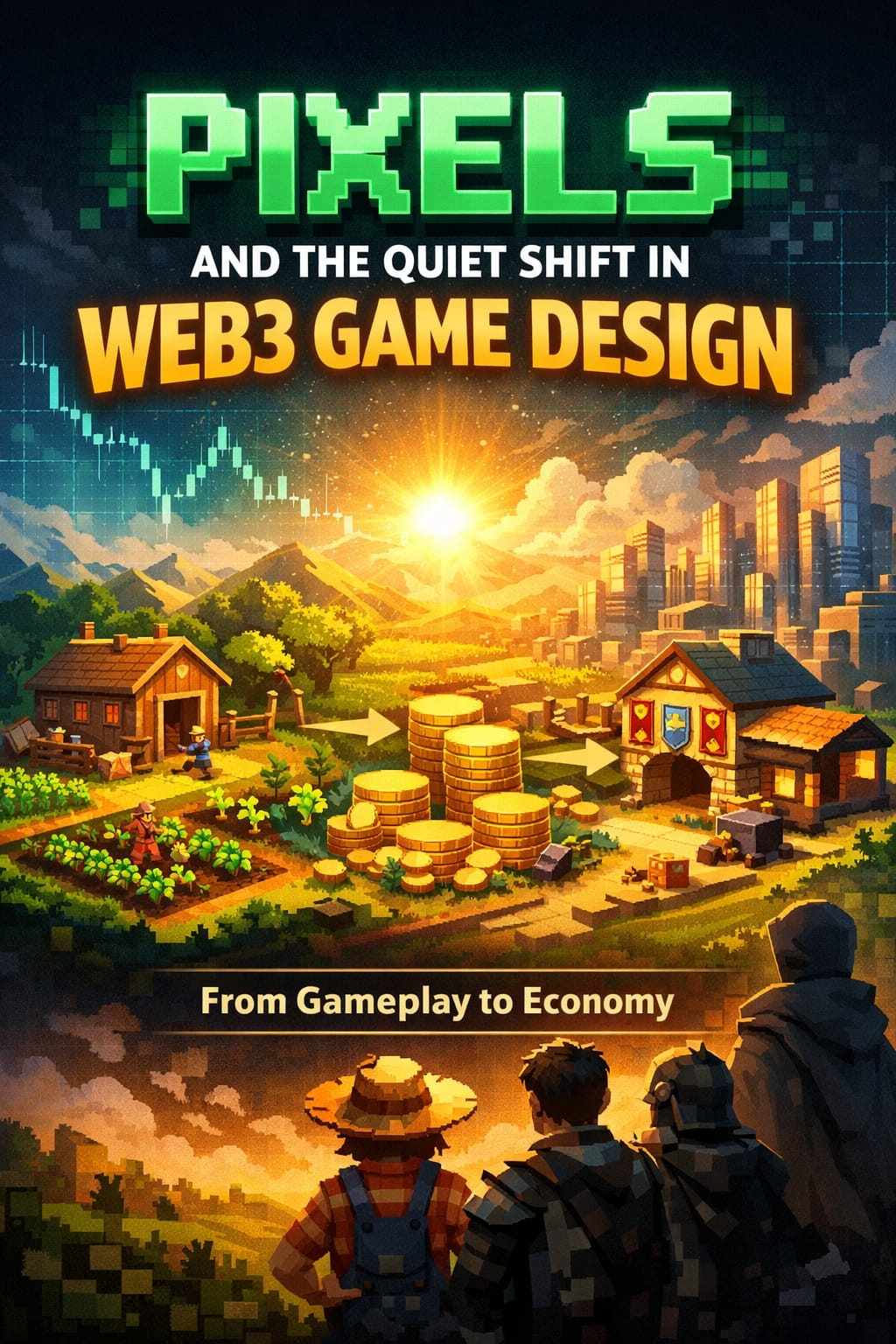
Most Web3 games begin with one thing in mind: tokens first, gameplay second.
That approach created an entire era of “play-to-earn” experiments but it also exposed a major flaw. When financial incentives come before game design, the economy usually ends up fighting the game itself.
Pixels appears to be experimenting in a different order.
Instead of building a token economy and forcing gameplay around it, it seems to start from the opposite direction: build a functioning game system first, then let the economy emerge from player behavior.
At first glance, Pixels doesn’t try to overwhelm you. It presents familiar loops: farming, crafting, land development, progression. Nothing flashy. Nothing complicated. But beneath that simplicity, there’s a more interesting design question being tested:
What if economic value is not injected into the game but generated by how players naturally interact with it?
From Reward Systems to Behavior Systems
Earlier Web3 games relied heavily on direct rewards. Do something → earn tokens → repeat.
The problem is that this model encourages extraction, not engagement. Players optimize rewards instead of participating in the world. Once incentives weaken, the system loses its gravity.
Pixels seems to move away from that mindset.
The focus shifts from: “what do players earn?”
to: “what do players create, maintain, and depend on inside the world?”
That subtle change transforms the design philosophy completely.
A Living Economy Built on Player Actions
Three core layers seem to define this approach:
1. Persistence of Ownership
Assets like land, items, and progression aren’t just rewards they become long-term positions inside a living system. Time spent doesn’t disappear; it accumulates meaning.
2. Structured Cooperation
Guilds and communities stop being purely social features. They begin to resemble organized production units, where coordination, specialization, and planning actually affect output.
3. Continuous Economic Tuning
Game updates aren’t just content drops. They act as adjustments to the internal economy:
introducing scarcity
creating new resource sinks
shifting production incentives
opening new demand pathways
In other words, LiveOps starts to behave like macroeconomic policy.
Why This Matters
If this model holds, the definition of a Web3 game changes.
It’s no longer just: a game + token system
It becomes: a controlled digital environment where gameplay itself generates economic structure.
That’s a much harder problem but also a more sustainable one if executed correctly.
Because in this version of design, value doesn’t come from external speculation. It comes from internal participation.
Still Experimental, Still Early
Of course, none of this guarantees success.
Questions remain:
Can balance be maintained long-term?
Will players stay for gameplay, not incentives?
Can the economy avoid becoming overly complex or fragile?
These are not solved problems.
But the direction is important.
Final Thought
Pixels may not be trying to reinvent gaming in a loud way.
Instead, it might be quietly testing something more fundamental:
A game where the economy is not attached to gameplay
but born from it.
And if that idea works at scale, it could reshape how Web3 games are built going forward.