
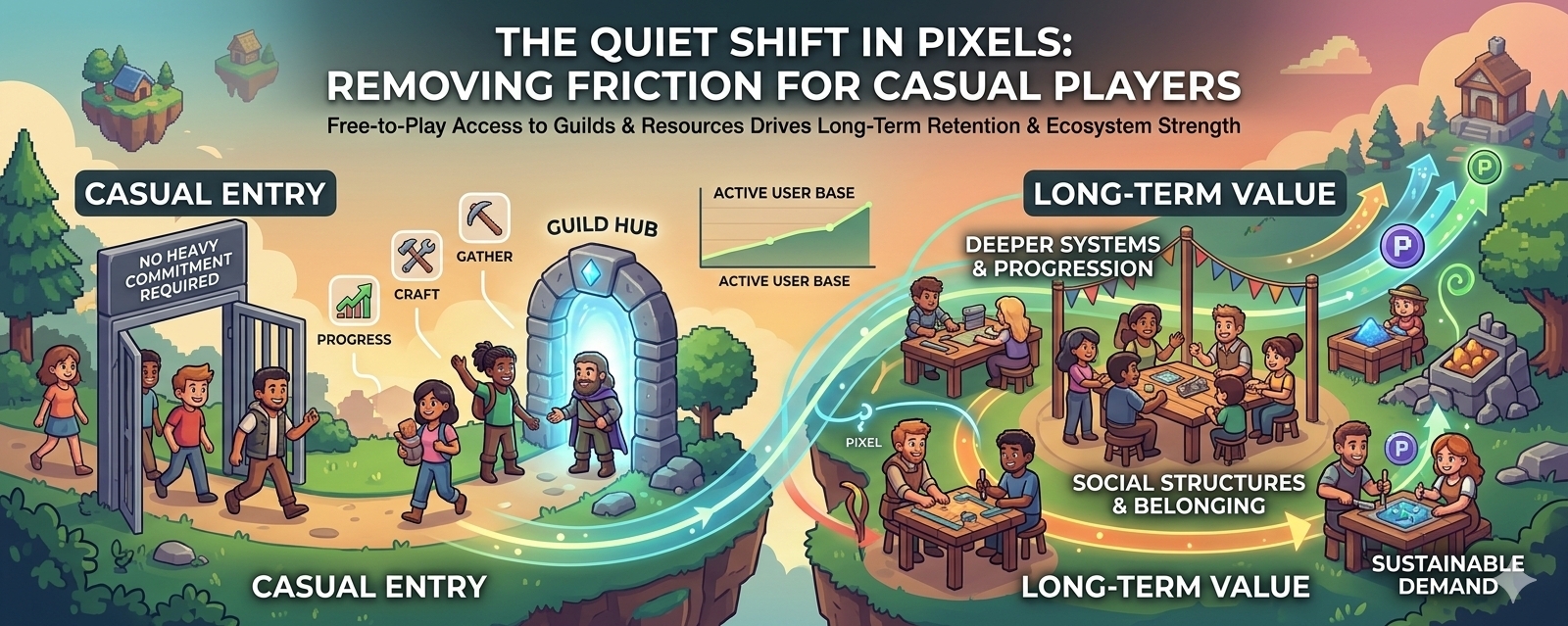
There was a point where Pixels stopped feeling like just another Web3 experiment and started making sense in a more practical way. It wasn’t because of some flashy mechanic or big reward promise. It was a small realization that changed the entire perspective. You don’t need land, you don’t need a heavy NFT position, and you don’t need endless time just to feel like you belong in the game. That moment—when it becomes clear that free-to-play users can still join guilds and tap into higher-tier resources—is where the experience really opens up. It removes that usual friction most Web3 games carry, where curiosity gets blocked by commitment too early. Here, you can step in, explore, and actually move forward without first proving you’re serious with your wallet. That alone reshapes how a casual player interacts with the game.
And that matters more than people usually give it credit for. Most GameFi projects don’t fail because the idea is bad—they fail because they ask too much too soon. Players log in, look around, and within minutes they’re pushed toward buying something or grinding harder than they’re willing to. Pixels feels like it’s trying to avoid that trap. If someone can casually log in, find a guild, interact with better systems, and feel like they’re progressing, the game has already done something most projects never manage. It has given the player a reason to come back. It’s a bit like walking into a gym and being allowed to actually use good equipment before someone asks you to sign up long-term. You get a real feel for the value first, and that makes all the difference.
From a trading perspective, this design choice is not just about gameplay—it directly ties into retention, and retention is where most of the real value sits. Right now, PIXEL is still in that small-cap zone where attention can move price quickly. The numbers show an active market, with volume sitting close to market cap, which usually signals strong participation but not necessarily long-term conviction. Traders are clearly present, but that doesn’t automatically mean they’re committed. This is exactly where the casual player angle becomes important. If Pixels can keep people engaged without forcing early commitment, it has a better chance of building a stable user base instead of just cycling through temporary attention. More active players means more in-game demand, more interaction, and a stronger foundation beneath the token itself.
What’s also worth noting is that the game isn’t relying only on rewards to keep people around. There’s been a steady push toward making the core loop more engaging, with deeper systems, more crafting layers, and better progression flow. That’s a healthier direction than simply throwing incentives at users and hoping they stick. People don’t return to a game just because it pays—they return because it feels like there’s something ongoing to be part of. When that is combined with social structures like guilds, it creates a sense of involvement that goes beyond simple earning. Casual players start to feel useful rather than just tolerated, and that shift is what keeps ecosystems alive over time.
Still, it’s not something to look at blindly. Guild access is a strong idea, but it comes with its own pressure. If guilds become too controlled, too selective, or too dependent on a few dominant players, then the system can quietly drift away from the openness it promises. Casual players might technically have access, but still feel like outsiders in practice. On top of that, token dynamics are still a factor that can’t be ignored. With a large maximum supply and a significant portion already circulating, dilution remains part of the equation. In a market this small, liquidity can flip quickly from being an advantage to becoming a risk if engagement slows down. Fast-moving volume works both ways, and it doesn’t take much for sentiment to shift.
That’s why Pixels stands out right now—not because it guarantees anything, but because it’s attempting something that actually addresses a real weakness in Web3 gaming. The focus isn’t just on price or hype, but on whether normal players can enter, participate, and stay without feeling like they’re second-tier users. That’s a harder problem to solve than it looks, and very few projects handle it well. If Pixels keeps improving that experience and makes it easier for casual players to remain part of the loop, it builds a stronger chance of lasting beyond short-term cycles. In the end, the real question isn’t how fast the token can move—it’s whether the players who start casually find enough value to keep coming back.