

I was scrolling through my feed again tonight, half awake, half annoyed, and it hit me how predictable this space has become. Same cycle, different logos. Something pumps, people scream “this changes everything,” a few threads go viral, and then three weeks later everyone quietly moves on like nothing happened. It’s like we’re all collectively pretending not to notice the pattern anymore.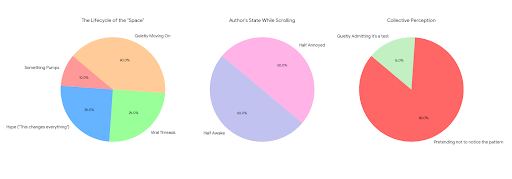
And somewhere in that noise, I keep seeing Pixels pop up.
Not loudly. Not aggressively. Just… there. Farming crops. Walking around. Doing its thing while the rest of crypto is busy arguing about AI agents that don’t really do anything yet.
That alone made me pause.
Because Pixels doesn’t try to look revolutionary at first glance. It doesn’t scream innovation. It doesn’t shove a whitepaper in your face full of theoretical mechanics that only work in ideal conditions. It’s just a game. A simple one. Farming, exploration, a bit of social interaction. The kind of thing that feels almost out of place in a market obsessed with complexity.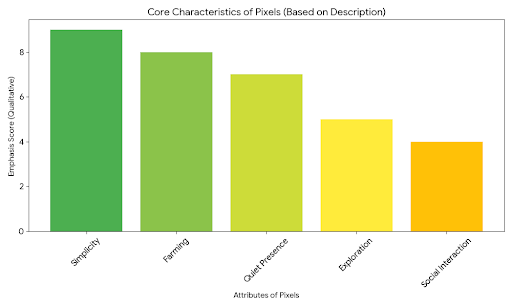
But of course, it’s not just a game. It’s Web3. So there’s always another layer underneath.
Tokens, ownership, land, economy.
And that’s where things start getting messy.
I’ve been around long enough to know that the moment you attach financial incentives to something simple, it stops being simple. Farming stops being farming. It becomes optimization. It becomes yield. It becomes a system people try to extract value from rather than experience.
And Pixels sits right in the middle of that contradiction.
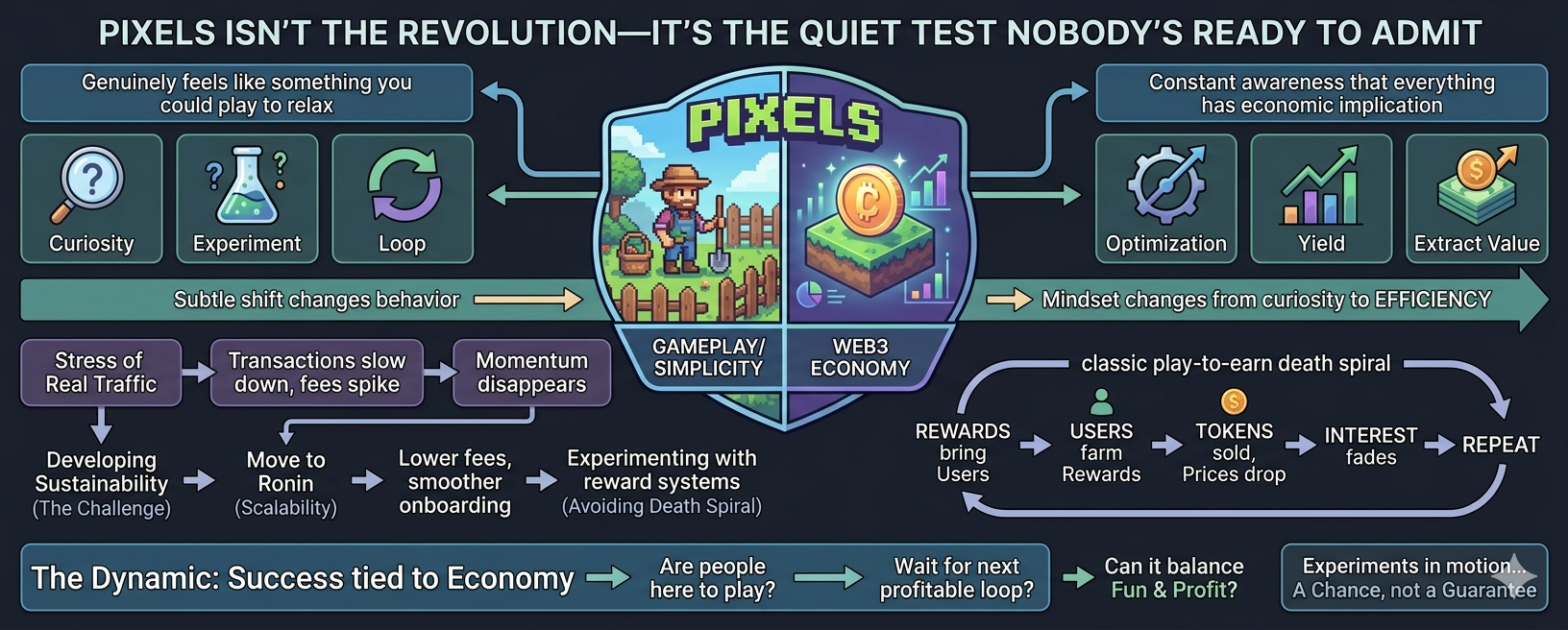
On one side, it genuinely feels like something you could play to relax. On the other, there’s this constant awareness that everything you’re doing might have some kind of economic implication. That subtle shift changes behavior more than most teams want to admit.
You can see it in how people approach the game. Early on, it’s curiosity. People explore, experiment, enjoy the loop. Then slowly, the mindset changes. Efficiency creeps in. Players start asking what’s profitable, what’s optimal, what’s worth their time.
That’s not a Pixels problem specifically. That’s just what happens when crypto touches anything.
What’s interesting, though, is how Pixels has been evolving through that pressure.
The move to the Ronin Network wasn’t random. It was a calculated step toward scalability and accessibility. Ronin already proved it can handle large player bases with games like Axie, even if that came with its own set of issues. Lower fees, smoother onboarding, faster transactions — all of that matters more than most people admit.
Because here’s the thing nobody likes to talk about: infrastructure doesn’t fail because it’s poorly designed. It fails because too many people show up at once.
We’ve seen it over and over again. Chains that look perfect on paper suddenly struggle when real traffic hits. Transactions slow down, fees spike, users get frustrated, and momentum disappears almost overnight.
Adoption is stress. Real usage is pressure. And most systems don’t survive that pressure gracefully.
Pixels hasn’t fully faced that kind of stress yet on a massive scale. It’s growing, yes. It’s active. But there’s a difference between steady engagement and sudden explosion. The real test isn’t whether people like the game. It’s whether the system holds when everyone tries to extract value at the same time.
And that moment always comes.
What I find interesting is that Pixels doesn’t seem to be chasing that explosive moment aggressively. It’s building, adjusting, tweaking its economy in real time. You can see the developers experimenting with reward systems, balancing token emissions, trying to avoid the classic play-to-earn death spiral.
Because we’ve already seen how that story ends.
Rewards bring users. Users farm rewards. Tokens get sold. Prices drop. Interest fades. Repeat.
It’s not even controversial anymore. It’s just how these systems behave.
Pixels feels aware of that, at least to some extent. The focus seems to be shifting toward sustainability rather than pure growth. More sinks, more utility, more reasons to stay beyond just earning.
But even that raises questions.
Are people actually here to play, or are they just waiting for the next profitable loop?
Because let’s be honest, most crypto users aren’t gamers. They’re opportunists. They go where the incentives are. The moment something stops being profitable, they leave. Not out of malice, just out of habit.
That creates a strange dynamic where a game’s success isn’t entirely tied to its quality. It’s tied to its economy.
Pixels might be fun. It might be well-designed. But if the numbers don’t make sense, a large portion of its user base won’t care.
And that’s the uncomfortable truth Web3 gaming keeps running into.
There’s also the broader environment to consider. Right now, everything is fighting for attention. AI narratives are everywhere. New chains, new protocols, new “breakthroughs” launching every week. Most of them sound impressive until you actually look closer and realize they’re just slight variations of existing ideas.
In that chaos, something like Pixels can either get ignored or quietly build a loyal base.
I’m not sure which path it’s on yet.
There are competitors, of course. Other Web3 games trying different approaches. Some lean heavily into graphics and immersion. Others go deeper into tokenomics. A few try to remove the financial layer entirely and focus on gameplay first.
Pixels sits somewhere in between. Not the most advanced, not the most minimal. Just balanced enough to keep things interesting.
That might actually be its strength.
Or its weakness.
Because being in the middle means you don’t fully capture either extreme. You’re not purely a game, and you’re not purely a financial system. You’re this hybrid that depends on both sides working together.
And both sides are unreliable.
Players get bored. Markets fluctuate. Liquidity dries up. Narratives shift.
Any one of those can disrupt the entire ecosystem.
I keep thinking about liquidity, actually. It’s one of those invisible forces that determines everything but rarely gets discussed in depth. Without liquidity, tokens stagnate. Without active markets, incentives lose meaning. Without movement, the entire system starts to feel static.
Pixels still depends on that flow. Like every Web3 project does.
And then there’s user behavior.
People underestimate how lazy users are. Not in a negative way, just realistically. Most people won’t go through complicated onboarding. They won’t learn complex mechanics unless there’s a clear reward. They won’t stay engaged if the experience becomes tedious.
That’s where simple games have an advantage.
Pixels doesn’t ask too much from you. You can log in, do a few tasks, and leave. That low barrier is important. It’s probably one of the reasons it’s managed to maintain attention longer than some more ambitious projects.
But simplicity also limits depth.
How long does that loop stay interesting? How many variations can you introduce before it starts feeling repetitive? How do you keep players engaged without constantly increasing rewards?
Those are hard questions. And I don’t think there’s a clear answer yet.
Still, I can’t dismiss it.
There’s something quietly resilient about Pixels. It hasn’t overpromised. It hasn’t tried to redefine the entire industry overnight. It’s just been… iterating.
In a space full of noise, that almost feels suspicious.
Like, why aren’t they louder? Why aren’t they pushing harder? Is it confidence, or just caution?
Maybe both.
I guess where I land with Pixels right now is somewhere in the middle. I don’t think it’s the future of gaming. I don’t think it’s another empty experiment either.
It’s a test.
A real one.
Not of technology, but of behavior.
Can you build something that people actually use without relying entirely on financial incentives? Can you balance fun and profit without collapsing into one or the other? Can infrastructure handle growth when it actually matters?
I don’t know.
And honestly, I don’t think anyone else does either.
Pixels might figure it out slowly. Or it might just become another case study we reference later when talking about what almost worked.
That’s the weird part about all of this. We’re not really watching finished products. We’re watching experiments in motion.
Some survive. Most don’t.
Pixels feels like it has a chance. Not a guaranteed one, just a real one.
But chances in crypto don’t mean much on their own.
It still needs users who actually care, not just farmers passing through. It still needs an economy that doesn’t collapse under its own weight. It still needs infrastructure that holds when things get busy.
And that’s a lot to ask from something that looks so simple on the surface.
I’ll probably keep checking in on it, not because I’m convinced, but because I’m curious.
Sometimes that’s the most honest reason left in this space.
It might work.
Or everyone just moves on again.