

I’ve been thinking a lot about what real growth actually means in Web3 gaming. Not just numbers on a dashboard, not just hype cycles, but something deeper — something sustainable. And honestly, Pixels’ journey in 2024 feels like one of the most real examples of that shift.
On the surface, the story looks incredible. Pixels became the top Web3 game by daily active users and generated over $20 million in revenue. That’s the kind of milestone most projects dream about. Massive traction, strong community participation, and real money flowing through the ecosystem.
But if you look a little closer, you realize something important: growth alone isn’t enough.
Behind that success, there were cracks forming — the kind that don’t show up immediately but can slowly weaken the entire system if ignored.
The first issue was token inflation. When too many tokens are emitted too quickly, value starts to dilute. It’s like printing money without control — eventually, it loses meaning. Players may still earn, but what they’re earning doesn’t hold the same weight anymore.
Then there was sell pressure. A lot of players were coming in, extracting value, and leaving. No reinvestment, no long-term commitment, no real connection to the ecosystem. And when that happens at scale, it creates a constant downward pressure that’s hard to stabilize.
And maybe the most interesting challenge was mis-targeted rewards. Rewards were being distributed, yes — but not always to the right behaviors. Short-term actions were being incentivized instead of long-term contribution. So instead of building a strong economy, it was unintentionally encouraging quick wins and fast exits.
That’s the kind of moment where a project has two choices: ignore it and keep riding the surface-level success, or step back and rebuild with intention.
Pixels chose the second path.
What I find impressive is how they didn’t just patch things — they rethought the entire system from the ground up. The focus shifted from “more users, more activity” to “better users, better behavior.”
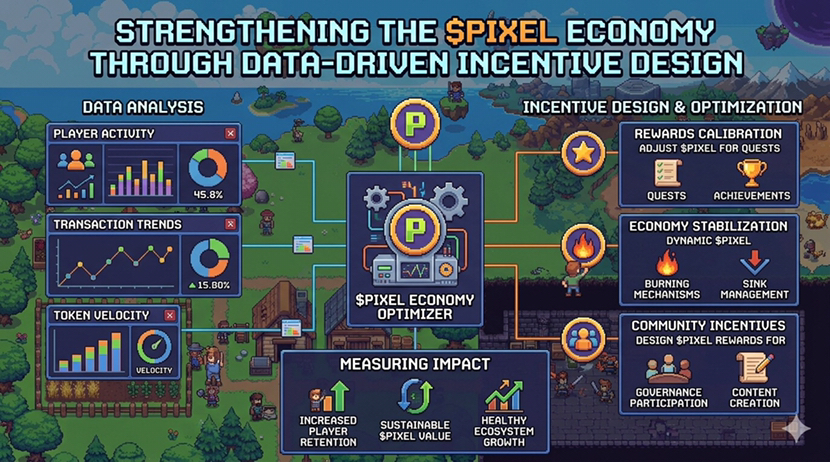
One of the biggest changes is the move toward data-backed incentives. Instead of distributing rewards broadly, the system now uses analytics to identify who is actually contributing value. The idea is simple but powerful: reward the players who are likely to stay, reinvest, and grow the ecosystem.
It’s a shift from quantity to quality.
Another bold move is the introduction of liquidity fees. At first, this might sound restrictive — heavier withdrawal fees on $PIXEL. But when you think about it, it’s actually about balance. If value is constantly leaving the ecosystem, nothing sustainable can be built. By redistributing those fees back to committed participants like stakers, it creates a loop where value circulates instead of draining out.
Then comes what I think is one of the most forward-looking ideas: the new publishing model.
A stake-to-vote-and-earn system changes the relationship between players and games completely. Instead of being passive participants, players become active stakeholders. They can influence which games succeed and directly benefit from that success. It’s not just playing anymore — it’s participating in an ecosystem.
And this is where Pixels’ vision really expands.
It’s no longer just about one game doing well. It’s about building a decentralized growth platform — something that supports both Web3 and Web2 games. Almost like creating an engine for user acquisition and engagement, but owned and shaped by the community itself.
The concept of RORS (Return on Reward Spend) becomes the anchor here. Every token distributed should create measurable, lasting value. Not temporary spikes, but sustainable growth. That kind of thinking brings a level of discipline that Web3 has often lacked.
In practical terms, this changes how the ecosystem operates.
Instead of chasing high DAU numbers just for the sake of it, the focus shifts to high-quality users. Players who actually care, who engage, who contribute. Because at the end of the day, 10,000 meaningful users are far more valuable than 100,000 passive ones.
The introduction of $vPIXEL is another smart layer. A spend-only token that works seamlessly across partner games removes friction. No extra fees, no complicated steps — just smooth interaction. It makes the ecosystem feel connected rather than fragmented.
And I like how growth is being approached more organically too. Incentives around referrals and content creation are being strengthened. Not forced marketing, but community-driven expansion. People sharing because they believe in it, not just because they’re farming rewards.
When it comes to Core Pixels, the changes get even more interesting.
Gating features and earnings behind VIP structures might seem limiting at first, but it actually encourages deeper engagement. It gives players a reason to stay invested, to level up their involvement rather than just skim the surface.
At the same time, there’s a clear effort to bring back what made Pixels fun in the first place. Stronger core loops, social interactions, casual mechanics — the things that create real enjoyment, not just financial incentives.
Because let’s be honest: if a game isn’t fun, no economy can save it.
The automatic staking of in-game balances is another subtle but powerful move. Instead of letting assets sit idle, they become part of the ecosystem’s growth. And when combined with boosts from holding Farm Land NFTs, it creates layered incentives that reward commitment.
Now, will all of this have short-term effects? Probably.
User numbers might fluctuate. Some players who were only there for quick gains might leave. And that’s okay. Because what’s being built here isn’t designed for short-term spikes — it’s designed for long-term stability.
That’s the part I respect the most.
In a space where it’s easy to chase hype, Pixels is choosing to build foundations. To prioritize sustainability over speed. To create systems where value is earned, circulated, and grown — not just extracted.
The long-term vision is clear: a decentralized platform that powers user acquisition and rewards across both Web3 and Web2 gaming.
Not just a game. Not just a token. But an ecosystem that actually works.
And if they get this right, it could redefine how we think about growth in this space.
Not as a race for numbers, but as a balance between players, incentives, and real value creation.
That’s the kind of shift Web3 gaming needs right now.
