
I've been thinking about how easy it is to spot when something is trying too hard.
You see it everywhere in Web3. Every project wants to sound like the future. Every game wants to act like it’s not really a game, like it’s some kind of economic revolution with a cute skin on top. And honestly, that’s where I usually stop listening. Because once the pitch gets louder than the product, you already know what’s happening. They want attention before they’ve earned trust.
That’s why Pixels feels different to me.
Not perfect. Not magical. Just different in a way that feels real.
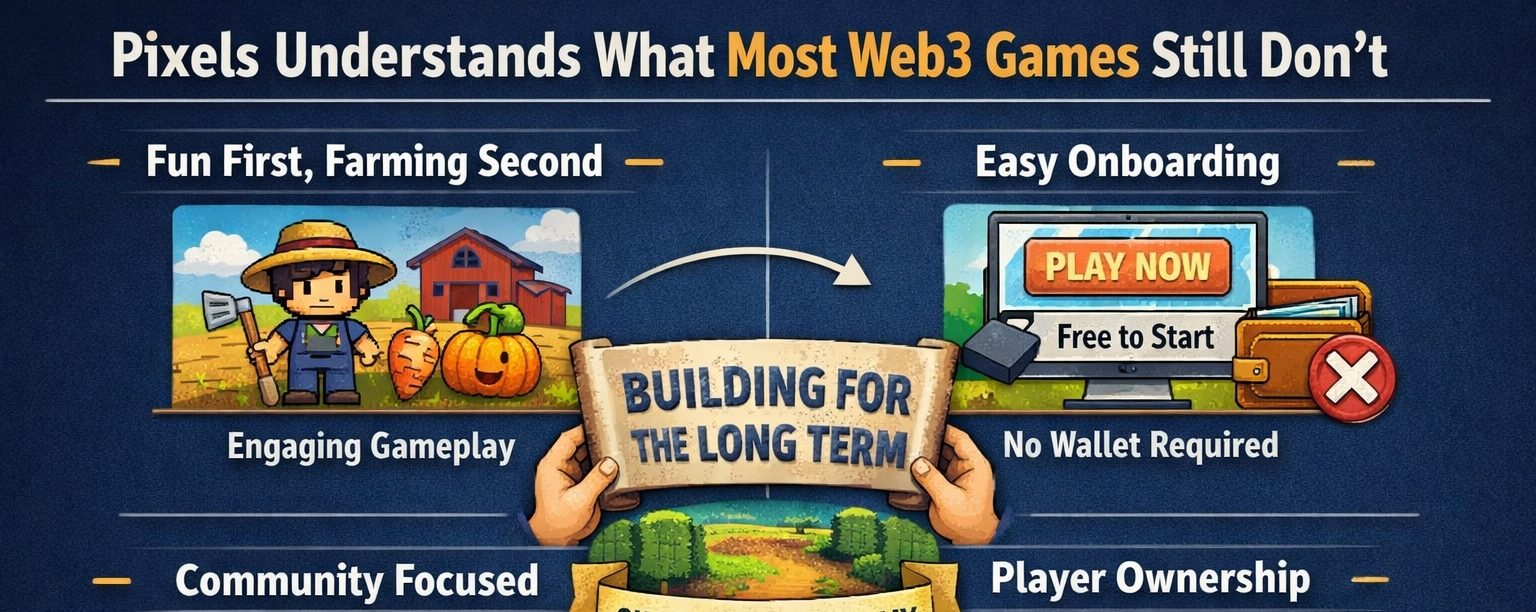
It doesn’t come at you like a machine built for speculation first. It feels like a world people can actually spend time in. That matters more than people admit. Because most so-called Web3 games are still trapped in this weird delusion that adding ownership, tokens, or blockchain logic automatically makes something meaningful. It doesn’t. People don’t stay because a system is “innovative.” They stay because it feels good to be there. Because it fits into their day. Because coming back tomorrow makes sense without needing a financial justification.
That’s the part Pixels seems to understand.
At the center of it, it’s farming, exploring, creating, trading, building. Nothing about that sounds radical. But maybe that’s exactly why it works. It speaks a language people already know. There’s something deeply human about planting something, waiting, returning, improving, trading with others, slowly building your own rhythm inside a world. That loop is simple. But simple doesn’t mean shallow. Sometimes simple is the hardest thing to get right.
And I keep thinking about how much of this industry hides behind complexity. Like confusion is proof of value. Like if normal people can understand something too quickly, it must not be deep enough. I don’t buy that anymore. Most of the time, complexity is just cover. A way to make broken things sound advanced.
Pixels doesn’t feel like that.
Even the fact that it runs on Ronin means something, not in the usual technical, overexplained way, but in a practical one. People need systems that don’t fight them every step of the way. They need low friction. They need something that feels usable, not something that turns every small action into a lesson in patience. If the infrastructure disappears into the background and the experience stays in front, that’s a good sign. That’s how it should be.
Of course there’s still tension in all of this. Any game connected to tokens will always walk that line between play and extraction. That risk never fully goes away. And pretending otherwise would be dishonest. But Pixels feels less interested in selling a dream and more interested in building a place. That difference is bigger than it sounds.
I’m not drawn to Pixels because it promises some grand digital future.
I’m drawn to it because beneath all the noise, it feels like one of the few projects that remembers people are not here to worship the system.
They’re here to live in it. And this one, quietly, seems to understand that.
