
You know….the hardest problem in blockchain gaming is not technology. It is translation. How do you take systems like ownership, tokens, and digital assets and turn them into something that feels natural inside a game?
Most projects answer this by exposing the mechanics too early. Players are asked to understand wallets before they understand the world. The result is friction without meaning.
Pixels approaches this differently. It begins with something familiar: a simple, social farming game. You plant crops, raise animals, gather resources, and gradually expand your land. On the surface, it feels closer to a casual simulation than a financial system. That is not accidental. I think it reflects a deliberate design choice to anchor complexity beneath experience rather than in front of it.#pixel
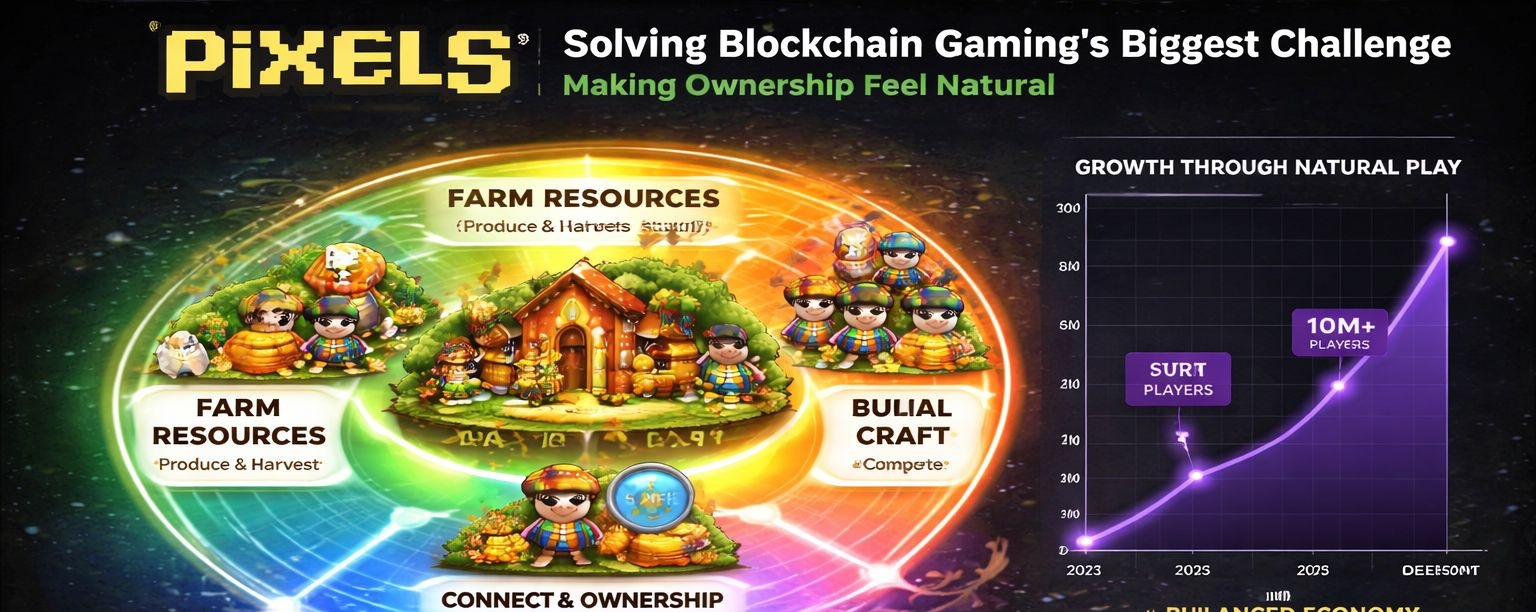
The core gameplay loop is easy to grasp but structurally important. Players farm to produce resources, convert those resources into usable outputs like energy, and then use that energy to build, craft and progress.What stands out to me is how tightly connected these actions are. Nothing exists in isolation. Farming feeds production. Production feeds expansion. Expansion unlocks new capabilities. It is a closed loop, but not a static one.
That distinction matters
. A static loop becomes repetitive. A connected loop becomes strategic.
As players spend more time in the system, the simplicity begins to reveal depth. Choices start to carry weight.
Do you prioritize immediate harvesting or long-term upgrades?
Do you invest in expanding land utility or optimizing current output?
These decisions are not imposed through complex menus; they emerge naturally from the structure of the game. That is where Pixels starts to feel less like a casual title and more like a small, functioning economy.
The social layer reinforces this dynamic.
Pixels is not designed as a solitary experience. Guilds, shared spaces, and collaborative play create a context where individual progress intersects with group behavior. I’ve seen many games treat social features as optional overlay chat systems, friend lists, cosmetic interaction. Here, they feel more embedded. Access to better resources, faster progression, or more efficient strategies often depends on cooperation.
At the same time, cooperation does not eliminate competition.
It reshapes it.Players may collaborate on certain goals while still competing for efficiency, positioning, or rewards. That dual structure…shared progress and individual optimization is what gives the world texture. Pure cooperation feels flat. Pure competition feels hostile. Pixels operates somewhere in between.
Underneath both gameplay and social interaction sits the blockchain layer. This is where Pixels takes a more measured approach than many of its peers.
Ownership is present, but it is not forced into every interaction. Land, items, and certain assets exist as NFTs, giving players real control over what they build and use. The key point is that these assets are functional. Land is not just a badge of status; it is a productive unit. It allows players to place industries, manage resources, and generate output.
i think this is one of the more important design decisions in the game. Ownership without utility is decorative. Ownership with function becomes meaningful.
The token extends this idea but avoids dominating it. It acts as a premium layer used for upgrades, speeding up processes, or accessing certain features but does not replace the core gameplay loop. Players can engage deeply with the game without relying entirely on the token, which helps maintain a balance between accessibility and economic depth. Staking mechanisms further connect players to the broader ecosystem, allowing them to support long-term development rather than simply extract short term rewards.
This balance is not easy to maintain. Too much reliance on tokens, and the game risks becoming transactional. Too little, and the blockchain layer feels unnecessary. Pixels seems to aim for a middle ground where the economy supports the experience rather than defining it.
There are also deliberate points of friction built into the system. Energy limits, resource cycles, tool degradation, and reputation systems all act as constraints.
At first glance, these may seem like obstacles. In practice, they are what give the system structure. Without limits, progression becomes trivial. Without cost, decisions lose meaning. Pixels does not remove friction; it organizes it.
That creates a more realistic dynamic. Players must plan, prioritize, and adapt. Some will optimize production chains. Others will focus on social coordination or land management. Over time, these different approaches create diversity in how the game is played. Not everyone is following the same path, and that variation is what keeps the system alive.
i keep coming back to the idea that Pixels is trying to behave like a living environment rather than a fixed product. Regular updates, new industries, and evolving mechanics prevent the economy from settling into a single optimal strategy. When a system is solved completely, engagement drops. By introducing change, Pixels reopens decision-making. It forces players to rethink rather than repeat.
That is a subtle but important distinction. Content extends a game. Systems sustain it.
In practical terms, Pixels matters because it offers a more grounded model for blockchain gaming. It does not assume that ownership alone will drive engagement. It builds a loop where gameplay, social interaction, and economic structure reinforce each other. The result is not perfect.
The real test for Pixels is not whether it can attract attention, but whether it can maintain relevance as the ecosystem evolves. So far, its approach suggests a clear direction: make the game understandable, make the economy useful, and let the player discover the connection between the two.
Simple on entry. Complex in motion. That is a difficult balance to achieve, and an even harder one to sustain.