

I Will Be Honest...
I’ve been thinking About something lately. Why do so many play-to-earn games feel like jobs that forgot they were Supposed to be games?
For years, crypto Gaming has promised a future where players finally get rewarded for the time they spend online. On Paper, it sounds fair. People spend hundreds or even thousands of hours building characters, grinding levels, Farming resources, and creating communities. In traditional games, most of that value stays inside the game company’s Walls. In crypto, the idea was that players could finally own a piece of what they help build.
But somewhere Along the way, the idea became distorted.
Yeah... Too many play-to-earn projects turned into systems Where the game itself became secondary. People were not logging in because they enjoyed the World, the mechanics, or the social experience. They were logging in because they felt pressured to keep earning. The Reward became the only reason to stay.
The problem With that model is simple. If the money disappears, the players disappear too.
That is probably one of the biggest reasons why so Many early Web3 games struggled to survive. The economies looked exciting at first, but most of them were built on endless inflation and Constant user growth. New players came in, rewards were distributed, tokens flooded the market, and eventually The entire system slowed down. What was supposed to be a game became a fragile financial loop.
I think this is Where the conversation around projects like PIXEL becomes more interesting.
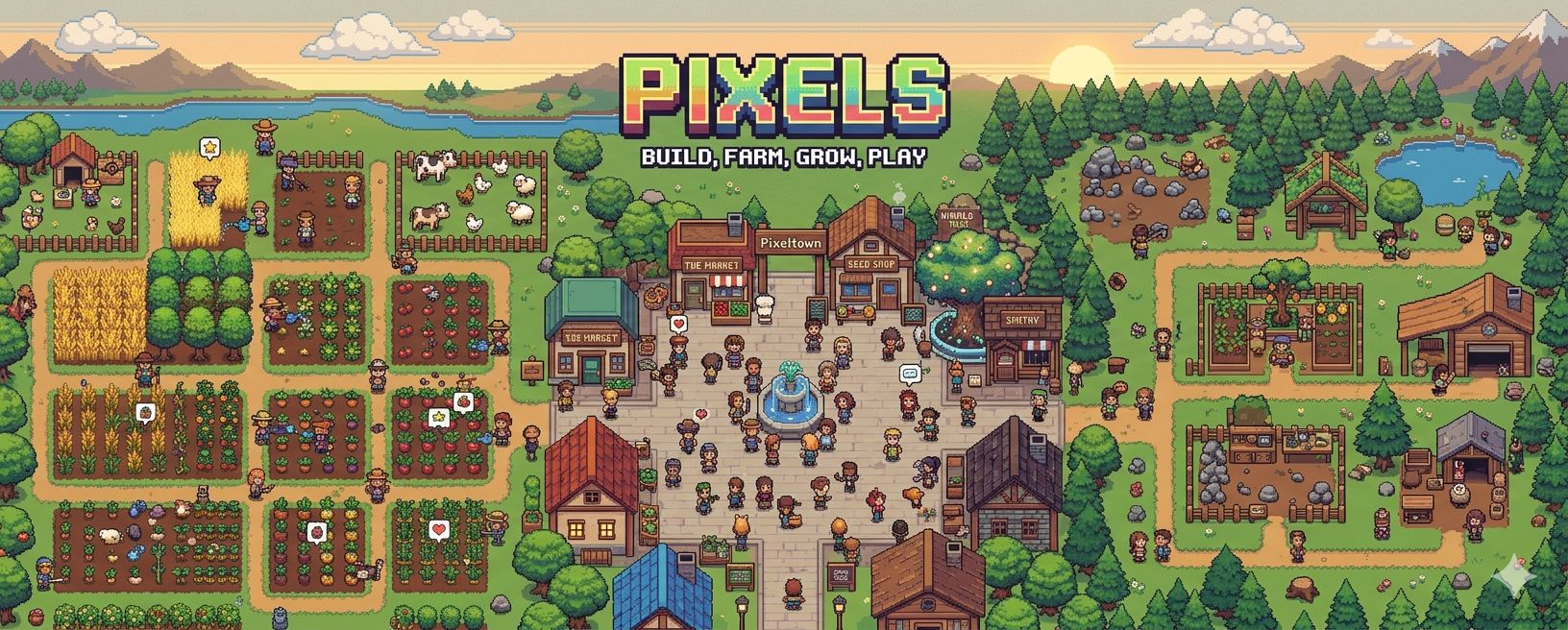
What caught my attention is not really the farming mechanics or the visual style of the Game itself. It is the bigger question the team seems to be asking: what if play-to-earn only works when the game is genuinely fun first?
That sounds Obvious, but in crypto, it often gets ignored.
A lot of teams begin with token models, reward systems, And economic diagrams. Then they try to build a game around those incentives. But players do not stay because of spreadsheets. They stay because they feel connected to the Experience. They stay because they enjoy the world, the progression, and the small emotional moments that make games memorable.
From what I see, PIXELS is trying to reverse that order. Instead of building a reward machine and calling it a game, it is Trying to build a game people actually want to play, then layer rewards on top in a Smarter way.
What makes that approach different is the focus on targeted rewards rather than broad rewards.
Most play-to-earn systems treat every player action the same. They reward grinding, repetition, and endless farming because those are easy things to measure. But not every action creates real Value for a game ecosystem. Some players help communities grow. Some bring in friends. Some stay active for months. Some create social activity that keeps the game alive.
PIXELS seems to be approaching rewards more Like a data problem. Instead of asking, “How do we reward everyone equally?” it asks, “Which behaviors Actually make the ecosystem stronger?”
That is a very different mindset.
If a game can identify the actions that create long-term value, it can reward players more Carefully and avoid wasting resources on behavior that only inflates the economy. In theory, that could Reduce one of the biggest weaknesses in crypto gaming: rewarding short-term extraction Instead of long-term participation.
I also think the publishing side of the idea matters more than people realize.
Most people look at a game and only think about players. But behind every successful game is a very expensive battle for user Attention. Traditional game publishers spend enormous amounts of money on ads, promotions, Influencers, And user acquisition campaigns. In crypto Gaming, those costs can be even higher because keeping users active is harder.
PIXELS appears to be building something Larger than a single game. It feels more like an ecosystem where player data, Game publishing, and incentives feed into each other. Better games attract more players. More players generate More useful behavioral data. Better data helps publishers find And retain the right users more efficiently.
If that cycle works, it could solve a problem that goes far beyond farming games.
Still, I do not think this approach is guaranteed to succeed.
The difficult Part is deciding which behaviors deserve rewards without making the system feel manipulative. If players start Feeling like every action is being tracked and optimized, the experience could Become less natural. There is also the risk that players learn how to “game the system” and imitate valuable Behavior without actually contributing much.
That balance between fun, fairness, and incentives is probably the hardest challenge in all of Web3 gaming.
What makes PIXELS interesting to me is not that it Claims to have all the answers. It is that it seems to understand the right question.
Maybe the future of play-to-earn is not about paying Everyone more. Maybe it is about understanding why people play in the first place.
If crypto gaming wants to survive beyond Speculation, it has to become something people would still enjoy even if the token rewards disappeared tomorrow.
That is the real test.
What are we actually building when we create play-to-earn systems? Are we creating stronger gaming communities, or are we simply building short-term financial loops?
Can targeted incentives make games healthier, Or will they eventually make them feel too engineered?
And if a game is not fun without rewards, was it ever really a game at all?
My view is simple. The next phase of crypto gaming Will not be won by the Projects with the biggest rewards. It will be won by the Projects that understand human behavior better than everyone else.