
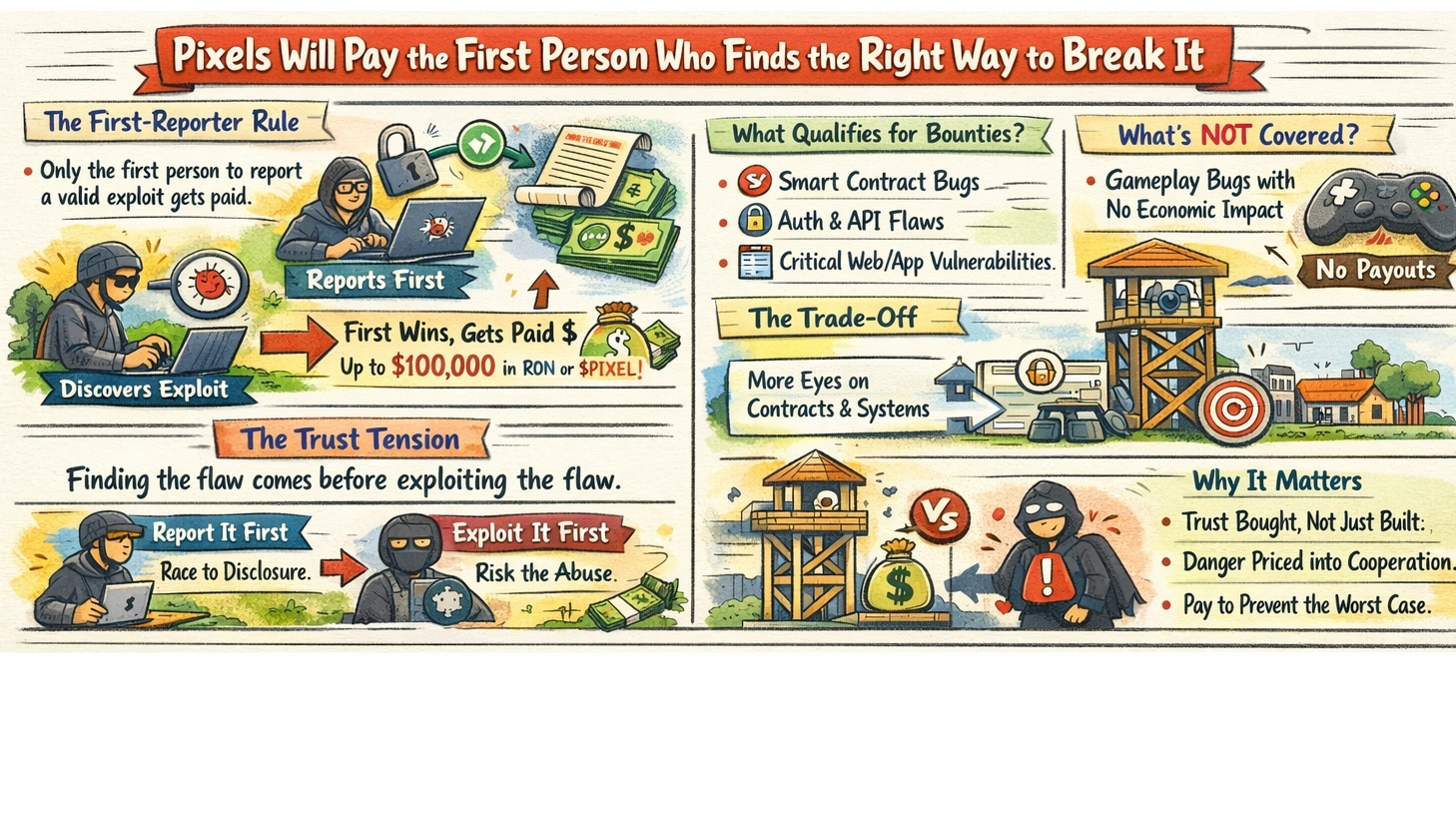
The part of Pixels that stuck with me was not a crop timer, a guild rule, or a VIP setting. It was the line saying the first reporter of a valid exploit is usually the one who gets paid. That one rule changes the feel of the whole system. Once only the first person wins, exploit discovery stops looking like quiet support work. It becomes a race.
That is why I do not read the Pixels bounty program as a side note. I read it as part of the security model.
Pixels is very specific about what qualifies. Serious issues across its contracts, authentication systems, APIs, web app, and mobile app can be rewarded. The reporter has to give reproducible steps and a real proof of concept. Severity decides the payout, and the biggest issues can go as high as one hundred thousand dollars in RON or $PIXEL. At the same time, Pixels draws a hard line around what it does not want to pay for. Gameplay bugs that do not affect game economics are out of scope.
That split says a lot.
Pixels is not just rewarding people for finding anything broken. It is paying for the things that can break trust in an economic sense. Asset loss, privilege abuse, contract risk, account risk, exploit paths that can move value or control. Those are the failures that get money attached to them. A weird gameplay bug that annoys players but does not damage the economy does not get the same urgency. That is a very clear statement about what Pixels thinks a real failure is.
I think that matters more than most readers realize. A lot of people still talk about trust in games like it comes mainly from design quality, community goodwill, or smooth updates. Those things matter. But Pixels is also showing another truth. Part of trust is being defended by an outside market of people who are good enough to find dangerous flaws before someone else uses them.
That is where the angle gets uncomfortable.
The kind of person who can discover a serious auth bypass, contract flaw, or API weakness is not far from the kind of person who could profit from it. The first-reporter rule is Pixels trying to pull that person toward disclosure before they move toward extraction. It is a payment for speed, not just honesty. Report first. Prove it works. Get paid before the wrong version of that same discovery reaches the wrong hands.
That creates a real advantage for Pixels. It gets more eyes on its contracts and systems than an internal team could provide alone. The bounty covers the PIXEL token contract, the farm land contract, the pet contract, the game contract, and the main web and app surfaces. So Pixels is not only relying on internal discipline. It is extending its defense line outward. That is smart. It is also a dependence. Once you build part of your trust model this way, you are depending on a paid race between discovery and abuse. If the reporter gets there first, the system looks safer. If the exploiter gets there first, the same openness becomes a liability.
That is the trade-off, and it is not a small one.
The first reporter rule helps because it makes delay expensive for honest researchers. If they wait, they risk losing the reward. But the same setup also exposes the core bottleneck. The people most capable of protecting the system are often the same people most capable of damaging it. Pixels is trying to make disclosure the better economic move. That is not the same thing as making danger disappear. It is trying to price danger into cooperation.
The out-of-scope rule makes this even sharper. Pixels is effectively saying that not every break deserves the same panic. If a gameplay bug does not touch the economy, it does not earn bounty money. I think that is one of the clearest windows into how the project ranks harm. The scary bugs are not just the ones that make the game feel broken. They are the ones that make the economy unsafe. That means Pixels is not only defending a play experience. It is defending a value system.
For a retail reader, that changes how trust should be read. A bounty program is not just a nice badge that says the team is responsible. It is also a signal that Pixels knows some of the worst failures need outside hunters, fast reporting, and enough money on the table to beat silence or exploitation. The project is not just building trust into the game. In one corner of the system, it is paying to discover broken trust early enough to survive it.
I do not think that makes Pixels weak. I think it makes Pixels honest about what a live game economy actually needs. But the consequence is still hard. Some of the most valuable work around Pixels may begin with someone actively looking for the fastest way to hurt it. The system works when that person reports first. It works much less well when the reward for keeping quiet, or moving first in the wrong direction, looks better than the payout for disclosure.
That is why the bounty matters. It is not just rewarding good behavior. It is trying to buy a head start against catastrophe. And in Pixels, that means some of the people protecting trust may begin as the people closest to breaking it.
