
Let’s try to understand what the real story is.
The more I study Pixels, the less it feels like just a game.
At first glance, Pixels looks easy to define. It is a social farming game, built around exploration, progression, and a soft, open-world kind of experience. That is the part people see first, and that part matters. But the more I sit with the project and read how it describes itself, the harder it becomes for me to see it as only a game. Underneath that surface, it feels like Pixels is trying to do something larger. It seems to be testing whether a game can also become a system for growth, retention, and ecosystem expansion.
That shift in perspective changes a lot.
If I only look at Pixels as a farming game, then I mostly think about gameplay, world design, and player experience. But once I start looking one layer deeper, I begin to notice that the project keeps pointing toward something else: rewards are not just being treated like player perks, they are being treated like part of a growth model. And that is a very different idea.
Normally, when I think about game publishing, I think about ad budgets, user acquisition costs, campaigns, and retention targets. A studio spends money to bring players in, watches who stays, and hopes the cost of acquiring users makes sense over time. Pixels seems to be moving toward a model where rewards can do some of that work from inside the ecosystem itself. That is what makes it interesting to me. It starts to look less like a game with a token, and more like a game trying to become its own distribution layer.
That is a big shift.
It suggests that rewards are not only there to make players feel engaged. They are also being used as a way to guide activity, attract attention, and potentially bring users back into the system. In that sense, reward spend starts to resemble a marketing budget — not in the usual advertising sense, but in a more internal, ecosystem-driven way. Instead of paying an outside platform to find users, the system tries to use its own economy to create movement.
And that is where Pixels begins to feel like more than a single product.
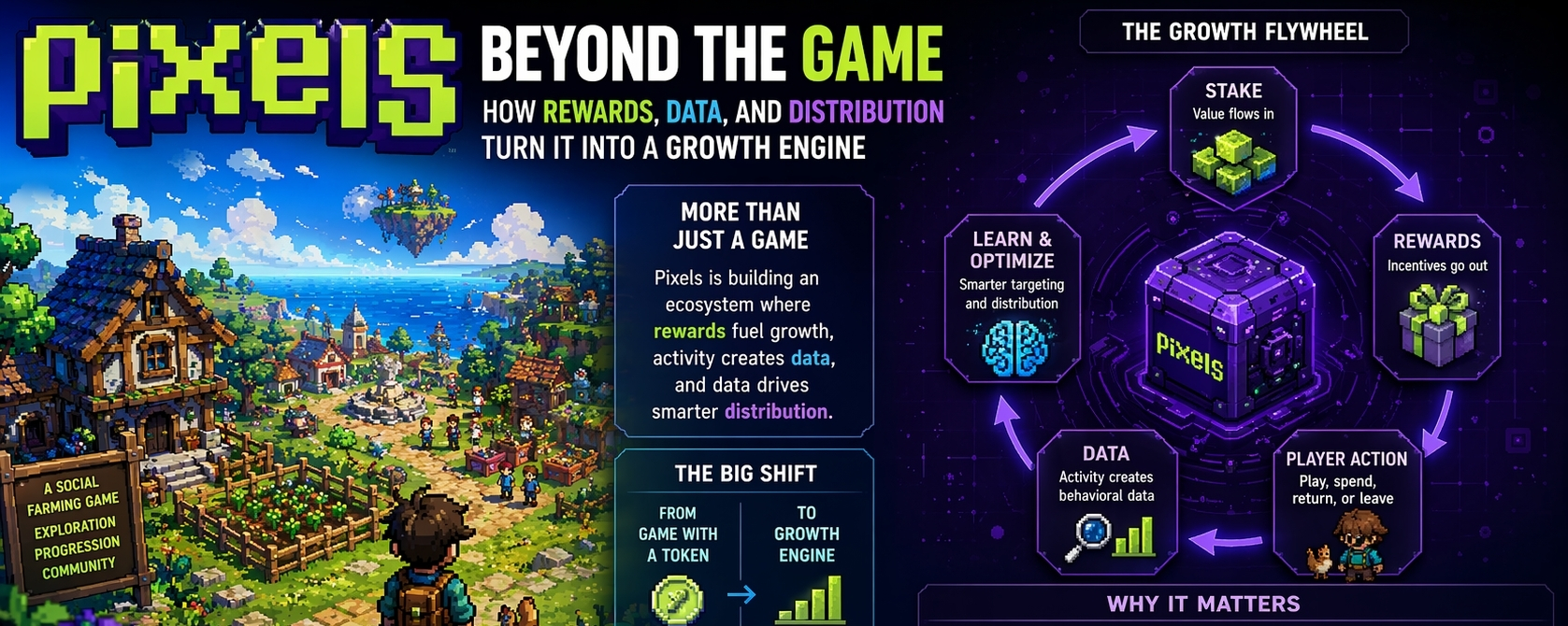
The project starts to resemble an ecosystem layer — something sitting between gameplay, incentives, player behavior, and growth. The game is still real, of course. It still has to stand on its own. But the deeper structure feels like it is trying to connect several things at once: staking, rewards, spending, user behavior, retention, and data. When those pieces are tied together, the project stops looking like a simple game economy and starts looking more like a flywheel.
That flywheel idea matters.
The basic logic seems to be that value moves through the system in a loop. Stake flows in. Rewards go out. Players act, spend, return, or leave. That activity creates data. Then the system uses what it learns to improve the next round of targeting and distribution. If that loop gets stronger over time, Pixels is not only growing a game — it is building a repeatable method for attracting and holding users.
To me, that is the part that quietly changes the whole meaning of the project.
Because once a game starts behaving like a growth engine, the real product may no longer be just the world players log into. The real product may also be the system underneath — the one that turns rewards into user acquisition, turns activity into insight, and turns player behavior into something the ecosystem can keep learning from.
At the same time, I do not think this is automatically a clean or easy idea.
There is always some tension when rewards start doing the work that marketing budgets usually do. On one hand, it can be smarter. It can keep value circulating inside the ecosystem instead of sending money outward to ad platforms. It can also make growth feel more native to the product itself. But on the other hand, it raises a harder question: at what point does the system start optimizing the player more than serving the player?
That is the part I keep thinking about.
If a game becomes too focused on reward flows, targeting, and behavioral loops, it can start to feel less like a world and more like a machine. And once that happens, the system may still be efficient, but it risks becoming emotionally thin. That is probably why the “fun first” idea matters so much here. If the game is not genuinely enjoyable, then the whole engine underneath becomes unstable. Rewards can attract attention, but they cannot create real attachment by themselves.
So when I think about Pixels now, I do not really ask whether it is a game or a growth engine. I think the more honest answer is that it is trying to be both. It still needs to work as a game, because without that, everything underneath becomes hollow. But the deeper ambition seems larger than gameplay alone.
And maybe that is the clearest way to describe it: Pixels looks like a farming game on the surface, but underneath, it may be trying to build a system where game design, growth, data, and incentives all move together.
If that is true, then maybe the real product is not only the game people play.
Maybe the real product is the loop being built beneath it.