
I remember the first time I seriously questioned a game token model—it wasn’t theoretical, it was practical. I had been playing a Web3 farming game, not unlike PIXEL, and I noticed something strange. Every time I earned rewards, I felt an urge to sell. Not because I didn’t like the game, but because the token itself didn’t give me a reason to hold. It felt like a loop designed for extraction, not alignment. That moment stuck with me, and it’s exactly why PIXEL’s current transition feels worth paying attention to.
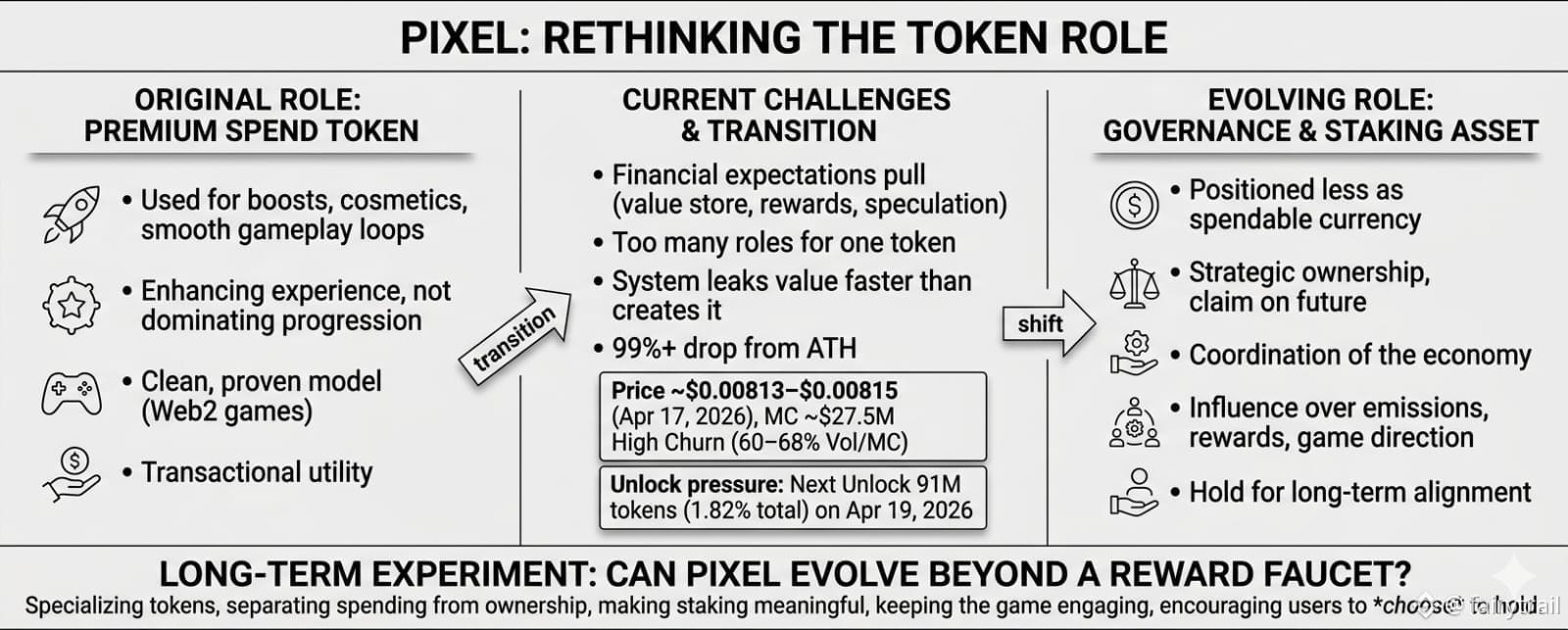
Right now, the market still treats PIXEL as a collapsed narrative play. The numbers reflect that reality. As of April 17, 2026, PIXEL is trading around $0.00813–$0.00815, with a market cap of roughly $27.5M depending on the tracker, and a fully diluted valuation near $40.7M. Daily volume sits unusually high at $16–17.6M, which means the volume-to-market-cap ratio is hovering around 60–68%. That’s not stability—it’s churn. It tells me traders are active, but conviction is thin.
But I think focusing only on the chart misses the deeper shift.
Originally, PIXEL functioned as a premium in-game currency. I actually liked that design. It wasn’t trying to be everything. It was used for boosts, cosmetics, and smoother gameplay loops—basically enhancing experience without dominating progression. That’s a clean model. I’ve seen it work in Web2 games for years.
The problem started when the token got pulled into financial expectations. Suddenly, it wasn’t just something to spend—it had to store value, reward players, attract speculators, and remain scarce. That’s where things broke. I’ve seen this pattern too many times: one token, too many roles. Players farm and sell, traders expect upside, emissions keep flowing, and before long, the system leaks value faster than it creates it.
PIXEL followed that script for a while. The ATH of $1.02 back in March 2024 now looks like a different universe—down over 99%. But here’s the part that changed my perspective: instead of doubling down on the old loop, the project started redesigning the role of the token itself.
Now, PIXEL is being positioned less as a spendable currency and more as a governance and staking asset. That’s not just a narrative tweak—it’s a structural shift. I noticed this when I looked deeper into how incentives are being reframed. Instead of asking, “What can I buy with this today?” the system is slowly pushing toward, “What influence does this give me over tomorrow?”
That distinction matters more than most people think.
A spend token is transactional. You use it, and it’s gone. A governance asset is strategic. You hold it because it represents a claim on future decisions, future incentives, and future value flows. It sits above the day-to-day economy instead of being consumed by it.
I once tested this idea in a smaller DAO I participated in. I staked tokens not because the yield was attractive, but because I wanted voting power over treasury allocations. That small shift—from consumption to coordination—completely changed how I valued the asset. I stopped thinking short term.
That’s the direction PIXEL seems to be moving toward.
Looking at tokenomics, the structure supports this transition, at least partially. Total supply is fixed at 5B, with around 52% unlocked so far. The distribution is broad—34% allocated to ecosystem rewards, 17% treasury, 14% private investors, and smaller portions to team, advisors, and launchpool participants. But here’s the catch: unlock pressure is still real. The next unlock on April 19, 2026, will release around 91M tokens, about 1.82% of total supply. These cliffs and linear vesting schedules extend all the way to 2029.
So even if the design improves, supply-side pressure doesn’t disappear overnight.
That’s where skepticism comes in.
Governance is easy to promise but hard to execute. I’ve seen projects introduce staking and voting, but users don’t engage because the outcomes feel disconnected. If staking PIXEL doesn’t meaningfully influence emissions, rewards, or game direction, then it risks becoming passive yield farming under a different name.
The product layer also matters. Pixels has shown strong historical traction—millions of users, hundreds of thousands of daily players, and over $25M in ecosystem revenue at one point. But retention is everything. If the game loses relevance, no amount of governance design can save the token.
Here’s how I think about it now, based on what I’ve learned the hard way:
Short term, PIXEL is still a high-volatility asset driven by sentiment, unlocks, and trading flows. The high volume confirms that. It’s attractive, but fragile.
Long term, it’s a design experiment. Can a game token evolve beyond being a reward faucet into something that actually coordinates an economy?
If it works, the implications go beyond Pixels. It would suggest that GameFi tokens don’t need to die—they just need to specialize.
If it fails, it reinforces the idea that most gaming tokens are fundamentally flawed.
So when I look at PIXEL today, I don’t ask if it will return to $1. That question feels outdated. I ask whether it can become something more durable than what it originally was designed to be.
Can it separate spending from ownership effectively?
Can staking feel meaningful instead of passive?
Can the game remain engaging enough that governance actually matters?
And maybe the most important one—will users choose to hold, not because they’re trapped, but because they see a reason to?
Curious how others see this shift. Are you still viewing PIXEL as a trading token, or are you starting to treat it like a long-term coordination asset?
$PIXEL @Pixels #pixel $MOVR $AUDIO #Kalshi’sDisputewithNevada #CharlesSchwabtoRollOutSpotCryptoTrading #USInitialJoblessClaimsBelowForecast #BitcoinPriceTrends
