
When I first saw Tier 5 roll out in Pixels, I didn’t see it as just another feature update. I saw it as a structural shift—one that says more about the game’s economy than its gameplay.
Because in Web3, especially in systems built around land and production, every upgrade carries an underlying question: who actually benefits?
On the surface, Land Management 2.0 looked like progress. More industries, deeper mechanics, expanded production chains—it all pointed toward a richer and more engaging experience. The messaging leaned heavily into accessibility and opportunity, suggesting that players would now have more ways to grow, earn, and compete.
But the deeper I looked, the more I felt something didn’t quite add up.
Pixels has already proven it can scale. At one point, it pushed over a million daily active users and built one of the most active ecosystems in Web3 gaming. That kind of growth doesn’t happen by accident. It comes from well-designed reward loops, frictionless onboarding, and a system that constantly gives players a reason to come back.
Yet scale doesn’t always mean balance.
What I’ve learned from watching Pixels closely is that its economy isn’t flat—it’s layered. From basic farming plots to higher-tier land NFTs, the system already had a built-in hierarchy. Tier 5 didn’t remove that hierarchy. It extended it.
And that’s where the contradiction begins.
Because when you add more industries and more production depth, you’re not just adding gameplay—you’re adding complexity. And complexity, by its nature, rewards those who can navigate it best.
In theory, more options should mean more opportunity. In practice, it often means more advantage for those who are already ahead.
Think about how the core loop works: you farm, you produce, you complete tasks, you earn rewards, and then you reinvest. It sounds simple, almost fair. But once higher-tier systems come into play, that loop stops behaving like a straight line. It starts behaving like a curve.
Players with better land, better setups, and better understanding don’t just earn more—they scale faster. And once scaling begins, it compounds.
This is where Tier 5 quietly changes the game.
It introduces new layers of optimization—more ways to refine output, reduce inefficiencies, and maximize returns. But not every player can access or fully utilize those layers. The ones who can are usually the ones who already have the resources, the time, and the knowledge.
So instead of narrowing the gap, the system stretches it.
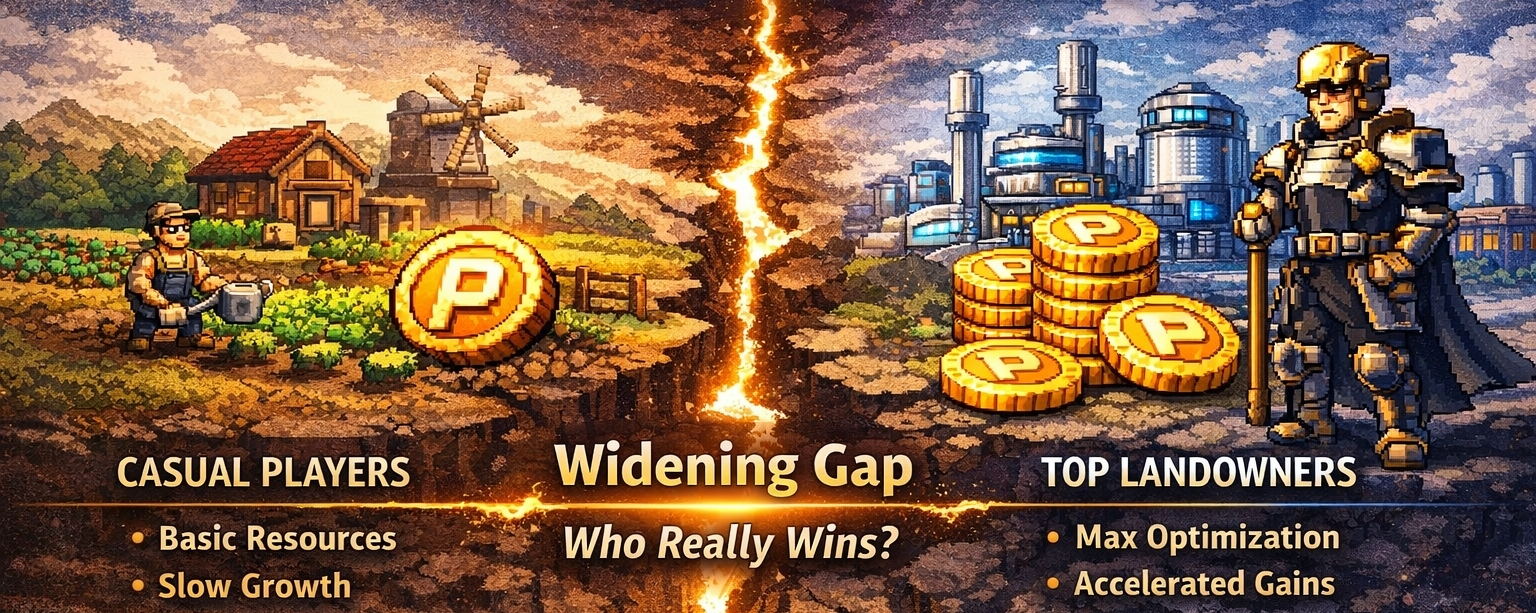
I started thinking about two types of players. One who owns high-tier land, understands production chains, and actively reinvests. Another who plays casually, maybe without land ownership, just engaging with basic loops.
Before Tier 5, the difference between them was noticeable but manageable. After Tier 5, it becomes exponential.
The first player doesn’t just progress—they accelerate. They unlock better efficiencies, control more production, and position themselves deeper into the economy. The second player doesn’t just lag—they struggle to keep pace in a system that’s constantly moving forward.
And this isn’t necessarily a flaw. It’s a reflection of how these systems are designed.
In traditional games, progression is often capped or balanced to maintain fairness. In Web3 games like Pixels, progression is tied to ownership, efficiency, and reinvestment. That naturally creates a different dynamic—one where economic behavior matters as much as gameplay.
This is why I don’t think Tier 5 “failed.” If anything, it revealed the true nature of the system.
Pixels isn’t just building a game—it’s building a digital economy. And in any economy, advantages tend to compound over time. The players who understand the system early, invest wisely, and optimize consistently don’t just stay ahead—they extend their lead.
That’s exactly what we’re starting to see.
Even the token side reflects this imbalance. Despite strong user growth and engagement, the $PIXEL token has experienced significant volatility and drawdowns. That disconnect tells its own story: user activity doesn’t always translate into value for everyone equally. It often depends on where you sit within the system.
And that brings me back to the original promise of Land Management 2.0.
Was it really about closing the gap?
Or was it about expanding the system in a way that inevitably rewards those already positioned to win?
The more I think about it, the more I lean toward the latter.
Because when you build a system around ownership, efficiency, and scaling, equality isn’t something you naturally get. It’s something you have to actively design for. And if it’s not explicitly designed, the system will default to amplification—of skill, of capital, of advantage.
That’s the contrarian truth most people don’t want to confront.
Maybe Pixels isn’t trying to create a level playing field.
Maybe it’s trying to create something more real—an economy where decisions matter, positioning matters, and understanding the system is the ultimate edge.
And if that’s the case, then the gap we’re seeing isn’t a problem to fix.
It’s a feature to understand.
So the real question isn’t whether Tier 5 widened the gap.
It’s whether we’re ready to accept that in Web3 gaming, the gap might be the game itself.