
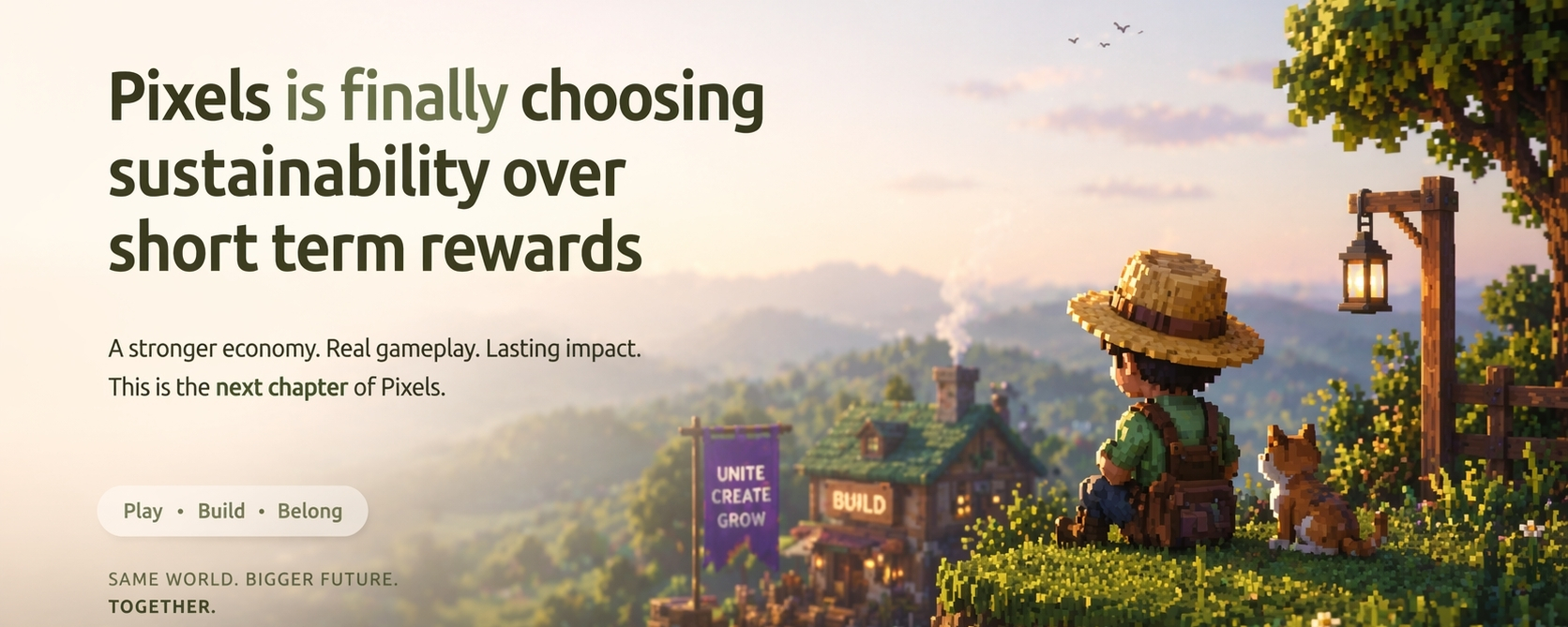

Pixels is not trying to impress you anymore. It is trying to survive. And that shift is exactly why it is starting to matter.
For a long time, Pixels sat in the same bucket as most GameFi experiments. Easy rewards, fast growth, and a user base driven more by extraction than experience. It worked in the early phase, but like every system built on inflation, it started to crack. Too many tokens, too little meaning, and players who were there for yield, not for the game.
What is happening now feels different.
The recent updates are not loud, but they are intentional. Instead of chasing attention, the team is refining the core loop. Farming, crafting, and daily activities are being rebalanced so that time spent in the game actually translates into consistent value rather than random spikes of reward . That may sound small, but in GameFi, this is everything. Stability is what most projects never reach.
Chapter 3, known as Bountyfall, quietly changed the structure of the game. It introduced Union based gameplay where players align into factions, compete, contribute, and actually care about outcomes . This is a fundamental shift away from solo farming toward coordinated participation. The game is no longer just about optimizing your own land. It is about being part of a system where your actions influence a larger result.
That single change moves Pixels closer to what real games do well. They create tension, identity, and social dynamics.
And it does not stop there.
The ecosystem is expanding beyond one game into a multi game structure where the PIXEL token is being positioned as a shared layer across different experiences . This matters because it turns Pixels from a single product into a platform. Instead of one loop that risks burnout, it becomes a network of loops that can sustain attention over time.
At the same time, the introduction of systems like social reputation and trust scoring adds another layer of depth. Rewards are no longer purely mechanical. They are influenced by behavior, participation, and credibility inside the ecosystem . That is a direct response to one of the biggest problems in Web3 gaming which is bots and low quality engagement.
What you are seeing is a slow transition from extraction to contribution.
Even the role of the token is becoming clearer. PIXEL is not just a reward anymore. It is tied to upgrades, governance, staking, and access across the ecosystem . When a token has real in game utility instead of just market speculation, it changes how people interact with it. They hold it for function, not just for exit.
And this is where the real story sits.
There is now a visible split between two groups. Traders are watching charts, reacting to volatility, and debating price levels. Players are still logging in, doing tasks, joining factions, and spending time in the world. The fact that the second group still exists is the strongest signal Pixels has going for it .
Because in the end, GameFi does not fail when prices drop. It fails when players stop caring.
Pixels is not perfect. The token structure still carries risks like concentration and liquidity sensitivity, and the roadmap depends heavily on execution. Expanding into multiple games sounds strong on paper, but it only works if those experiences are actually engaging. Otherwise, it becomes fragmentation instead of growth.
But despite that, there is something here that most projects never achieve.
Discipline.
They already went through the phase of unsustainable rewards and corrected it. They are actively tuning the economy instead of ignoring it. They are aligning gameplay with incentives instead of separating them. And they are building systems that encourage participation, not just extraction.
That is not the easy path. It is the necessary one.
From my perspective, Pixels is no longer a hype driven play to earn cycle. It is becoming a controlled digital economy with game mechanics layered on top. And that is a much harder model to build, but also a much more durable one if executed correctly.
If they stay consistent, keep tightening the economy, and continue pushing toward real player driven systems, Pixels does not just remain relevant. It becomes one of the few GameFi projects that actually grows up.
And in this space, that alone puts it ahead of most.
