
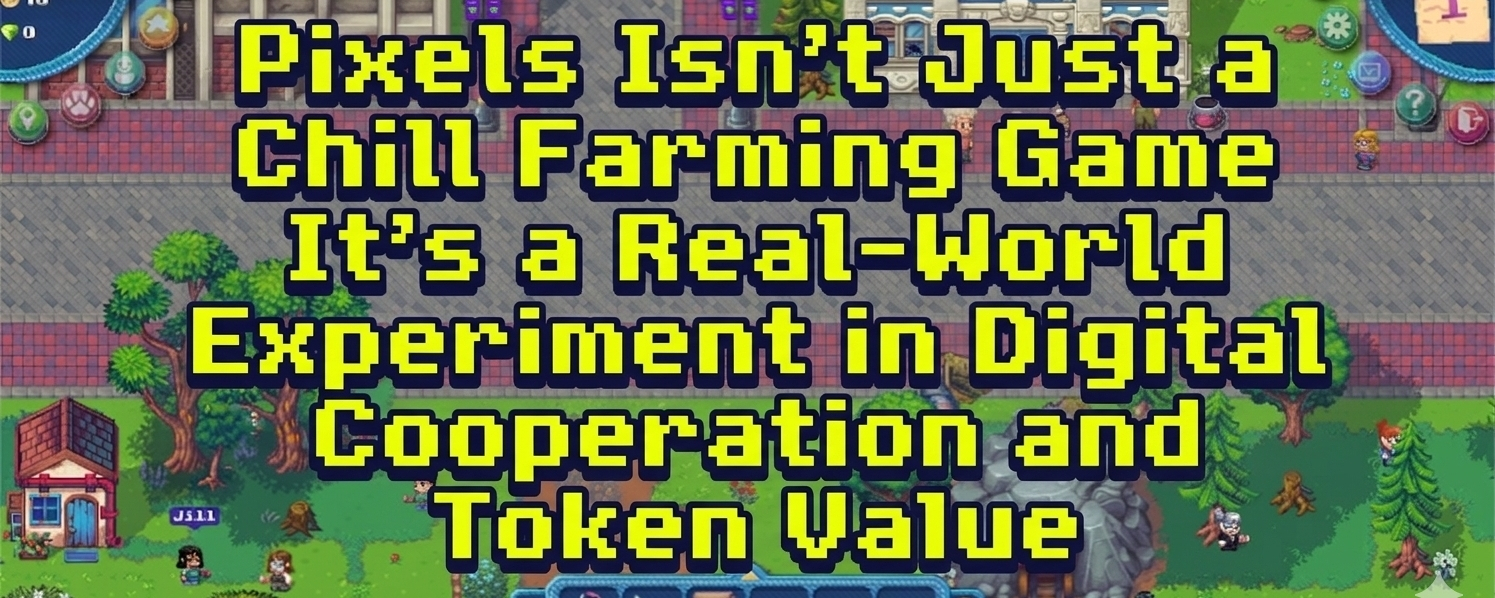


Alright, i've thinking a question that kept bouncing around my head like a lost pixelated chicken 🐔
Why does a chill little farming game even need an economy?
I mean, c'mon. I'm watching Pixels, and at first glance it's simple as dirt. Plant stuff, grab resources, maybe throw a fence around your patch. Relaxing. Slow. No stress.
But then I spent a bit more time with it, and something clicked. There's actually a structure under the hood. It's not just built for killing time it's trying to keep a thread going after you log off. And that's where things get interesting. Most games don't give a crap about your effort once you close the tab. You grind, you earn, you spend loop over. Pixels wants that loop to stretch. They use blockchain to give you ownership, which sounds like a buzzword salad, but from a player's seat? It actually changes stuff.
Let me be real. Say you build a farm over a week. In a normal game, that farm is trapped inside that game's walls. Here? Technically, it's yours. Not just "feels like yours" like, really yours. That tiny shift makes the game feel heavier. Because now effort isn't just about moving forward it's about stacking up. But I had a doubt. Ownership alone doesn't create value. You can own a pile of useless junk. So where does the value come from?
Pixels seems to answer that with a behavior-driven system. No fixed rewards, no guaranteed payout. Instead, how you play how efficient you are, how much you plan, how you interact determines what you get. It's a bit like a tiny real-world economy. Two people can spend the same time and end up with totally different results.
Imagine two players:
One rushes through tasks, wastes energy, no planning. The other takes it slow, maps out crop cycles, coordinates with a guild, cuts waste. Same game, same tools, different mindset. Over time? Their outcomes diverge. That's the quiet thing Pixels is building. And it's kinda special.
Then there's the social layer. Guilds here aren't just buddy lists. They work more like mini production units. Shared effort, shared strategy, sometimes shared output. It stops feeling like multiplayer and starts feeling like a coordination system. Little digital cooperatives popping up inside the game. Honestly, I've rarely seen this done so clearly.
Now the token layer $PIXEL Usually tokens feel shoved in. Get rewards, dump 'em, cycle ends. But Pixels is trying to tie rewards to actual in-game contribution. Staking, activity based distribution trying to cut the "free money" problem. Not perfect yet, but the direction matters. There's a subtle shift here:
From Play 2 Earn to Play 2 Participate
You're not just taking value. You're creating it by being part of the system.
Another thing I kept wondering: why update every two weeks? At first I thought, "cool, new stuff." But then I realized those updates are also economic tuning. New items, new industries, new sinks. Not just gameplay tools for balancing the ecosystem. It's not just game design. It's system design.
And maybe that's the real point. Pixels doesn't want to be the most complex game. It wants to stay simple on the surface. But underneath, it's experimenting with something hard: how to make time, effort, and coordination economically meaningful without wrecking the fun.
Is it fully successful? Nah, not yet. Lots of open questions. What happens if user growth slows? How centralized is the backend? Is distribution really fair?
But still… it's hard to ignore. Because it's not just selling an idea it's quietly testing infrastructure. Can a game behave like a lightweight economy? Can ownership change not just how you feel, but how you act? Can player coordination beat individual grinding?
Pixels hasn't answered these perfectly. But it's asking the right questions and building in a way that lets answers emerge over time. Maybe that's where the real change is.
Don't just play and earn.
Play, contribute, and see if the system recognizes you.
That's something special. 🚀
And yeah, I once spent three weeks farming in a different Web3 game, only to realize my "rare" crops were worth less than the gas fees to sell 'em. My wife still brings it up at dinner. So I'm cautiously optimistic, but also keeping my boots muddy. 🌱