
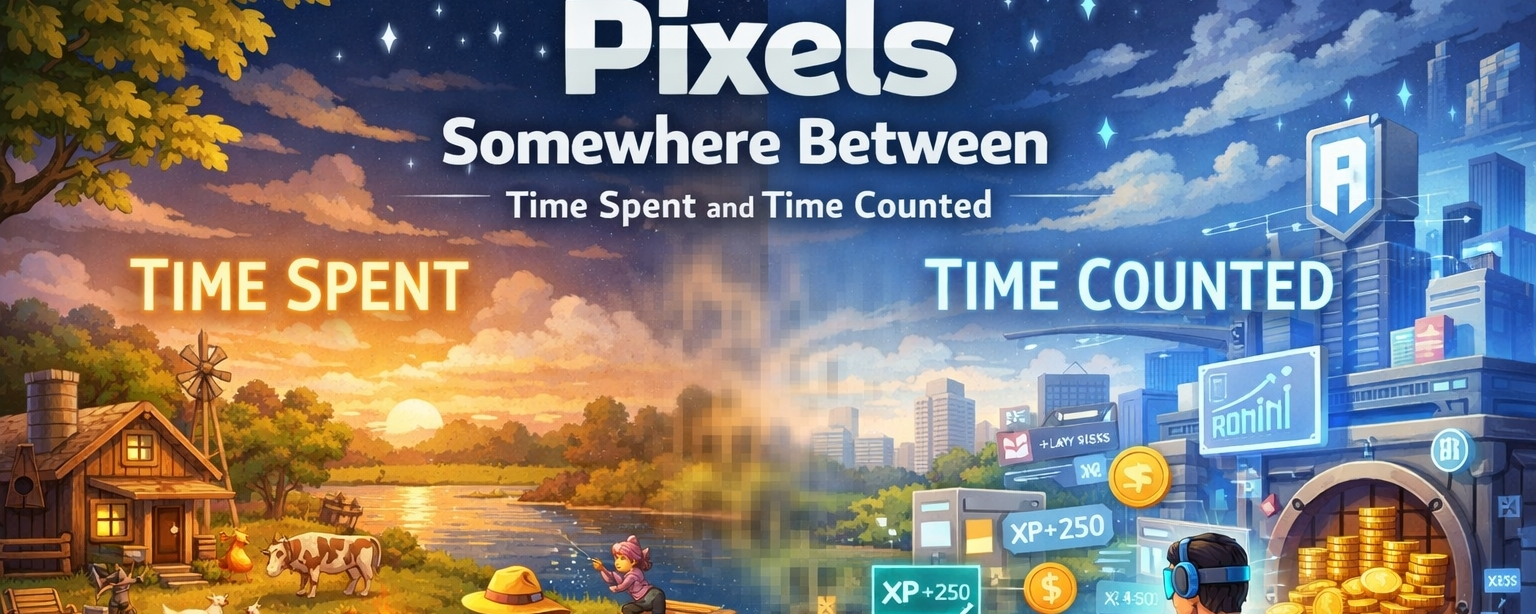
Pixels did not look important to me at first. That is probably the simplest way to say it. I saw the familiar shape of it and felt the usual reaction that comes after spending too much time in this market. Another project, another wave of attention, another thing people were ready to turn into a signal before it had the chance to become anything more human than that.
The first impression was easy. Farming, progression, land, routines, a world built to keep people moving. Crypto has shown that pattern enough times that it almost trains you not to pause. You think you understand the category, so you move on. And honestly, that is what I thought I had done here.
But Pixels kept returning to me in a way I did not expect. Not because it looked bigger than everything else. Not because it came with some grand claim attached to it. More because it stayed in my mind after I had already decided it was simple. That usually gets my attention more than the obvious things do. In a market full of projects trying hard to look meaningful, the ones that linger quietly tend to say more.
What started to interest me was not really the game on the surface. It was the kind of problem sitting underneath it. Pixels feels like it is circling something crypto keeps running into, even when the language changes. The space has always wanted people to do more than arrive. It wants them to remain. It wants their time, not just their click. Their rhythm, not just their entry. And those are very different things, even if people often talk about them like they are the same.
That difference matters more than most projects admit.
It is easy to generate movement. It is easy to manufacture a spike of attention, especially in crypto, where people are trained to chase whatever looks active. But staying is different. Real return is different. A person coming back to something over and over again is not always proof of belief, but it is still a more serious test than a single moment of interest. Repetition exposes things. It strips away the launch energy and the polished story and leaves you with the actual relationship between the person and the system.
That is where Pixels starts to feel more interesting to me.
Because a farming loop is not naturally dramatic. It is repetitive by design. You return, you do small tasks, you wait, you repeat. On the surface, that can sound almost too ordinary to matter. But ordinary things are where the truth usually shows itself. The market loves spectacle. Real attachment usually grows somewhere quieter. In routine. In familiarity. In the low, almost forgettable motions people keep making because something about the environment gives them a reason to continue.
And I think that is part of what Pixels is touching, whether intentionally or not.
What stood out to me was that it did not force itself into my attention through complexity. It was actually the opposite. It felt light enough to dismiss, and yet it kept pulling me back because the project seems to sit near a much older question, one that is bigger than gaming and bigger than crypto too. How do you make people spend time somewhere in a way that feels real? Not just rewarded. Not just tracked. Not just converted into numbers that look good from the outside. Real.
That sounds simple when written down, but it is not simple at all.
Crypto has spent years building systems that can record almost everything. Actions, transactions, ownership, movement, history. It is extremely good at turning behavior into visible proof. But proof is not the same thing as trust. Record is not the same thing as meaning. You can see that someone showed up. You can see that they interacted. What you cannot always see is whether their presence meant anything to them beyond the immediate incentive in front of them.
That gap sits inside so much of this market.
Pixels, for me, pulled that gap into focus again. Not because it solves it cleanly, and not because I think it escapes all the usual crypto distortions. It does not. No project really does. But it puts the issue in front of you in a way that feels harder to ignore. When people return to a world built around simple loops, the obvious question is whether they are there because the experience holds them or because the reward structure does. And maybe the most uncomfortable answer is that sometimes those two things blur together so completely that even the people inside it cannot fully separate them.
That is not a flaw unique to this project. That is a much older digital problem.
Every online system eventually runs into the same tension. Action versus proof. Signal versus noise. Trust versus record. We keep building environments where everything can be counted, and then we act surprised when counting starts to replace understanding. The visible side becomes easier to read than the human side. Metrics rise faster than meaning. Participation becomes legible long before it becomes believable.
That is why Pixels stayed with me more than I expected. It feels less like a project that should be read only through performance and more like a project that reveals how incomplete those measurements really are. You can count users. You can count activity. You can count transactions and retention curves and movement across an ecosystem. But none of that fully answers the deeper question. Why do people actually stay? What are they forming inside a space like this? Habit? Attachment? Hope? Opportunism? A mix of all of them?
Probably a mix. That is what makes it hard.
And maybe that is also what makes it worth thinking about.
There is something revealing about a project built around repetition in a market that still prefers intensity. Crypto understands the event very well. The launch, the narrative shift, the breakout, the price reaction. It understands what to do with visible acceleration. But it still does not understand ordinary time in a mature way. It does not always know how to value the quiet parts, the slow parts, the parts where people are not making declarations but are still there. Pixels seems to live closer to that slower layer, and because of that, it ends up touching questions the louder projects often avoid.
For me, that is where the project becomes more than just a casual Web3 game people mention in passing.
It starts to look like a test of whether digital spaces tied to ownership and incentives can still create a sense of return that does not feel hollow. Not perfect trust. Not pure community. Just something more durable than a temporary rush. Something that feels chosen often enough to matter.
I am still careful with that thought, because crypto has a habit of dressing up incentive loops as belonging. It has done that many times. It has mistaken motion for meaning so often that fatigue becomes the natural response. And I carry that fatigue too. I think most people who have stayed in this space long enough do. You stop reacting to polished narratives. You stop being impressed by surface-level traction. You start looking for the smaller signs instead. What keeps returning to your attention. What feels structurally interesting even when it does not sound exciting.
Pixels landed there for me.
Not as something I wanted to overstate. Not as something I feel the need to defend. More as a project that kept making me think about how hard it is to build systems where presence means something beyond visibility. That problem keeps showing up in new forms. Social platforms deal with it. Games deal with it. Online communities deal with it. Crypto just makes the tension more obvious because it records everything so aggressively and monetizes attention so quickly.
So when I look at Pixels now, I do not really focus first on the obvious category it belongs to. I focus on the pressure point it seems to reveal. The struggle to make repetition feel human instead of mechanical. The struggle to make activity feel lived rather than just measured. The struggle to build something people return to without reducing that return to a dashboard before understanding what it actually is.
I do not think the project answers all of that. I am not even sure projects like this are supposed to answer it fully. But sometimes a project matters because it circles the right question, even if the answer stays incomplete.
That is where I ended up with Pixels.
It looked small at first. Maybe too small to hold attention for long. But the longer I sat with it, the more it felt connected to something much bigger than itself. Not a grand future. Not a dramatic shift. Just an old problem wearing a new form again. How to turn presence into something real without flattening it into pure proof. How to let people spend time somewhere without immediately forcing that time to justify itself in numbers.
That tension is still there when I think about the project. I do not think it goes away. And maybe it should not. Some things are more honest when they remain unresolved.
That, more than anything, is why Pixels stayed with me. Not because it demanded belief. Because it kept quietly asking a better question.