
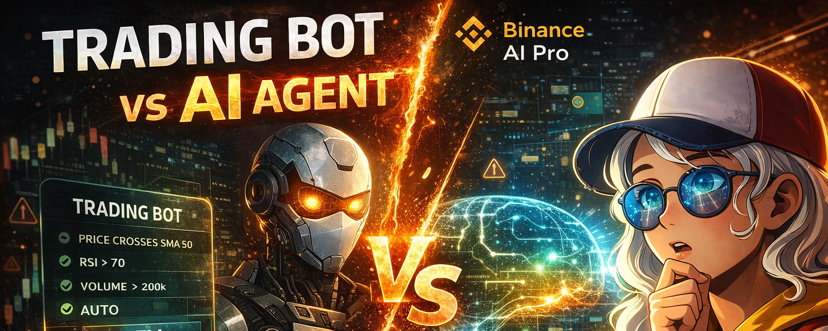

Every time I see Binance AI Pro mentioned in a discussion thread, someone in the comments draws the trading bot comparison. And every time, I find myself wanting to explain why that comparison misses something fundamental — not just about this product, but about what AI agents actually are versus what rule-based automation has always been.
The distinction matters. Especially if you’re making a decision about whether to use @binance AI Pro based on your experience with traditional trading bots.
Here’s the core difference, stated as plainly as I can.
A trading bot executes rules. You define the conditions — price crosses this level, RSI drops below this threshold, volume spikes above this multiple — and the bot fires the corresponding action. It doesn’t reason. It doesn’t interpret context. It doesn’t notice that the market structure has shifted in a way that makes your original rule set obsolete. It just matches conditions to actions, mechanically, until you turn it off or the conditions stop triggering.
There’s real value in that. Rule-based automation is consistent, emotionless, and fast. For specific well-defined strategies in stable market regimes, bots perform exactly what they’re designed to perform. The limitation isn’t the execution — it’s the rigidity. A bot optimized for trending markets keeps running the same playbook in a ranging market. It doesn’t adapt because it can’t reason about context. It can only check whether conditions are met.
An AI agent does something structurally different. It interprets. When you give Binance AI Pro a prompt about your current position, it doesn’t check that prompt against a rule table. It reasons about it — considering market structure, sentiment context, your stated objectives, relevant historical patterns, and the specific framing of your question — before producing a response or taking an action. The output isn’t predetermined. It emerges from reasoning applied to context.
That difference has practical implications that go beyond the philosophical.
When market conditions shift unexpectedly, a bot keeps executing its rule set until you intervene. An AI agent can recognize — if prompted, or if configured to monitor — that the context has changed in ways that make the original strategy parameters worth reconsidering. Whether it will do so correctly and consistently is a legitimate open question. But the capability for contextual reasoning exists in a way it simply doesn’t in rule-based systems.
The ecosystem implications are also different. Traditional bots operate on fixed integrations — they connect to specific exchange APIs, execute specific order types, and that’s the boundary of their world. Binance AI Pro sits inside the OpenClaw ecosystem, which means the skill layer is extensible. Developers can build specialized modules that expand what the AI agent can do within specific domains. The ceiling of the system isn’t fixed at launch — it’s a function of how the ecosystem develops around it.
That said — and I think this part deserves honest acknowledgment — an AI agent introduces a category of unpredictability that a rule-based bot doesn’t. With a bot, you know exactly what will happen in a given set of conditions. The behavior is deterministic. With an AI agent, the reasoning process is less transparent. The same prompt in slightly different market contexts might produce different outputs. That’s a feature in some respects — it’s what allows contextual adaptation — but it’s also a risk surface that experienced bot traders may find genuinely uncomfortable.
The oversight model is different too. Running a bot well means designing good rules and monitoring whether the rules still match the market regime. Running an AI agent well means something more demanding — maintaining enough engagement with the system to know whether its reasoning is tracking with reality, adjusting your prompts and parameters as conditions evolve, and recognizing when to override the AI’s judgment rather than deferring to it.
Most people who’ve used trading bots are used to a relatively hands-off relationship with their automation. Set the parameters, check the P&L, intervene when something goes wrong. The Binance AI Pro ecosystem is designed for a more interactive relationship. The quality of the outputs — both analysis and execution — tracks closely with the quality of the inputs you provide. That’s a fundamentally different user skill set.
I’m not saying one is better than the other in absolute terms. They solve different problems for different trader profiles. But the comparison is imprecise in ways that matter when you’re deciding which tool actually fits your situation.
If you want deterministic rule-following, a bot is probably still the right tool. If you want contextual reasoning that can adapt to conditions your rules didn’t anticipate, an AI agent is doing something the bot genuinely can’t. Understanding which problem you’re actually trying to solve is the starting point — not the comparison.
#BinanceAIPro @Binance Vietnam
Trading always carries risk. AI-generated suggestions do not constitute financial advice. Past performance does not reflect future results. Please check product availability in your region.