
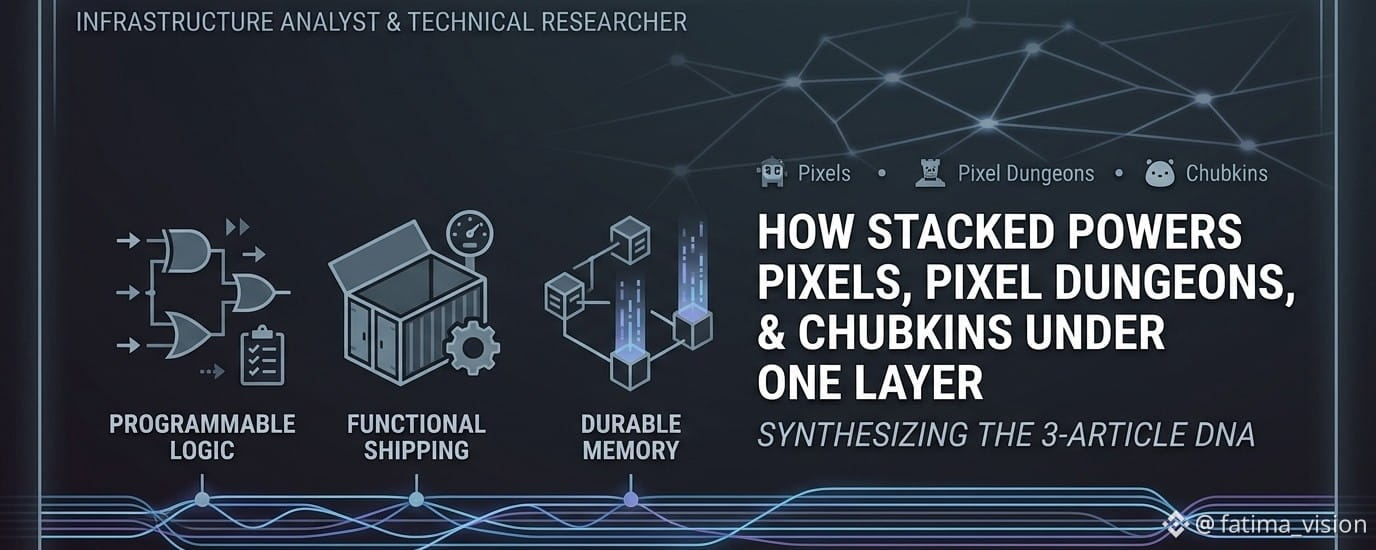
I keep noticing a fundamental shift in how we think about game state and asset ownership across these three specific ecosystems. We are moving away from pixels as isolated art files and toward pixels as programmable layers of coordination. In systems like Pixels and Pixel Dungeons, the asset is no longer a static entry in a database. It is a live logic gate.
When you look at Stacked, you see the infrastructure that allows these disparate entities to share a unified state layer. It is not about a shared "metaverse" vibe. It is about a shared verification layer.
The difference is subtle but the implications for developers are massive.
Most people focus on the floor price of a Chubkin or the cosmetic appeal of a Pixel Dungeon map. That is market hype. The real work is in the unsexy mechanics of how a Chubkin’s traits are actually read and processed by a third party environment without breaking the original logic.
Shipping functional tools in this space is harder than the whitepapers suggest. i have seen many teams fail because they optimize for the "vibe" of interoperability instead of the actual coordination of data. Stacked provides the piping, but the individual projects must still build for strict verification.
If the logic is not programmable, it is not scalable.
The gap between a functional game and a truly durable digital world is larger than it looks. We have plenty of data, but we lack continuity. When a player moves an asset from the farm in Pixels into a different competitive environment, the proof of that asset’s history often disappears. This is the memory gap.
data is useless if it loses its meaning the moment it crosses a digital border.
For Chubkins to mean something five years from now, their attestations must remain legible. we are currently building systems that remember the "what" but forget the "why" and the "how." The infrastructure at the core of this stack must act as a durable memory bank that preserves the integrity of the asset across every pixelated world it enters.
The shipping reality is that most systems are still too fragile for this kind of cross-chain or cross-game pressure. but the shift toward programmable logic layers is the only way to bridge the gap between temporary entertainment and permanent digital infrastructure.
Coordination is the only metric that matters for long term survival.