
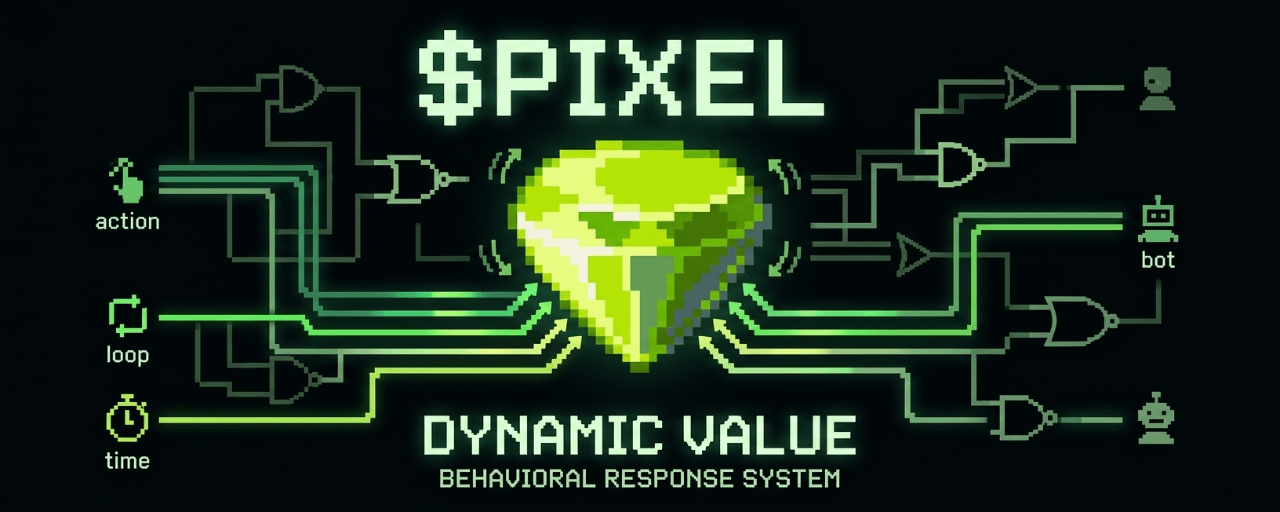
I did not notice this at first while interacting with Pixels. It only became clear after a few sessions where my outcomes did not match my effort. I spent similar time, followed similar loops, but the results were inconsistent. That was the moment I stopped looking at the game as a farming environment and started asking a different question: what exactly is the system reacting to?
In many game models, behavior is recorded and analyzed later. You act first, the system evaluates later. Here, it feels like evaluation is happening in parallel with your actions. That creates a different experience. Instead of a fixed loop, the environment starts to feel conditional, as if what you see and get is partially shaped by how the system interprets you over time.
A simple example is how two players can follow nearly identical routines but diverge in outcomes after a few days. One continues progressing at a steady rate, while the other starts to feel diminishing returns. At first, it looks random. But after repeating this pattern, it becomes harder to ignore that the system may be weighting behavior differently, not just counting it.
This is where Stacked starts to make more sense to me, not as an expansion, but as a system layer that connects behavior to response. Instead of waiting for manual adjustments or predefined updates, it allows the system to react continuously. If a group of players begins to disengage at a certain point, the system does not just log it. It can reshape what those players experience next, whether through access, pacing, or incentives.
From a technical perspective, this reduces the gap between signal and execution. Behavior is not just data sitting in storage. It becomes an active input that influences outputs in near real time. That changes how you think about interaction, because the loop is no longer static.
The role of $PIXEL also feels different under this structure. It is easy to see it as something you earn through actions, but in this context, it looks more like a reflection of how the system evaluates those actions. In other words, it is not just generated, it is assigned based on interpretation.
I also started thinking about how this system handles edge cases. If behavior becomes the key signal, then imitation becomes the obvious strategy. Bots or optimized users will try to replicate patterns that appear valuable. That means the system has to continuously adjust how it reads those patterns, otherwise it becomes predictable. This suggests that part of its strength comes from operating in a live environment where these interactions have already been tested and refined.
What makes this interesting is not a single feature, but the direction. If this structure expands across multiple games through Stacked, then behavior from different environments has to be interpreted under a shared logic without losing nuance. That is not simple, because each game produces different types of signals.
I am still observing how consistent this feels over longer periods, but the shift is already noticeable. It no longer feels like I am just playing within a designed loop. It feels like I am interacting with a system that is continuously forming a view of my behavior and adjusting around it.
That is a very different foundation compared to static systems, where actions lead to predictable outputs regardless of context.