
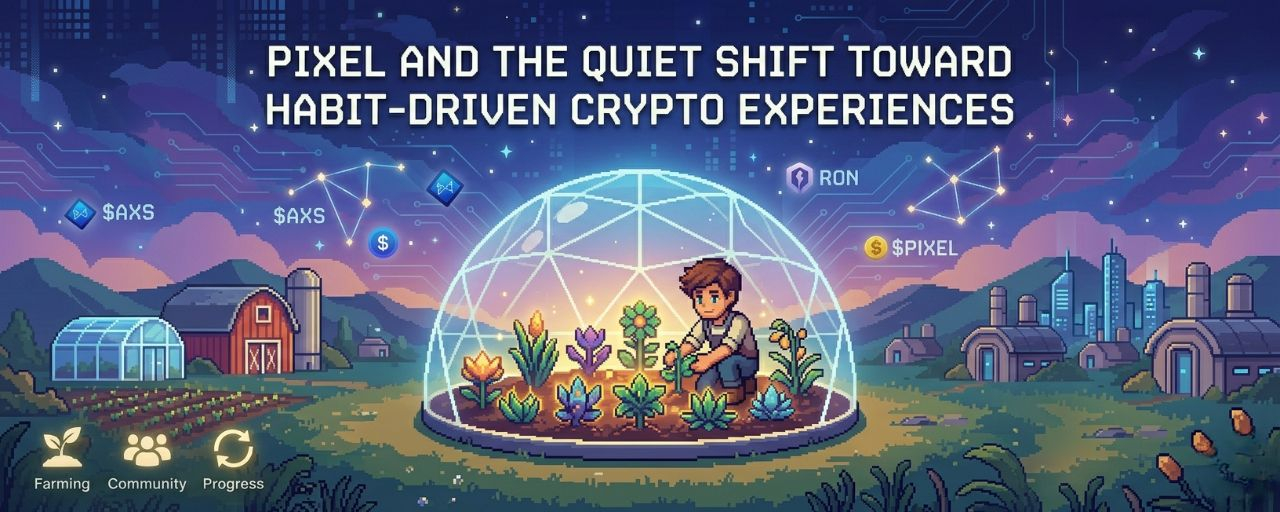

Lately, I’ve been noticing something small but persistent in how people move through crypto not in what they say, but in what they actually do. There’s less obsession with “being early” and more quiet drifting toward things that simply hold attention. Not necessarily because they’re revolutionary, but because they’re… sticky. Familiar. Almost ordinary.
For a long time, the space was built on a kind of idealism decentralization, ownership, transparency. But if I’m being honest, most users never really showed up for those reasons. They stayed when there was something to do, something that rewarded their time in a way that felt immediate, even if shallow. The narratives were philosophical, but the behavior was practical.
That’s why projects like Pixels don’t feel like a sudden innovation to me. They feel more like an adjustment a response to this quiet shift where attention matters more than ideology. An open-world farming game on a blockchain doesn’t sound particularly disruptive on paper. In fact, it sounds almost regressive, like something we’ve already seen in Web2 a dozen times.
And maybe that’s the point.
What’s different now isn’t the concept of farming or casual gameplay it’s the environment around it. The infrastructure has matured just enough that these kinds of experiences can exist without constantly reminding you that they’re “on-chain.” The Ronin ecosystem, for example, isn’t trying to impress users with technical depth; it’s trying to remove friction. That alone says a lot about where priorities are shifting.
I think we’re moving away from this assumption that users care deeply about ownership mechanics. They don’t wake up thinking about token standards or decentralization layers. They respond to incentives, loops, and habits. If tending a virtual farm creates a rhythm that feels rewarding even in a small way that’s often enough. The blockchain part becomes secondary, almost invisible.
But that creates an uncomfortable question: if users are primarily driven by incentives, what happens when those incentives fade? We’ve seen it before entire ecosystems that looked alive, only to hollow out once rewards dried up. So when I look at Pixels, I don’t just see a game; I see an experiment in whether engagement can outlast extraction.
There’s also something interesting about the tone of these kinds of projects. They’re not trying to sell a grand vision of the future anymore. They’re quieter, more grounded. Almost as if they’ve accepted that most people don’t want to rethink the internet they just want something mildly enjoyable that doesn’t waste their time.
And yet, there’s still a tension there.
Because even if the experience feels simple, the underlying systems are not. Token economies, asset ownership, progression loops they all have to be carefully balanced, or the whole thing starts to feel transactional instead of playful. That balance is harder than it looks, especially in a space where speculation is always lurking just beneath the surface.
I guess what makes Pixels feel relevant right now isn’t that it’s doing something entirely new. It’s that it aligns with how behavior is already changing. Less theory, more habit. Less promise, more presence.
Still, I can’t tell if this is where things are actually heading, or if it’s just another phase a softer version of the same cycle. Maybe the market is finally ready for experiences that don’t need to shout to survive.
Or maybe we’re just getting better at disguising the noise.
