
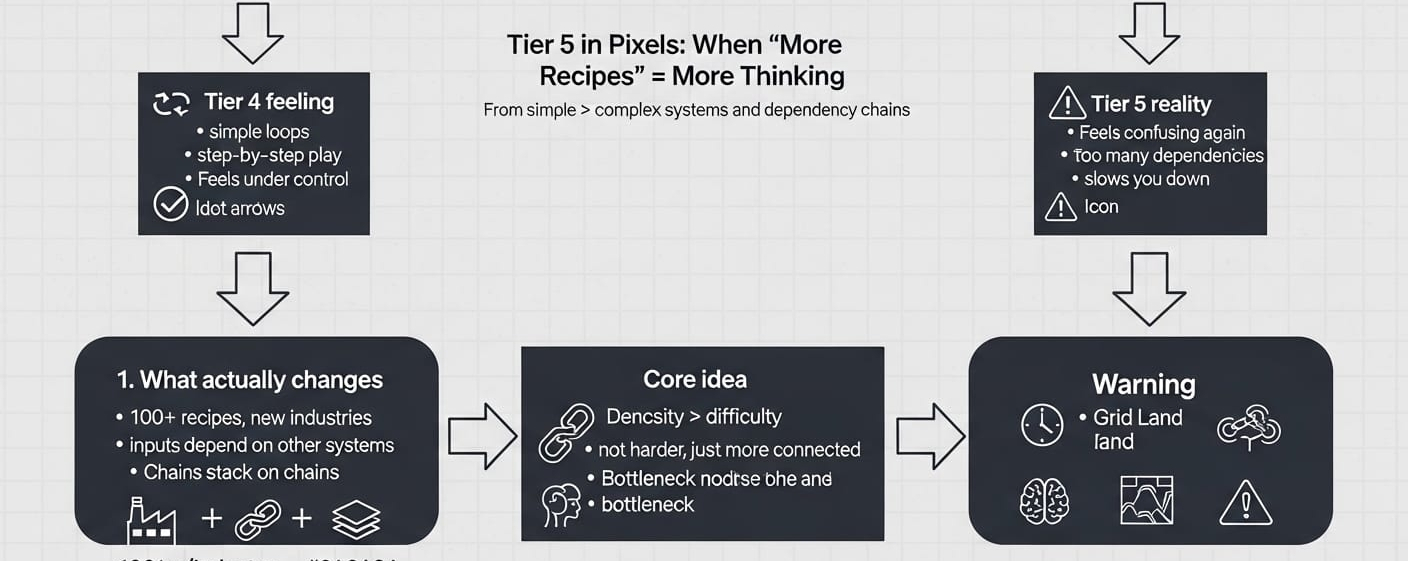
i swear i walked into Tier 5 like i was some pro. Tier 4 had me feeling confident, like ok i got the loop now, i know my industries, i know my timing. then i opened Tier 5 and boom… i felt lost again. not because it’s impossible, but because it feels like the game purposely slows you down so you start respecting decisions again.
on the surface Tier 5 looks like simple expansion. new industries, 100+ recipes, new materials. but the real change is density. in Tier 4 you can often think in steps: do this, wait, harvest, repeat. in Tier 5 you have to think in systems. one input depends on two older industries. those industries depend on upgraded land setups. suddenly “more recipes” isn’t content, it’s dependency chains stacked on dependency chains.
when i first checked crafting needs for a Tier 5 industry, the numbers didn’t look scary alone. few new chains, some refined outputs, couple intermediate steps. but when you trace the path, you realize it’s resource compression. lower tier materials that used to feel cheap now get pulled upward into tighter loops. wood becomes processed goods, processed goods become industrial inputs, and those inputs feed one Tier 5 output that actually matters. so the bottleneck isn’t always grind, it’s planning.
that’s why a lot of players stall early. not because they’re lazy. because they don’t stabilize the flow. like imagine your first Tier 5 industry needs 3 new materials. each material needs 2 sub-recipes. now you got 6 production paths. even if each path takes 10 min to stabilize, that’s an hour just to get the flow working, not even producing real output yet. and the game doesn’t explain this in a big tutorial. it lets you feel it, which is kinda brutal but also smart.
Tier 5 also changes the main constraint. earlier tiers felt like time was the enemy. you wait, harvest, repeat. now coordination is the enemy. you can have all the time, but if your chain is not aligned, you stall. that creates a diff type of advantage: not whales, not pure grinders, but organizers. people who think one step ahead win.
there’s also the sequencing lesson. you don’t start by rushing the Tier 5 structure. you start by stabilizing dependencies. ask yourself: can my existing industries sustain output without me babysitting it? if no, Tier 5 feels slow. if yes, Tier 5 becomes a multiplier.
rushing can backfire too. if you dump everything into one Tier 5 build, the system becomes fragile. one missing input and the whole chain stops. but if you build support industries first, it takes longer but your output becomes steady. and Tier 5 is about steady, not spikes.
land management makes it even tighter. Tier 5 adds industries but your land doesn’t expand same rate. so every tile matters more. placement decisions get expensive. players who ignore layout early end up rebuilding mid-process, wasting time in restructuring, not crafting.
and the market reacts too. longer supply chains make early materials valuable again. Tier 4 inputs can become Tier 5 bottlenecks. even small demand changes can create scarcity if supply doesn’t adjust. so not everyone has to rush Tier 5 crafting. some can profit by producing key inputs and selling into spikes.
Tier 5 isn’t just more stuff. it’s a test: can the game support layered economies where players don’t just consume systems, they sustain them. complexity can push some people away, sure. but if balance is right, it rewards thinking without killing curiosity. and once you start asking “what will i need in 30 minutes,” you stop reacting and start building a network. that’s when Pixels feels less like tasks and more like structure.