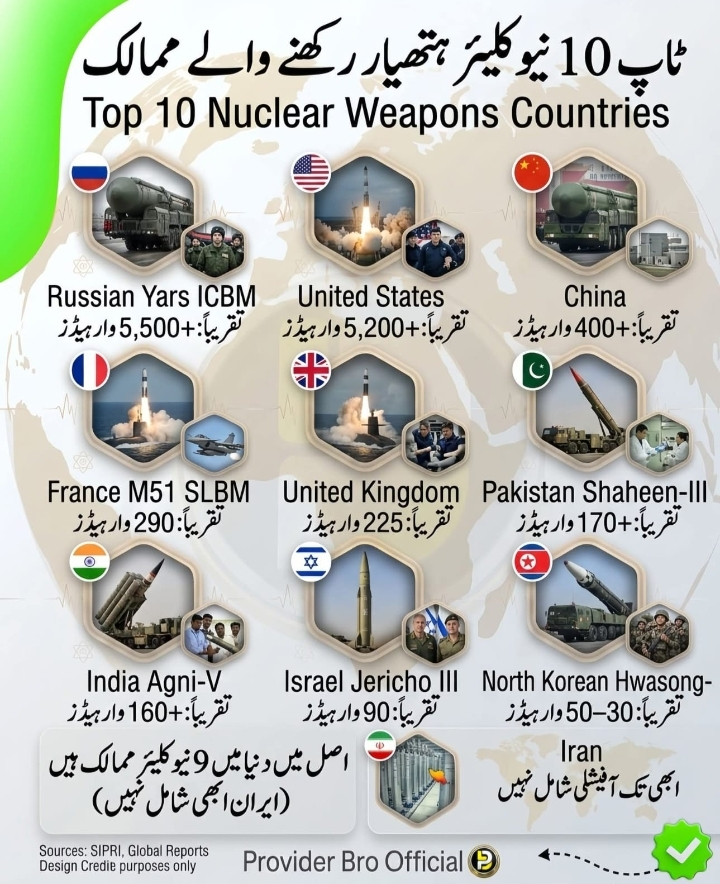
Nuclear weapons remain one of the most powerful and controversial elements of global military strength. As of 2025–2026, there are nine countries that possess nuclear weapons, despite the common misconception that there are ten. These nations hold a combined total of more than 12,000 nuclear warheads, with the majority concentrated in just two countries.
1. Russia
Russia possesses the largest nuclear arsenal in the world, with over 5,400 warheads. It maintains a vast stockpile of both deployed and reserve weapons, along with advanced delivery systems such as intercontinental ballistic missiles (ICBMs) and submarine-launched ballistic missiles (SLBMs).
2. United States
The United States holds around 5,100 nuclear warheads. It has one of the most technologically advanced nuclear forces, supported by a powerful nuclear triad consisting of land, sea, and air-based systems.
3. China
China has approximately 600 nuclear warheads and is rapidly expanding its capabilities. It is investing heavily in modernizing its missile systems and increasing its nuclear stockpile.
4. France
France maintains around 290 nuclear warheads. Its nuclear deterrence strategy is primarily based on submarine-launched missiles and air-delivered weapons.
5. United Kingdom
The United Kingdom has about 225 nuclear warheads. Its nuclear capability is mainly sea-based, relying on its fleet of nuclear-powered submarines.
6. India
India possesses roughly 180 nuclear warheads. It continues to develop its nuclear triad and enhance its missile technology.
7. Pakistan
Pakistan is estimated to have around 170 nuclear warheads. Its nuclear program focuses on maintaining strategic balance in the South Asian region.
8. Israel
Israel is believed to have approximately 90 nuclear warheads, although it has never officially confirmed its nuclear weapons program.
9. North Korea
North Korea is estimated to possess around 50 nuclear warheads. Despite its smaller arsenal, it remains a significant concern due to ongoing missile testing and regional tensions.
Key Insights
Russia and the United States together control nearly 85–90% of the world’s nuclear weapons.
China is rapidly increasing its nuclear capabilities, signaling a shift in global power dynamics.
India and Pakistan maintain nuclear arsenals primarily for regional deterrence.
North Korea, though smaller in scale, poses strategic risks due to its unpredictable policies.
Conclusion
While only nine countries currently possess nuclear weapons, their impact on global security is immense. Efforts such as arms control treaties and non-proliferation agreements continue to play a critical role in preventing the spread of these weapons. However, evolving geopolitical tensions mean that nuclear capabilities will remain a central issue in international relations for years to come.