
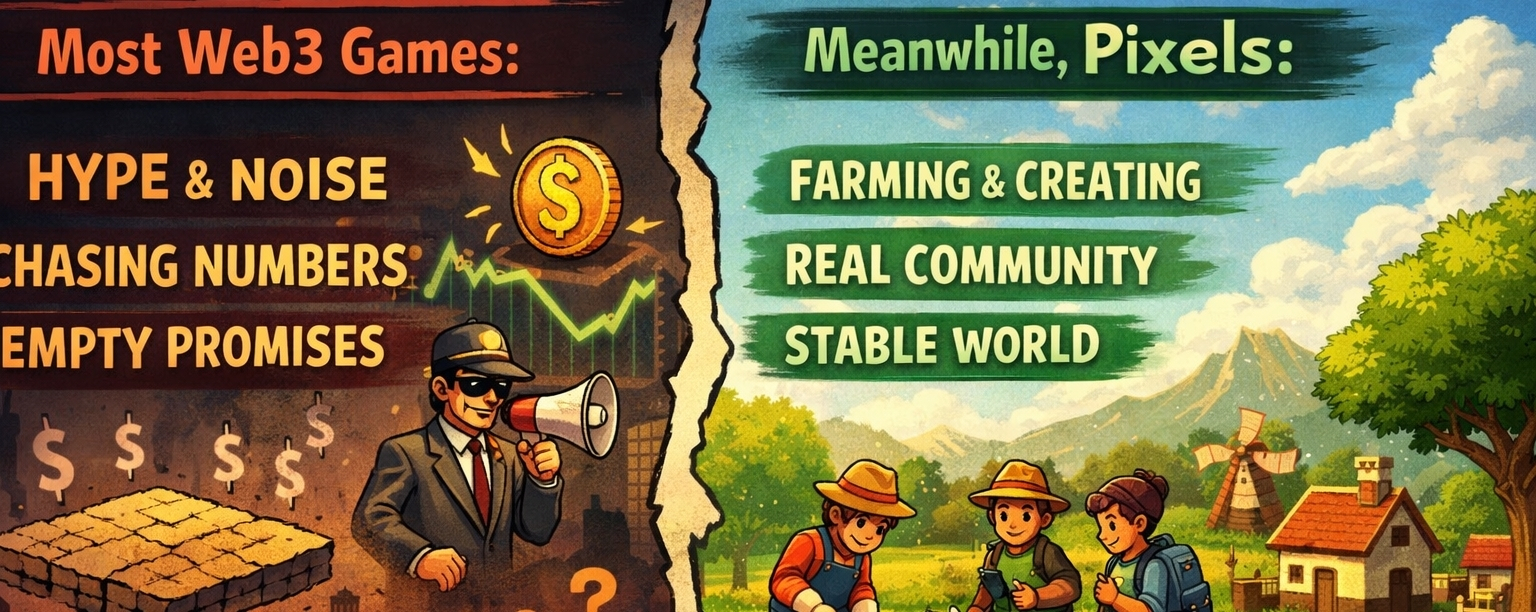
I keep seeing the same pattern with Web3. People get excited fast. Too fast. A token starts moving, a community gets loud, a roadmap gets dressed up like prophecy, and suddenly everyone is speaking in this strange confident tone like the thing has already proven itself. But most of the time, when you sit with it for more than five minutes, it starts to feel thin. Too much noise around something that hasn’t really entered real life.
That’s what makes Pixels interesting to me.
Not because it’s perfect. Not because I think every Web3 game deserves credit for existing. Most of them don’t. Most of them still feel like financial systems wearing game skins, asking people to confuse extraction with fun. They say it’s about ownership, freedom, participation. Fine. But if the actual experience feels hollow, then what are people really owning? A position? A hope? A digital object floating inside a world they don’t even enjoy being in?
That’s the part nobody wants to say out loud.
A game has to work as a game before any of the Web3 language means anything. It has to give people a reason to come back when the market is boring. When nobody is farming attention on the timeline. When the price is not doing the marketing for you. And Pixels feels like one of the few projects that gets that. It starts somewhere much more grounded. Farming, exploring, creating, meeting people, building routines. Simple things. Human things. The kind of loop people understand without needing a thread, a chart, or a manifesto.
That matters more than hype ever will.
Because real products usually enter people’s lives quietly. They don’t arrive with a speech. They become part of someone’s day because they make sense there. Same in business. Same in games. Same in almost every system that actually lasts. A café doesn’t survive because its branding sounds revolutionary. It survives because people come back. A tool doesn’t matter because the founder uses big words. It matters because it saves time and keeps working. Pixels gives me more of that feeling than most crypto projects do. Less theater. More function.
And the Ronin side of it matters too, but only in the way good infrastructure matters anywhere else. Not as a slogan. As support. If the rails are smooth, people stay inside the experience. If the rails are clumsy, the whole thing starts feeling like homework. That’s where so many Web3 products fail. They ask normal people to tolerate bad design in exchange for some future promise. Most people are not interested in promises anymore. They want something that works now.
That’s why Pixels stands out to me. It doesn’t feel like a fantasy trying to impersonate reality. It feels closer to a real product with real behavior behind it. And in a space this crowded with performance, that kind of honesty is hard to miss.
