
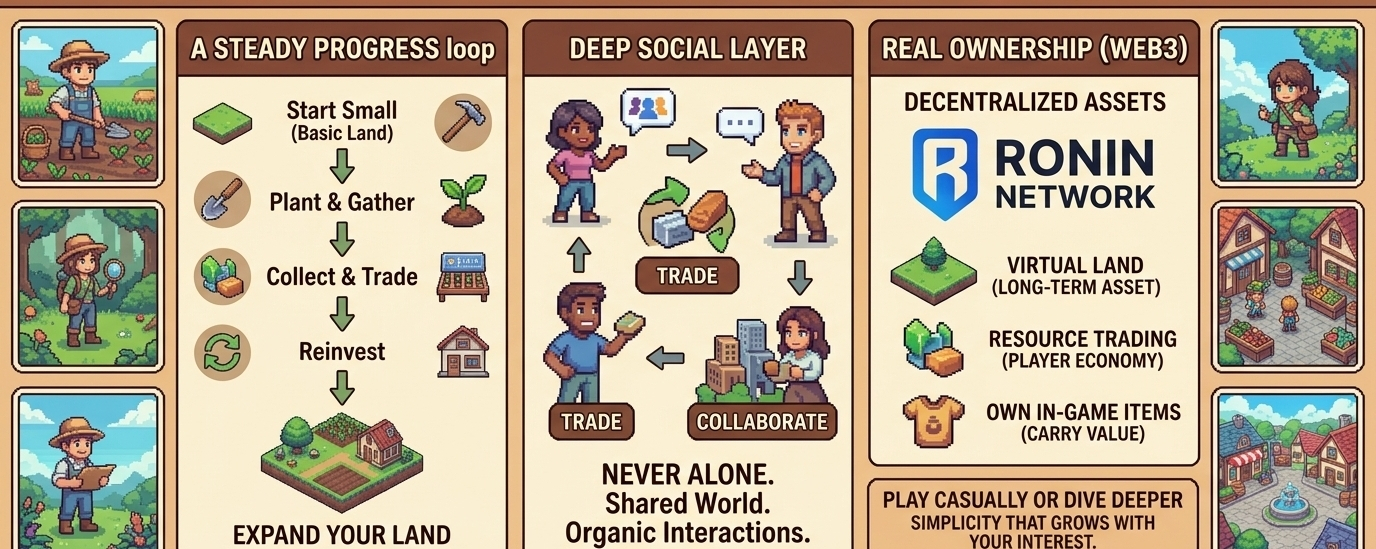
Pixels (PIXEL) is a social Web3 farming game built around a simple idea that feels surprisingly refreshing in today’s fast paced gaming world: what if a game didn’t rush you, but instead let you build, explore and connect at your own pace?
At its core Pixels is an open world farming and life simulation experience where players enter a pixel style universe and slowly build their own space. You start small with basic land, a few tools, and simple tasks like planting crops or gathering resources. But as you spend more time in the world, it gradually expands into something much bigger exploration trading, social interaction and creative building all become part of your daily gameplay loop.
The game runs on the Ronin Network, a blockchain ecosystem designed specifically for gaming. This allows Pixels to combine traditional gameplay with Web3 mechanics, meaning players can have real ownership over certain in game assets while still enjoying a smooth game first experience. Importantly, you don’t need to understand blockchain technology to play. Everything is designed to feel natural with Web3 features working quietly in the background.
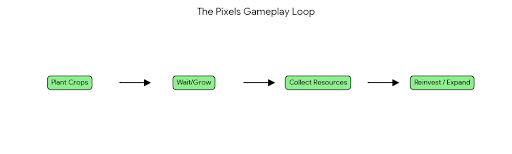
The gameplay itself is built around a relaxing cycle. You farm crops, wait for them to grow collect resources, and reinvest them into expanding your land. Over time this simple loop evolves. You unlock new areas, discover additional resources, and begin shaping your own personal space within a shared world. Unlike competitive games that push constant pressure, Pixels focuses on steady progress and personal freedom.
But what truly brings the game to life is the social layer. You are never alone in the world. Other players are constantly around you farming, trading, building, and exploring just like you. This creates a living, breathing environment where interactions happen naturally. Sometimes it’s a simple trade. Sometimes it’s passing by another player working on their land. These small moments build a sense of shared presence that feels more organic than traditional multiplayer systems.
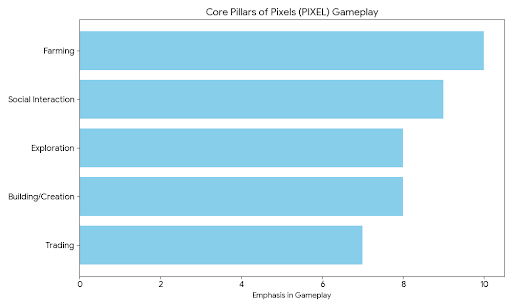
One of the key features of Pixels is its farming and resource system. Players can plant crops, harvest them over time and use those resources for upgrades or trading. This creates a steady in-game economy where time and activity directly contribute to progress. Alongside farming, exploration plays a major role. As the world expands, players can move into new regions discover different materials, and unlock more advanced gameplay opportunities.
Another important feature is creation and land development. Players are not limited to farming alone. They can shape their environment, expand their land, and gradually build a personalized space that reflects their journey in the game. This sense of ownership is one of the strongest parts of Pixels—it turns time spent in-game into something visible and meaningful.
The Web3 layer adds another dimension to this experience. In Pixels certain in-game assets can be owned by players in a way that extends beyond traditional gaming systems. Items, resources, and progress are not just temporary achievements within a closed ecosystem. Instead, they can exist as player-owned assets, creating a player-driven economy where value is shaped by participation and activity.
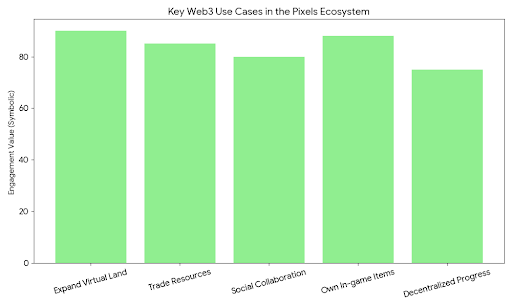
This opens up real use cases within the Pixels ecosystem. Players can:
Build and expand virtual land over time as a long-term asset
Farm and trade resources within a player-driven economy
Participate in a social world where collaboration and exchange matter
Own in game items that carry value beyond gameplay
Engage in a decentralized gaming environment where progress is not locked to a single platform
Despite these deeper mechanics, the experience never feels complicated. One of Pixels’ strongest design choices is its simplicity. You can play it casually, focusing only on farming and exploration, or you can dive deeper into its economic and ownership systems. The game never forces you into complexity it grows with your interest.
Visually, Pixels uses a clean pixel art style that enhances its relaxing atmosphere. It avoids overwhelming detail and instead focuses on clarity and nostalgia. This design choice makes the world feel approachable, almost like stepping into a familiar digital space where creativity matters more than visual intensity.
In many ways, Pixels succeeds because it understands something important about modern gaming: not every experience needs to be high-pressure or competitive. Sometimes players just want a world they can return to, where progress feels steady and interactions feel real.
Whether you’re farming quietly, exploring new areas, trading with others, or slowly building your own space, Pixels creates an environment that feels alive without ever feeling demanding. It is a blend of casual gaming, social interaction, and Web3 ownership, designed in a way that stays accessible while still offering depth for those who want it.
At its heart Pixels is not just about farming or building. It’s about presence being part of a shared world that moves at a human pace, where every small action contributes to something larger over time.