
I wasn’t planning to pay attention to Pixels at first.
It looked like another familiar loop in Web3 gaming: soft visuals, farming mechanics, incremental upgrades, and the usual promise that “this time it’s different.” You’ve seen enough of those pitches to recognize the pattern early—gameplay first, token second, hype somewhere in between.
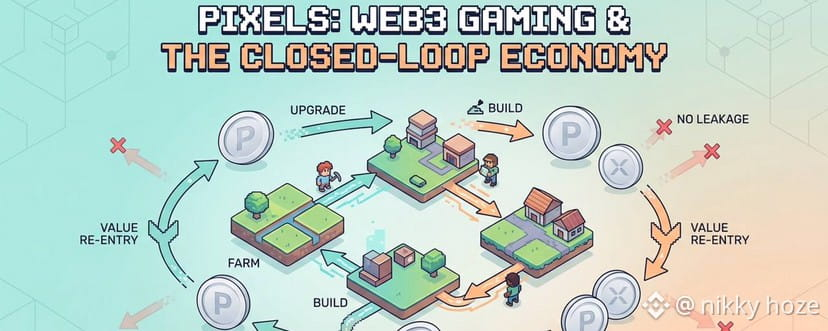
But Pixels doesn’t actually behave like a traditional “play-to-earn” pitch when you sit with it longer. The interesting part isn’t the farming, or even the social layer. It’s the way value circulates inside the system.
In most crypto games, the economy leaks. Tokens are earned in-game, then immediately exit—players cash out, speculation dominates, and the in-game economy slowly bleeds liquidity. That creates a constant pressure: new users are needed just to replace the capital that left.
Pixels is trying to tighten that loop.
Instead of treating the token as something that naturally exits the system, it leans into the idea of internal velocity. Players don’t just earn and withdraw—they spend, upgrade, re-enter, and re-stake within the ecosystem itself. Land, resources, tools, cosmetics, progression systems—all of it is designed to keep value circulating inside rather than leaking out.
That’s where the real shift happens.
Because once you stop assuming tokens are meant to leave, the design philosophy changes completely. You’re no longer building a cash-out funnel. You’re building a closed economic circuit where behavior itself becomes demand.
What Happens When Tokens Don’t Leave the Ecosystem?
This is the uncomfortable question most Web3 games avoid.
If tokens don’t leave, three things tend to happen:
First, internal demand becomes the only real demand. Players are no longer competing with external buyers or sellers. They are competing with each other for resources, upgrades, status, and progression. The economy becomes self-referential.
Second, value shifts from extraction to positioning. Instead of “how much can I earn and withdraw,” the question becomes “what position do I hold inside the system that gives me continued advantage?” That changes user behavior from short-term farming to long-term optimization.
Third, and most importantly, the token stops behaving like money and starts behaving like energy inside a closed loop. It moves fast, but mostly within boundaries. That can stabilize an ecosystem—but it also means the system must constantly generate reasons to spend, or it stagnates.
And that’s the tension.
A closed-loop economy is powerful when it’s alive, because it reduces leakage and strengthens internal coordination. But it also risks becoming insular—where value only exists because participants agree to keep circulating it, not because external demand validates it.
So when people say “Pixels is just a game,” they’re missing the deeper experiment.
It’s not just about farming mechanics or visuals.
It’s about whether a digital economy can sustain itself when tokens stop being treated as exit liquidity—and start being treated as circulating infrastructure inside a controlled system.
And that question doesn’t have a clean answer yet.