
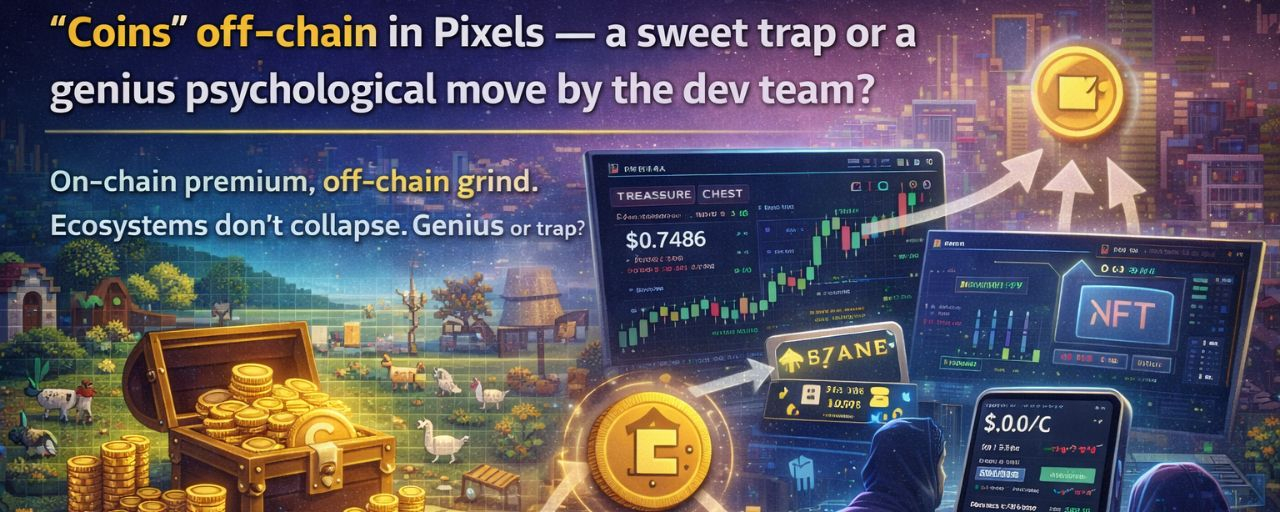
Honestly I was pretty skeptical when I first heard about the off-chain "Coins" mechanic in Pixels. Like, yet another in-game currency? Sounds unnecessarily complicated at first glance. But after sitting down and reading through the roadmap and the project's history properly, I actually think this is one of the smartest decisions the Pixels team has ever made, and I feel like a lot of people are completely sleeping on it.
To understand why, you have to rewind a little. Pixels used to run on two tokens, an on-chain one called PIXEL, and an in-game one called BERRY. On paper that model seemed reasonable, but the problem was BERRY was too easy to farm, players would just grind and dump constantly, creating non-stop sell pressure across the entire ecosystem. The result was that PIXEL's asset value kept getting dragged down even though the game still had a decent player base. This wasn't a bad game problem, it was an economic design problem, and a ton of Web3 games have died from exactly this issue.
So what does off-chain Coins actually solve? Simply put, Coins is the currency you earn while playing the game but it doesn't exist on the blockchain. You can't take it to an exchange and sell it, you can't directly convert it into real money. It only exists and holds value inside the game's ecosystem. This creates an incredibly important buffer layer. Players still feel like they're earning something when they put time into the game, they still have rewards to reinvest into in-game activities like farming, crafting, or joining guilds, but none of that creates sell pressure on PIXEL anymore. The entire internal economic loop runs on Coins, while PIXEL is reserved for genuinely important actions like minting NFTs, buying VIP passes, and participating in high-level guild events.
In more practical terms this is how the dev team separates two completely different user groups. One group is pure players, they come for fun, earn Coins, spend Coins, don't care much about crypto. The other group is investors and serious players who hold PIXEL because that token carries real privileges in the ecosystem. When these two groups no longer economically step on each other, sell pressure drops significantly on its own.
I've seen a few other Web3 game projects try to do something similar and fail because they lacked consistency. What's clever about Pixels is they simultaneously removed BERRY entirely, they didn't keep the old system running in parallel. That's a tough call and in my opinion the right one. Usually projects shy away from doing that because they fear backlash from the existing community, but long term, keeping an inflationary token just to appease a portion of users only hurts the entire system further.
Chapter 2 that the team is preparing to roll out in three to four month cycles also integrates guilds and exploration, meaning there will be far more reasons for players to actually need PIXEL rather than just holding and waiting. When real utility genuinely increases, natural demand follows, and since supply isn't being pressured by in-game farming anymore because Coins can't leave the ecosystem, theoretically the asset value of the token will more accurately reflect the project's true health.
To be clear I'm not saying Pixels is a perfect project or a guaranteed success. Web3 gaming still carries enormous risks, team execution, the broader market, or simply whether the game is fun enough to retain users long term, those remain open questions with no certain answers. But judged purely on economic design, the off-chain Coins mechanic is a move with genuine depth and I think it's worth watching closely in the coming quarters.
What do you think? Is this model actually sustainable or is it just another new loop?@Pixels $PIXEL #pixel