Whenever I look at crypto-based games, I tend to ignore what the game claims is important and instead observe what players naturally gravitate toward. That difference often reveals far more. Certain actions get repeated excessively, some features that seem optional slowly become essential, and specific loops turn into habits without any explicit instruction.
Lately, I’ve been looking at Pixels through that lens — not just as a game tied to a token, but as something closer to a growing ecosystem. In this setup, the token doesn’t just reward activity; it quietly shapes what actually matters within the system, leaving other parts as mere decoration.
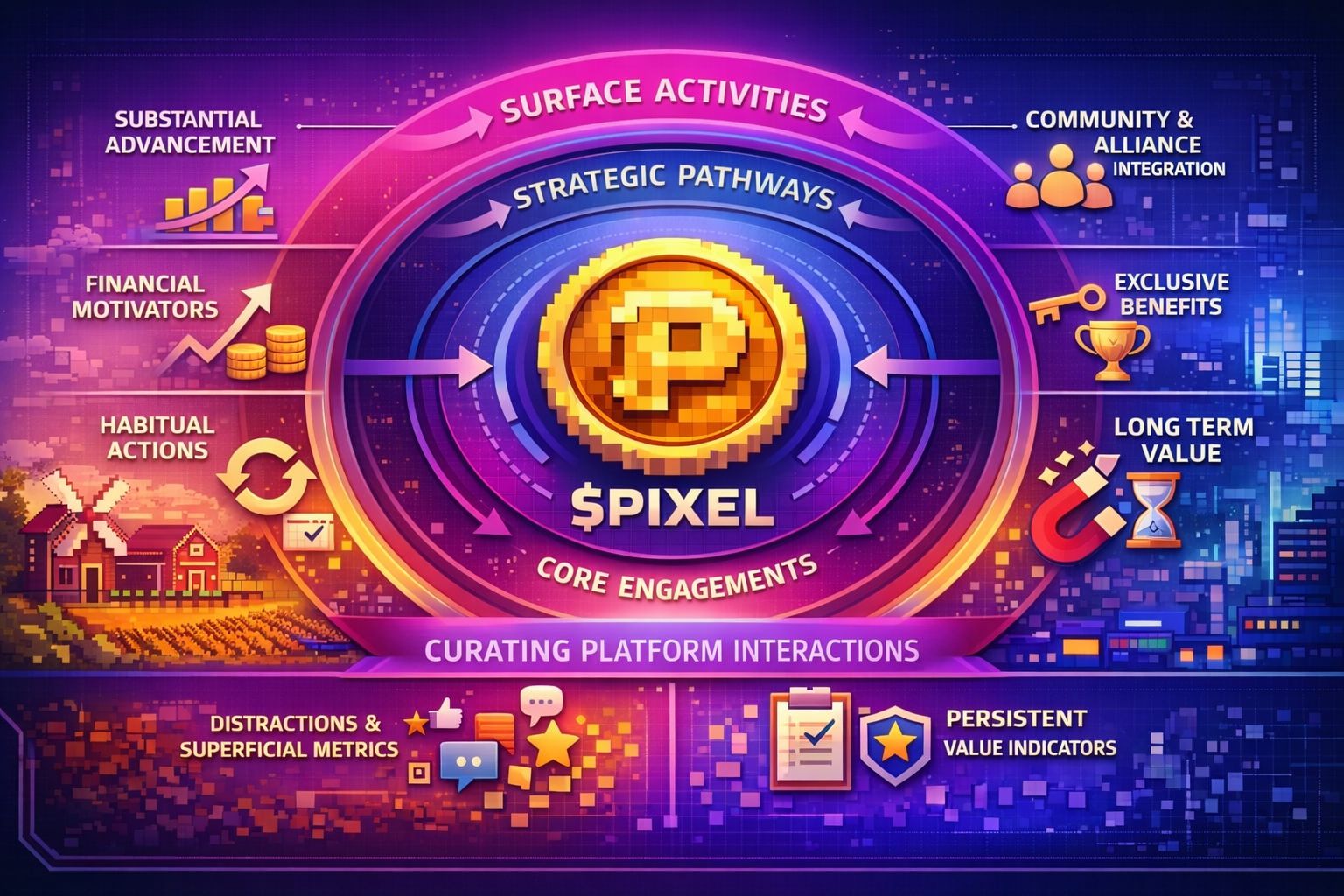
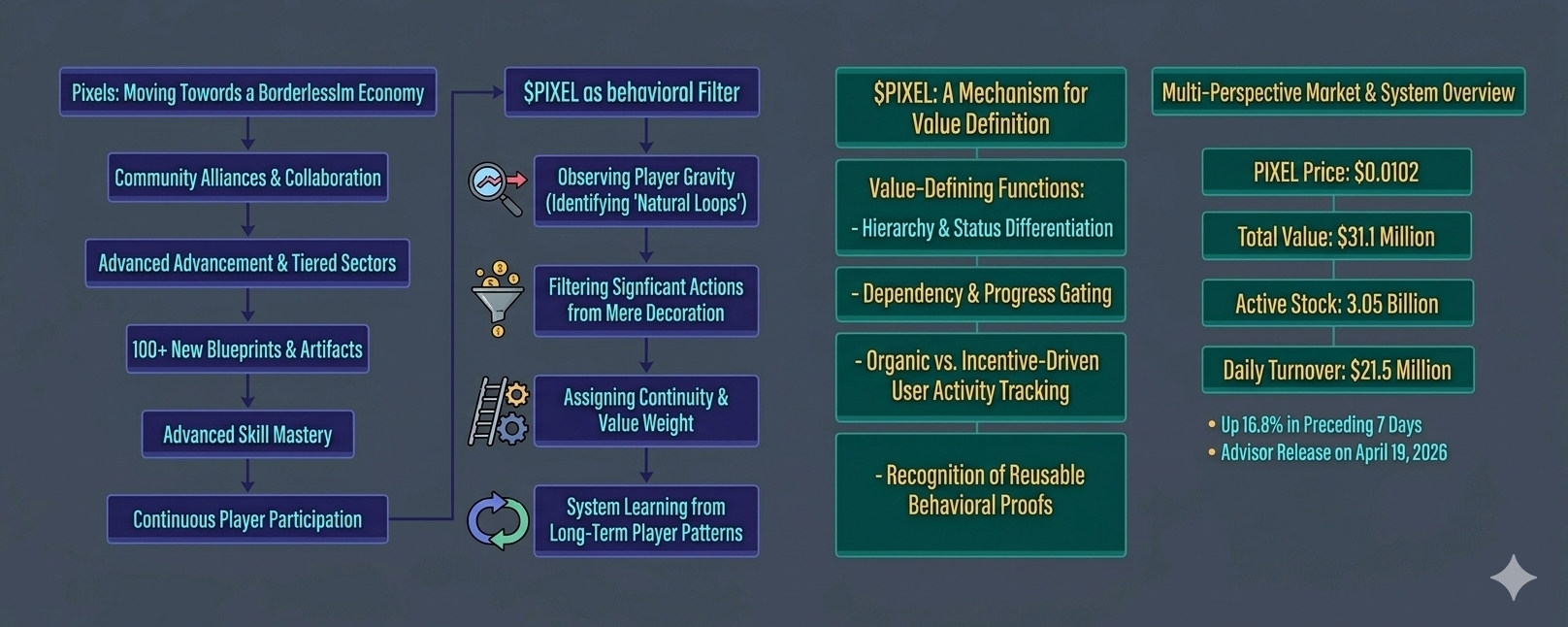
At first glance, this idea feels obvious. Tokens influence behavior — that’s expected. But there’s something deeper happening. As a game evolves into a platform, the number of available activities becomes less important than the ones players consistently choose and repeat. What truly matters is what the system can recognize, rank, and build upon over time. In that sense, PIXEL begins to act less like a reward and more like a filter — deciding which actions gain significance.
This shifts how growth should be understood. A platform can continuously add new features — zones, quests, social layers, and progression systems — creating the appearance of expansion. But not every feature holds equal weight. As systems grow, they naturally become selective. That selectivity may not always be obvious, but it appears through subtle factors like accessibility, efficiency, status, or cost. The token becomes part of this filtering process, influencing what’s worth doing and what isn’t.
There’s an important difference between activity and importance. Many crypto platforms look active, but activity alone is cheap. Real demand is reflected in repeated behavior — when users return to the same actions without needing constant incentives. That’s when habits form, and when systems stop resetting from zero every time. At that point, a token either strengthens the platform or exposes its limitations. If $PIXEL simply drives movement, it’s one thing. But if it determines which actions build long-term value, its role becomes far more significant.
Another key distinction is between participation and dependency. Users can casually engage in multiple activities, but dependency forms when one path becomes essential for progress, influence, or coordination. This doesn’t need to be obvious. It might come from better efficiency, stronger social positioning, or access to more powerful systems. Once users feel they can’t afford to lose that path, the token stops being an add-on — it starts defining the hierarchy within the platform.
This is where things become more complex. When tokens influence behavior, they don’t just measure demand — they also create it. Some user activity is organic, driven by genuine usefulness or social engagement. Other activity is incentive-driven, shaped by rewards, rankings, or unlocks. For a while, both can look identical. Metrics rise either way. But the difference becomes clear when incentives fade — one sustains itself, the other collapses.
This idea connects to something like “reusable signals.” While not often discussed in gaming, it’s relevant here. In broader crypto systems, reusable proofs might include credentials or verified histories. In a game-platform context, this could translate to behavior patterns, progression history, reputation, or contribution consistency. Once a platform starts recognizing and building on these signals, it no longer treats every session equally. Some actions gain long-term value, while others remain forgettable.
That’s why PIXEL might matter less as a simple currency and more as a mechanism for assigning weight to different types of activity. Not all gameplay creates meaningful signals. Some actions are repetitive but insignificant, while others generate patterns the system can reuse and build upon. If that’s the case, the token is doing more than rewarding time — it’s deciding which behaviors deserve continuity. And continuity is where real value lies, separating platforms that simply host activity from those that actually evolve around it.
Still, this doesn’t automatically lead to a better system. It can just as easily create limitations. When a token begins defining importance, the platform may over-focus on what it can measure, neglecting aspects that are harder to quantify. This is a common issue in crypto — systems become efficient at tracking actions but struggle to capture deeper meaning.
So yes, Pixels may be growing into something beyond a game. But as it shifts toward being a platform, the real question becomes more complex. It’s not just about user activity or token usage. It’s about whether $PIXEL is gradually deciding which forms of participation truly matter — and ultimately shaping what the platform becomes next.