
The Solana network entered 2026 in style. Despite the volatility of the SOL token price, it recorded the highest economic activity in history, surpassing the $1 trillion mark in a quarter for the first time.
The data shows that this growth is not only driven by speculation, but also by a rapidly growing number of users and a significant increase in transactions. Solana thus confirms its position as one of the most active blockchains today.
Record quarter: $1.1 trillion in motion
According to analytical data, Solana reached a total economic activity (TEA) of $1.1 trillion in the first quarter of 2026, which represents a new historical high.
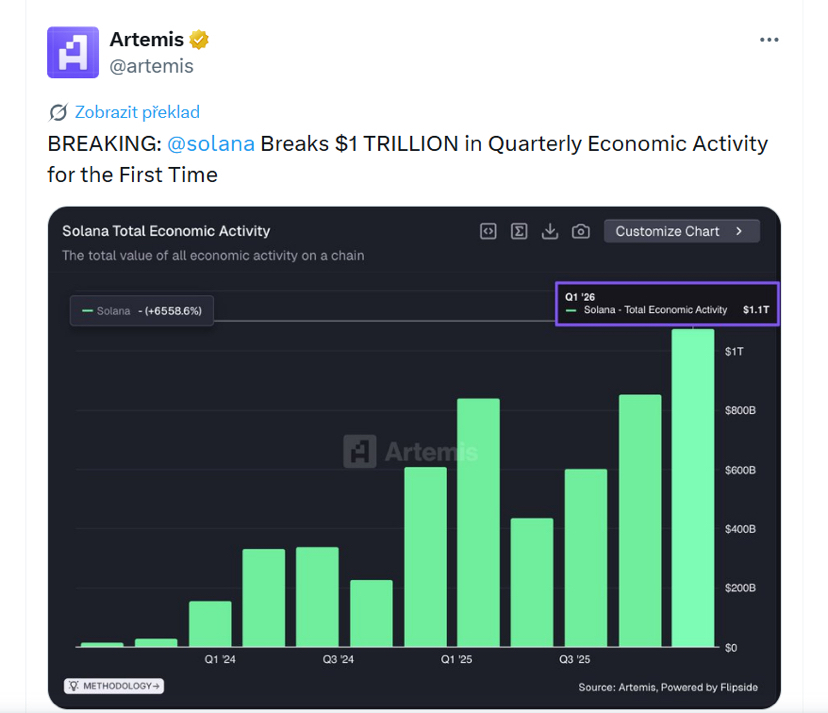
This is a 28.76% increase compared to the previous quarter, while activity increased by more than 30% year-on-year. Even more striking is the long-term trend, with TEA growing by more than 6,500% since Q2 2023.
Interestingly, this growth came even as the SOL price has been weakening since the beginning of the year. This suggests that network activity is not solely driven by the token’s price performance.
Users and transactions as the main growth drivers
A key factor behind the record-breaking quarter was the surge in user base. The number of new users increased from approximately 1.8 million in Q4 2025 to 3.2 million in Q1 2026, a jump of almost 78%.
At the same time, the number of daily active users has also increased. The indicator has moved from 3 million to 4.6 million, or more than 53%.
The trend has also been accompanied by an increase in transaction activity. For the first time in its history, Solana recorded more than 10 billion transactions per quarter, confirming its growing use in practice.
Stablecoins and P2P transfers on the rise
Stablecoins have also played a significant role. The volume of peer-to-peer stablecoin transfers on the network reached $832.7 billion in the first quarter of 2026, which is an increase of more than 60% compared to the previous quarter
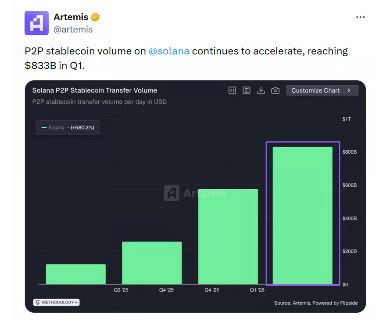
This development suggests that Solana is increasingly being used as an efficient infrastructure for fast and cheap value transfers, not just for speculative trading.
At the same time, growing activity in stablecoins often signals real-world use in payment and financial applications.
Growth despite SOL price decline
One of the most interesting aspects of this development is the fact that the network has grown despite the decline in the price of the SOL token since the beginning of the year.
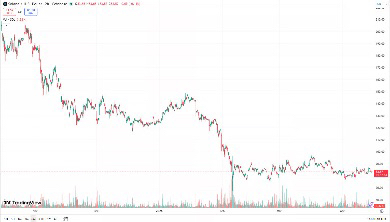
This may indicate strong confidence from both retail users and institutional players. Activity on the network has continued to grow regardless of short-term market developments.
A similar divergence between price and usage is a frequently monitored indicator, as it can reveal deeper trends in technology adoption.
Final Comment
Solana’s results show that blockchain projects do not have to be evaluated solely by the price of their token. Real-world activity, the number of users, and transaction volume provide a much more comprehensive picture of the state of the network.
The record quarter confirms that Solana is able to attract new users and maintain a high level of usage even in a less favorable market environment. At the same time, the question remains whether the trend will continue in future periods or whether it was a short-term fluctuation.
It is also important to note that the term Total Economic Activity itself is not always uniformly defined across different analyses, which can affect the interpretation of the data. Nevertheless, the current numbers clearly indicate a significant shift in the adoption and use of the Solana network.
Do you think the token price or real network activity is more important? Share your opinion in the comments.