
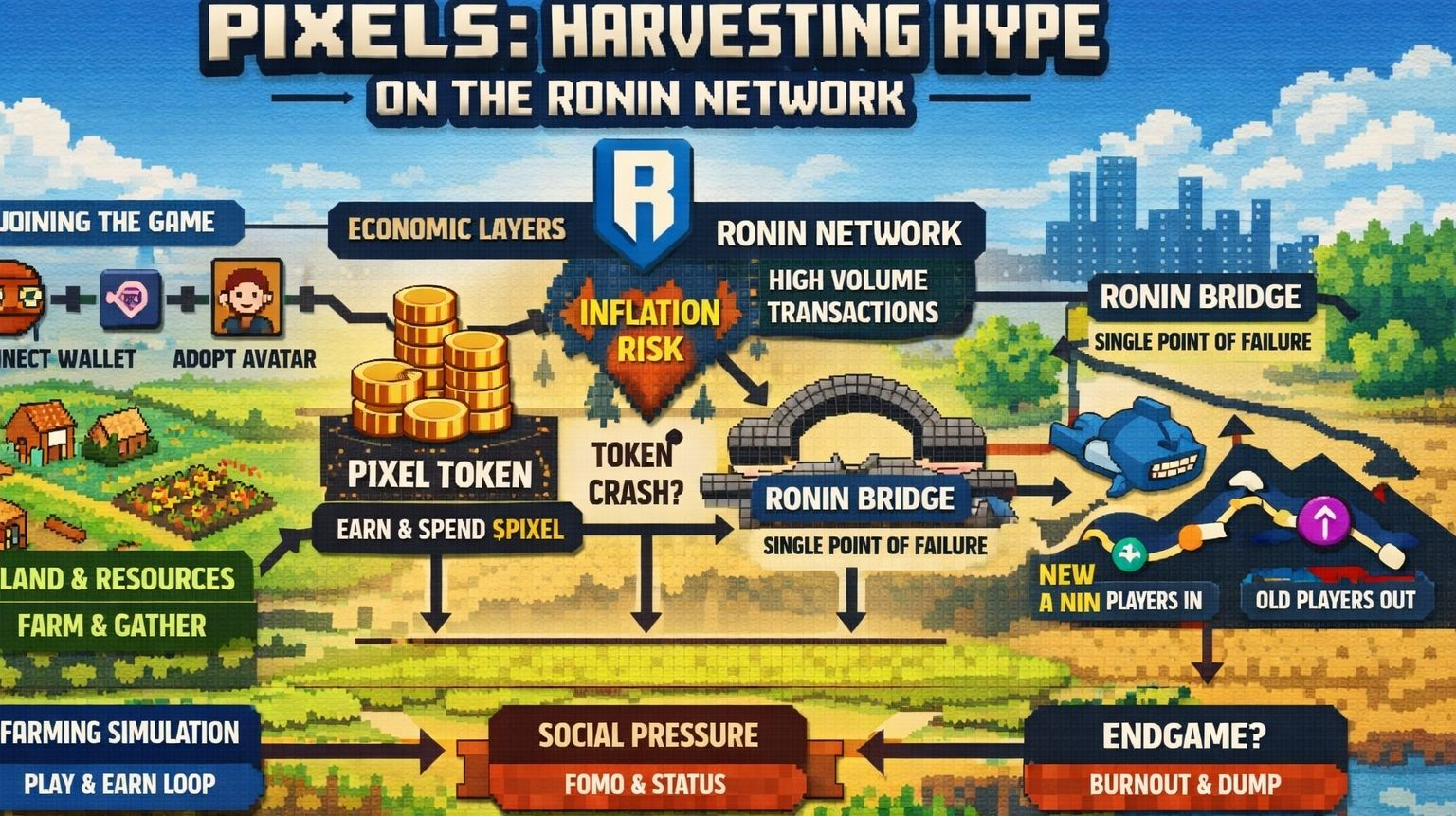
I have been watching the crypto gaming sector for a long time, long enough to remember when the first wave of "play-to-earn" mania swept through the industry like a fever. It felt inevitable that we would see a crash, and we did. Now, sitting here with a lukewarm coffee, I see a familiar pattern emerging with Pixels, a project that has recently migrated to the Ronin Network and is capturing the imagination of a fresh crop of retail investors. It is being pitched as a social casual game, a serene open-world experience involving farming and exploration, but let’s be honest about what we are looking at. This is not just a game; it is an economic experiment dressed in pixelated clothing, and the market is beginning to notice it not because of the gameplay mechanics, but because of the volume on the charts.
The core problem Pixels claims to address is the stark, joyless reality of Web3 gaming. For years, we have watched developers shovel clumsy, transactional interfaces onto a blockchain and call it a product. Users, if we can call them that, were not playing; they were grinding. They were clicking buttons to harvest numbers in a spreadsheet, driven purely by the promise of financial return. The industry has been desperate to solve the retention crisis that comes when the token price dips and the "players" vanish. Pixels posits that the solution lies in shifting the focus from the earn mechanic to the social mechanic, creating a sticky environment where people stay for the community rather than the yield. It sounds lovely. It sounds like every failed gamification strategy I have seen in the last decade, repackaged for a blockchain audience that is desperate for a win.
What most casual observers miss, however, is that the real product here is not the farming simulation. It is the retention layer. The deeper idea at play is the attempt to merge the mindless, addictive loop of mobile farming games with the financialhooks of crypto. By moving to Ronin, a chain built specifically for gaming and notoriously associated with Axie Infinity, Pixels is not just building a game; it is tapping into an existing, battle-hardened liquidity pool. The game itself is merely the user interface for a complex web of token swaps and NFT mints. It is a clever obfuscation. The farming serves to distract the user from the friction of blockchain interactions, smoothing out the harsh edges of gas fees and wallet signatures with the soothing repetition of watering digital crops.
Let’s look at how the system actually functions, stripping away the pastoral aesthetic. At its core, the architecture relies on the Ronin Network, an Ethereum-linked sidechain designed to handle high transaction volumes without clogging the mainnet. Players connect a wallet, adopt a digital avatar, and engage in resource gathering. The coordination is handled through smart contracts that govern land ownership and resource scarcity. Identity is wallet-based, meaning your inventory is your net worth. The verification of actions—planting a seed, waiting for a timer, harvesting a pixelated turnip—is recorded on the chain. It is a closed loop designed to generate constant micro-transactions. The system works, technically speaking, but it relies on a centralised point of failure: the Ronin bridge. If that bridge has issues, as we have seen in the past with massive hacks, the entire game freezes. It is a single point of failure for a supposedly decentralised world.
The economic layer is where the scepticism should really set in. The PIXEL token is the lifeblood of this system, but it is difficult to pin down exactly what sustains its value beyond speculation. It acts as a governance token and a medium of exchange, allowing players to buy upgrades, mint NFTs, and access exclusive content. But who is buying? The model relies heavily on a "play-to-earn" dynamic that the team is trying to rebrand as "play-and-earn," a distinction without a difference when the primary motivation is profit. The token acts as fuel for the ecosystem, but the engine is an inflationary nightmare. Every player is a printer of resources. Without a constant influx of new capital—new players buying tokens to enter the game—the tokenomics resemble a collapsing star. The team argues that sinks and burns will manage the supply, but I have seen these promises broken a hundred times. When the hype cycle turns, the sell pressure will be brutal.
Where the model gets interesting, and admittedly dangerous, is in its reliance on social pressure rather than game mechanics to drive value. Unlike traditional crypto projects that focus on decentralised finance primitives, Pixels is betting on human psychology. It creates a digital status game. Owning land, wearing a rare outfit, or having a high-level farm becomes a social signal within the crypto community. This is the "network effect" they are actually selling. They are monetising the human desire to belong and to show off. It is a design decision that leverages the worst aspects of mobile gaming—the fear of missing out and the addiction to progression bars—and couples it with the financial volatility of crypto assets. It is efficient, certainly, but it feels predatory.
The hard problem they face is one that no blockchain game has truly solved: intrinsic utility. If the token price collapses by ninety percent, as most crypto assets eventually do, will anyone still log in to farm? The team must solve the impossible equation of creating a fun game that is worth playing for free, while simultaneously maintaining an economy that rewards investment. These two goals are fundamentally at odds. A game designed for fun does not need a volatile token attached to every action. A game designed for investment does not need deep, immersive gameplay; it needs efficiency. Trying to do both usually results in doing neither well.
Let’s be realistic about the road ahead. The success of Pixels will not be determined by the quality of its graphics or the sophistication of its smart contracts. It will be determined by its ability to onboard a continuous stream of new users who are willing to pay the entry fee for the previous generation of users. It is a beautiful carousel, spinning smoothly for now, powered by the Ronin infrastructure and the relentless optimism of a bull market. But the music always stops eventually. When it does, we will find out if Pixels was actually building a sustainable digital nation, or just another speculative farm waiting to be harvested by the whales at the top.