
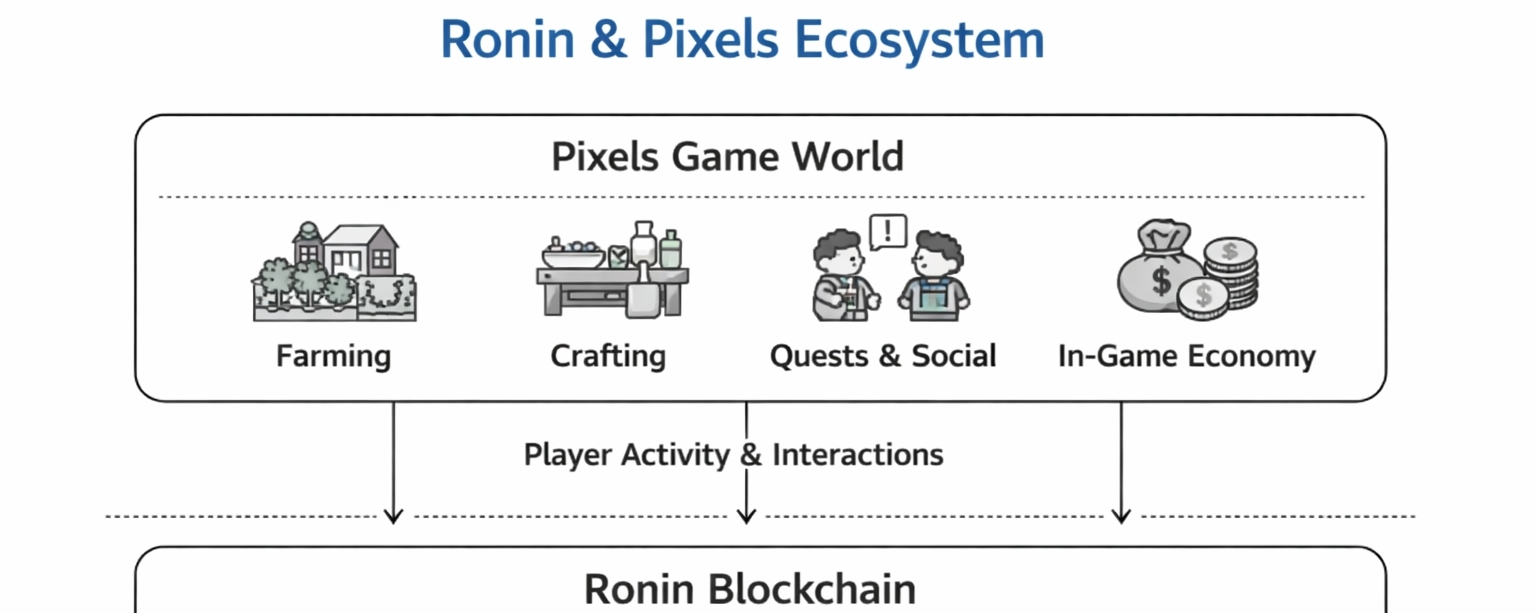
The first time I came across Pixels, it didn’t feel like a “chain” at all. It felt like a game trying to stay a game. That alone was a bit disorienting. Most things in this space introduce themselves with infrastructure first throughput numbers, consensus models, some diagram that tries to look like a subway map of the future. Pixels doesn’t really do that. It pulls you into a world before it explains itself. Farming, wandering, clicking around, figuring things out slowly. It’s softer. Almost suspiciously so.
And then you remember it’s sitting on Ronin, which is already its own kind of experiment. Not quite a traditional Layer 1 in the grand, “we will replace everything” sense. More like a purpose-built environment that grew out of a single use case and then tried to generalize after the fact. That’s a different starting point. Less theory, more adaptation.
But stepping back, it’s hard not to feel that familiar fatigue. Every cycle, there’s another wave of “new base layers,” each one framed as the missing piece. Faster, cheaper, more scalable, more decentralized, or sometimes all of those at once somehow. It’s a loop. You start recognizing the tone before you even read the details. The industry doesn’t really lack chains anymore. It lacks reasons for people to care about new ones.
And the thing people don’t like to admit is that most chains don’t break in whitepapers. They break when people actually show up. When transactions stop being neat little test cases and start piling up in messy, unpredictable ways. Real usage is chaotic. It’s not just about volume — it’s about behavior. Bots, spikes, weird edge cases. That’s where systems start to reveal what they actually are.
You can see it even in networks that are considered “working.” Solana, for example, can feel incredibly smooth when things are calm. Fast, almost invisible. But it has also had moments where that smoothness cracks under pressure. Not constantly, not catastrophically every time, but enough to remind you that performance claims always come with conditions. There’s always a context where things hold together, and another where they don’t.
Pixels, through Ronin, seems to be approaching this from a different angle. Instead of trying to be everything at once, it leans into a narrower reality: what if the chain exists primarily to support a specific kind of activity in this case, a game that actually has people interacting with it regularly? Not just trading tokens, but doing repetitive, slightly mundane actions. Farming, crafting, moving around. It’s not glamorous usage, but it’s real usage.
That’s kind of interesting because most chains optimize for financial throughput first and hope other use cases follow. Here it feels inverted. The activity comes first, and the infrastructure adjusts around it. It quietly acknowledges something a lot of projects gloss over: people don’t wake up wanting to use a blockchain. They wake up wanting to do something, and the blockchain either gets in the way or disappears into the background.
Of course, that comes with trade-offs. When you design around a specific environment, you’re inevitably simplifying something. Maybe it’s decentralization in the purist sense. Maybe it’s flexibility. Maybe it’s the ability to support entirely different kinds of applications without friction. There’s always a cost to focus. And it’s not always obvious at the start which compromises will matter later.
There’s also the question of whether this model scales beyond its original context. A system that works well for one successful game might not automatically become a general-purpose ecosystem. It might just remain… a very good place for that one thing. And maybe that’s fine. But the industry tends to overextend narratives. One success becomes proof of a universal model, even when it’s not.
Then there’s adoption, which is where most of these ideas quietly stall out. It’s one thing to build something that works. It’s another to get people and more importantly, capital to move. Users don’t migrate easily. Liquidity even less so. Everything tends to stick where it already is unless there’s a very clear, immediate reason to leave. Not a theoretical advantage, but something you can feel right away.
Pixels has a bit of an edge here because it doesn’t ask users to think in those terms. It just gives them something to do. That lowers the barrier in a subtle way. But whether that translates into a broader shift is unclear. People might engage with the game and never think twice about the underlying chain. Which is arguably the point… but also limits how far the ecosystem narrative can stretch.
I keep coming back to that tension. On one hand, there’s something refreshingly grounded about it. Less obsession with being the “next” anything, more focus on making a specific experience actually function. On the other hand, it’s hard to ignore how many times we’ve seen promising setups struggle to expand beyond their initial spark.
There’s a version of the future where multiple smaller ecosystems like this coexist, each handling its own kind of activity. Not competing to dominate, just… existing alongside each other. It sounds reasonable when you say it out loud. But in practice, coordination, fragmentation, and incentives tend to complicate that picture pretty quickly. Theory and behavior don’t always line up.
Still, there’s something here that feels a bit more honest than most attempts at building a new base layer from scratch. It doesn’t try to solve everything. It just tries to not break while people are actually using it. That’s a lower bar, but also a more meaningful one.
I wouldn’t call it convincing yet. But it’s at least pointing in a direction that doesn’t feel entirely recycled.
It might work. Or nobody shows up.
