
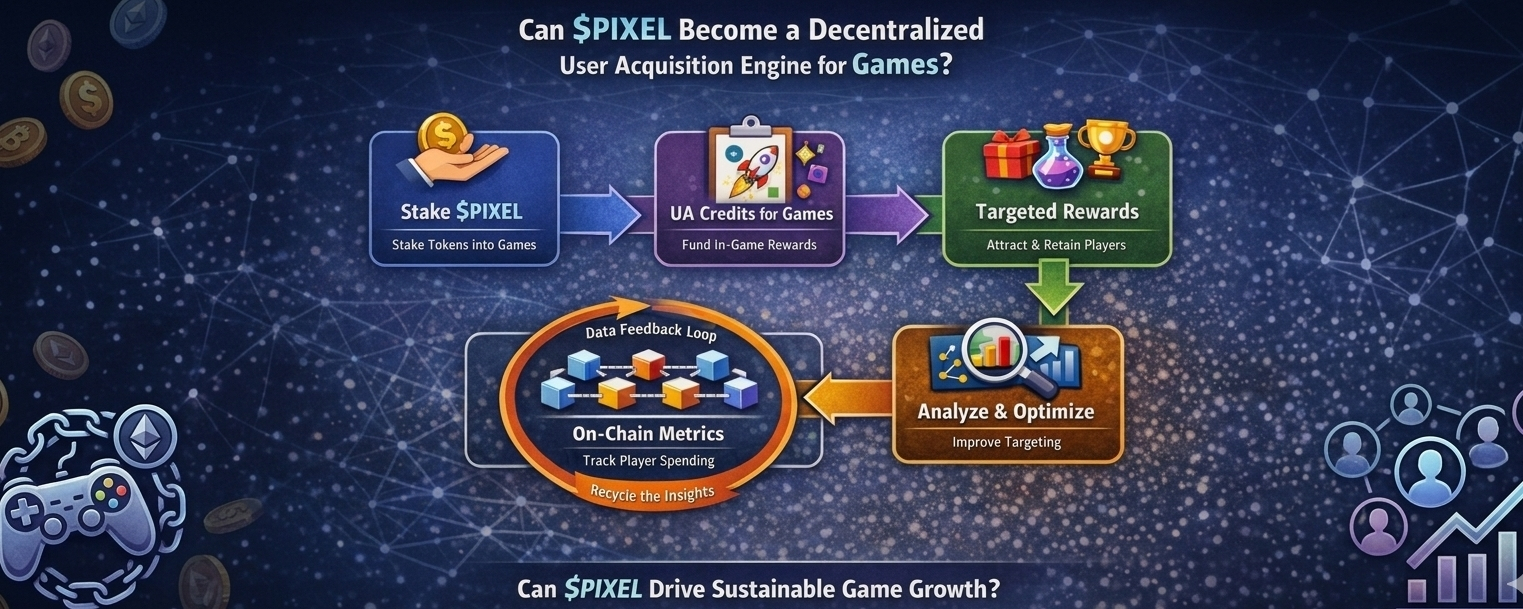

I keep coming back to this question because it pushes $PIXEL beyond the usual “game token” discussion.
Most game tokens are judged by price, emissions, or short-term player excitement. But the more interesting possibility is whether PIXEL can become infrastructure for distribution.
Pixels itself says the ambition is bigger than one farming game.
The whitepaper frames the project as an attempt to solve play-to-earn in a way that creates a new model for game growth and user acquisition, using targeted rewards, stronger incentive design, and data science to optimize long-term engagement rather than just temporary activity.
That is a much more serious idea than simply rewarding users and hoping they stay.
What makes the idea different is the structure. In the updated whitepaper, Pixels does not describe staking as something passive that only secures a network in the old sense.
It turns games themselves into the main validators of the ecosystem. Players stake PIXEL toward games, and that staking becomes an on-chain user acquisition budget that studios can use for targeted in-game rewards instead of spending blindly on traditional ad platforms. In other words,
PIXEL is being positioned as programmable acquisition capital.
A game that can attract stake is effectively earning the right to deploy growth spend inside the ecosystem, and a game that uses those incentives well should be able to attract more support over time.
That creates a market-based filter where capital flows toward the games that can convert incentives into real retention and spend, not just empty traffic.
That is where the decentralized user acquisition engine thesis starts to make sense. In a normal Web2 setup, game studios buy users through closed advertising systems, accept weak attribution, and often lose control over data, audience quality, and economics.
Pixels is trying to flip that model into a visible loop: stake becomes UA credits, UA credits bring in or reactivate players, player spend creates revenue, revenue supports stakers, and every action adds more first-party data that improves future targeting.
The important part is not only that rewards are distributed, but that the full cycle becomes measurable. If this works, then PIXEL is no longer just a reward token.
It becomes the accounting layer for who deserves growth capital, how efficiently it is used, and whether a game is actually creating durable value.
That would make acquisition feel less like marketing burn and more like an economic system with feedback, memory, and competition built into it.
But I do not think the thesis is proven yet. The biggest reason is simple: Pixels’ own metric, Return on Reward Spend, is currently around 0.8, while the target is to push above 1.0.
That matters because the whole model only becomes truly self-sustaining when reward spend brings back enough value to cover itself and keep compounding.
Until then, the mechanism is promising, but still incomplete. There is also a more practical issue. A decentralized acquisition engine only works if the games inside it are genuinely worth retaining users for. Pixels itself still emphasizes “fun first,” and that is not a side note. If the games are weak, no amount of smart targeting will fix the problem. Better reward allocation can reduce waste, but it cannot manufacture authentic player interest from nothing.
There is also the question of token behavior. The older lite paper makes it clear that PIXEL was designed as a premium in-game currency tied to upgrades, cosmetics, land minting, accelerators, and other forms of utility rather than pure earnings.
It even explicitly says the goal is to avoid users valuing the token mainly because it increases future earnings.
That design choice matters here. If the token is mostly treated as an extraction asset, the acquisition engine leaks.
But if the token remains tied to status, speed, enjoyment, and useful in-game actions, then capital has a better chance of cycling through the ecosystem instead of immediately exiting it. In that sense, the real battle is not just growth efficiency. It is whether the token can sit at the center of a closed economic loop without collapsing into a sell-pressure machine.
So my view is this: yes, PIXEL could become a decentralized user acquisition engine for games, but only if Pixels proves three things at the same time. First, rewards must keep getting smarter, not broader. Second, the games inside the system must be good enough that fun and progression do most of the retention work. Third, RORS has to move decisively above 1.0 and stay there.
If that happens, PIXEL starts looking less like a speculative game token and more like shared growth infrastructure for a network of games. And that is the part that I find genuinely interesting, because it means the future value of the token would come not only from what players spend, but from how efficiently an entire gaming ecosystem learns to grow.
