

I didn’t open @Pixels expecting to think this deeply.
It looked like something I’ve seen a hundred times before. A calm farming game. You plant, you harvest, you move around a colorful map, and you log off. Nothing loud, nothing complicated. In a space like Web3, where everything tries to grab your attention in the first five minutes, this kind of simplicity almost feels out of place.
So I treated it casually at first.
A few actions here, a few resources there. No pressure, no plan. Just passing time.
But then something strange happened.
The game didn’t change. I did.
I started noticing small things. Decisions that didn’t seem important at first began to matter. Where I spent my time, how I used my resources, when I chose to act instead of waiting. None of this was forced. The game never tells you “optimize this” or “play smarter.” It just creates a space where your choices naturally start shaping your outcome.
That’s when Pixel stopped feeling like a game and started feeling like a system.
And once you see that shift, you can’t unsee it.
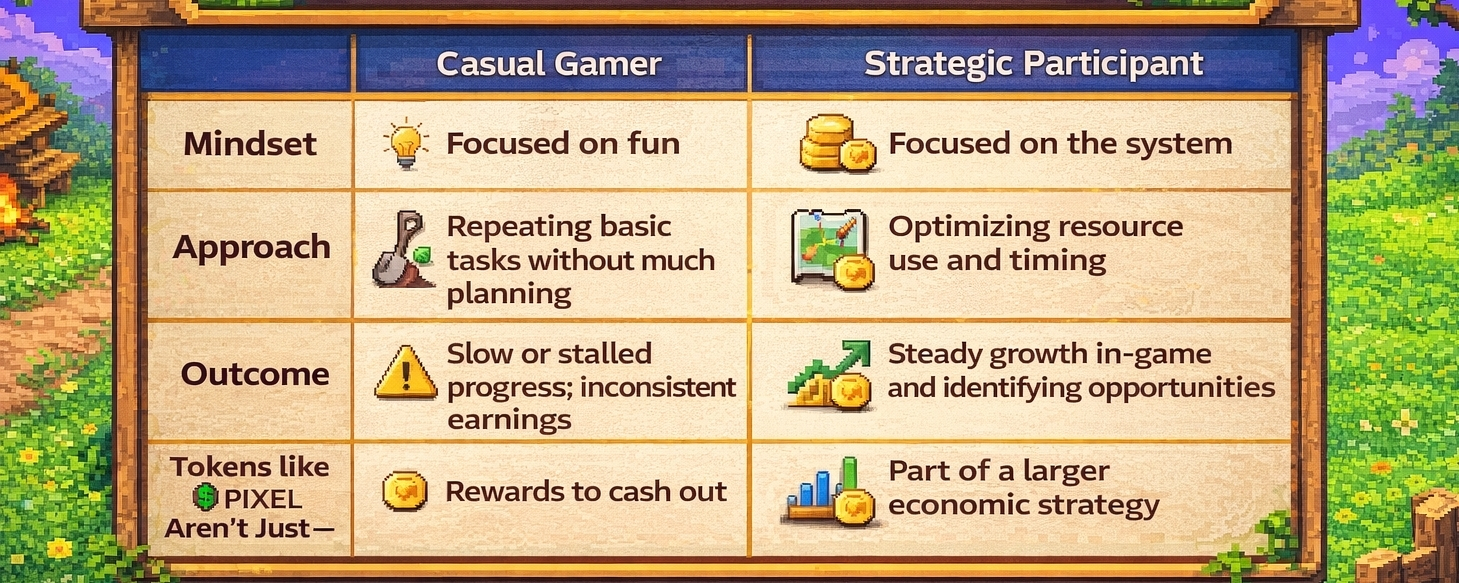
The Stacked ecosystem is where everything really clicks. It’s not just about doing more. It’s about understanding where you stand inside the system. Some players focus on constant activity. They log in, grind, collect, repeat. Others start thinking differently. They look at access, ownership, positioning. They begin to ask better questions.
“What actually moves me forward?”
That question changes everything.
Because now you’re not just playing. You’re participating in something that behaves more like an economy than a game loop.
The recent updates, especially around higher-tier industries, made this even clearer. Suddenly, it’s not about doing tasks anymore. It’s about managing capacity. You can’t just rush through everything. You have to think ahead. Commit to decisions. Accept trade-offs.
And that’s where most people either lean in… or fall off.
Because this kind of system doesn’t reward mindless repetition. It rewards awareness.
If you rush, things feel messy. Progress feels inconsistent. But if you slow down, if you start thinking about why you’re doing something instead of just doing it, the experience changes completely. You start seeing patterns. You start understanding flow.
You begin to realize that effort alone isn’t enough. Direction matters more.
What makes $PIXEL interesting here is that it quietly ties everything together without forcing it. The token isn’t just a reward. It becomes part of how you think inside the system. Every action has weight because it connects back to something larger.
And that “something larger” is what most Web3 games struggle to build.
A real sense of continuity.
Most projects reset you every time. New meta, new system, new grind. But Pixel does something different. It lets your understanding carry forward. The more time you spend inside, the more clarity you build. Not just about what to do, but about how the system behaves.
That’s rare.
And honestly, it’s hard to design.
Because it requires restraint. It means not overwhelming the player at the start. It means letting complexity reveal itself slowly, over time, instead of throwing everything upfront.
In a way, Pixel trusts the player to grow into the system.
And that trust is what creates depth.
The Stacked ecosystem isn’t loud about what it’s doing. It doesn’t try to impress you instantly. But if you stay long enough, you start to feel it. A shift from activity to strategy. From repetition to intention. From playing a game to thinking inside an economy.
That’s the part that stayed with me.
Not the rewards. Not the updates. But the way it changes how you approach decisions.
It reminds you that systems don’t need to be complicated to be meaningful. They just need to be consistent enough for patterns to emerge.
And once those patterns start making sense, you’re no longer just another player passing through.
You’re part of it.
That’s why I think Pixel is moving in a direction most people are still underestimating. It’s not trying to be the loudest project in Web3. It’s trying to be one of the few that actually works over time.
And if it continues building like this, focusing on structure instead of hype, it won’t just hold attention.
It’ll hold behavior.
That’s a much stronger foundation.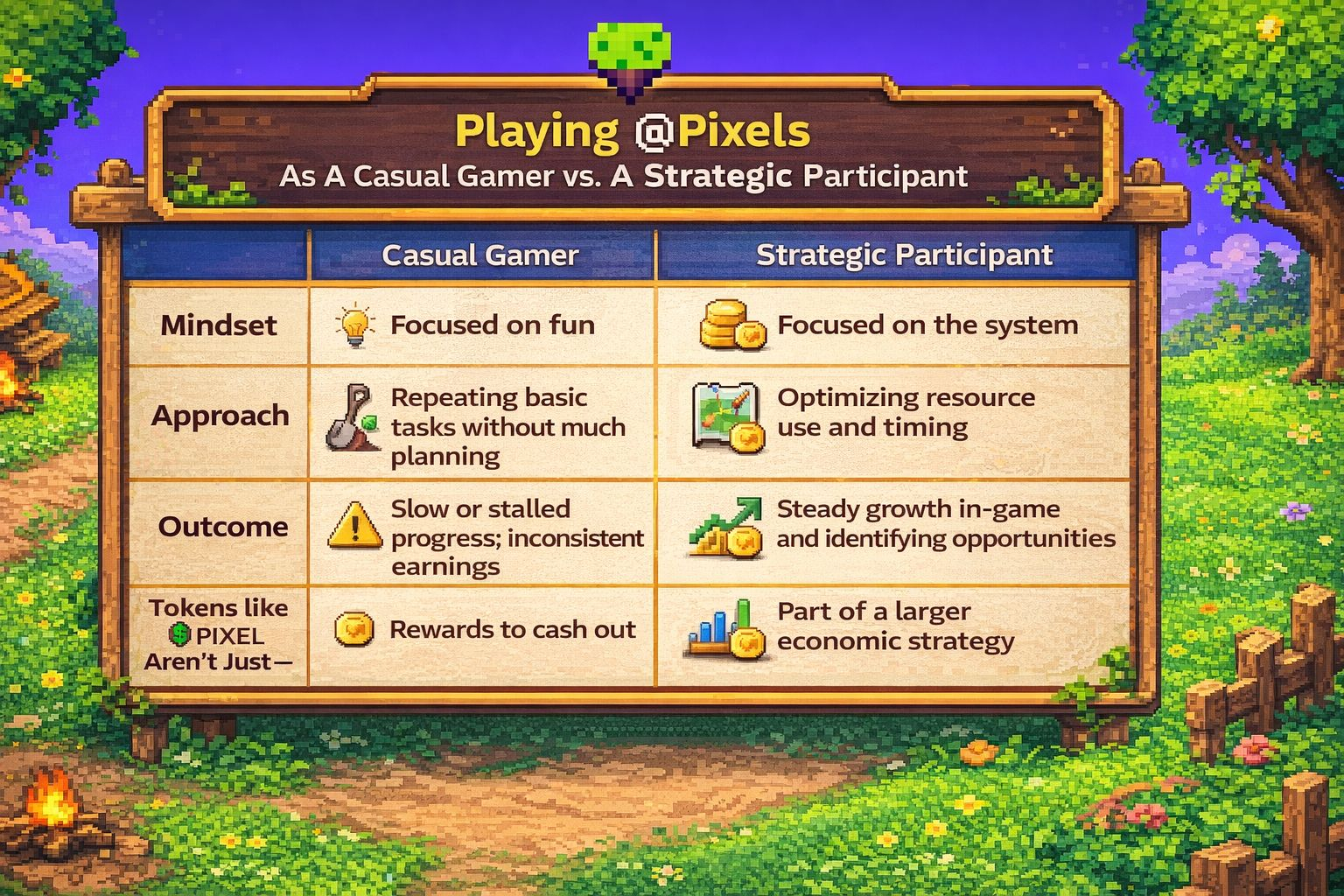
#pixel
