
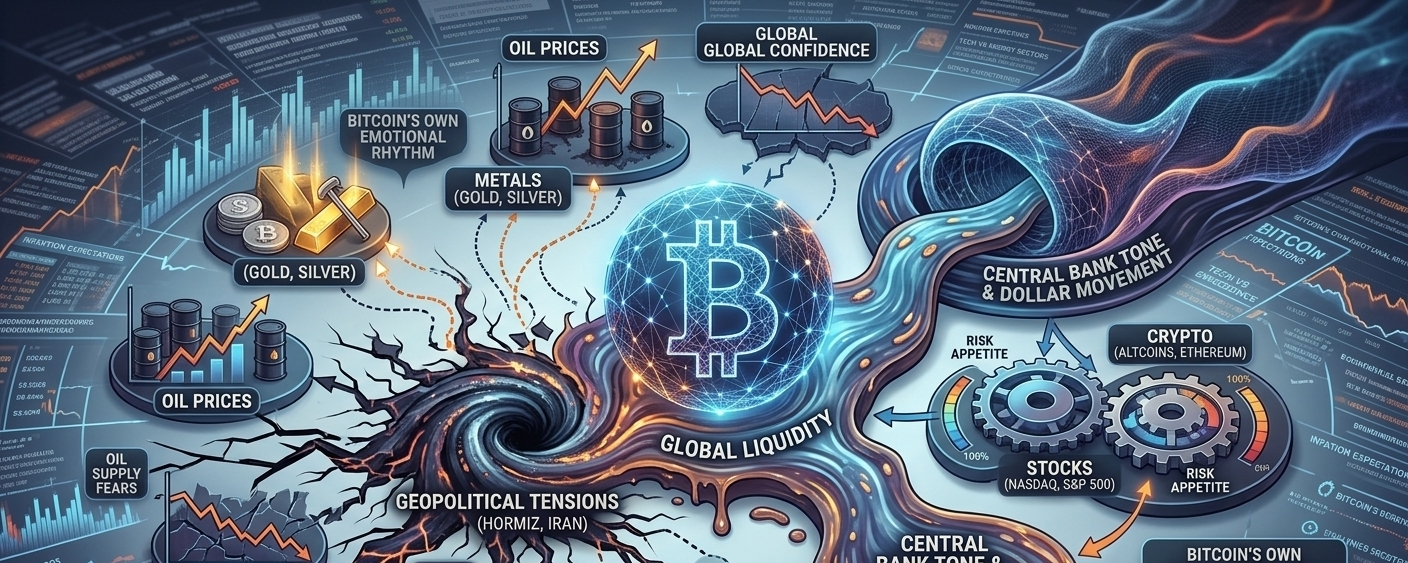
I have been watching Bitcoin long enough to realize it doesn’t really move in isolation anymore. People like to say it reacts to news, but what I’ve seen is something more layered than that. I spent a lot of time on research trying to understand how Bitcoin behaves when the world feels unstable—especially when headlines start focusing on places like the Strait of Hormuz, Iran-related tensions, oil supply fears, and sudden swings in global confidence.
What stands out to me is how quickly oil becomes the first domino. When there’s even a hint of disruption around Hormuz, oil reacts almost instantly. Prices jump, traders panic, and suddenly every market starts adjusting expectations. But Bitcoin doesn’t always follow in a simple way. Sometimes it drops at first, almost like it’s reacting with confusion rather than fear, and then later it starts to move in the opposite direction once the bigger picture becomes clearer.
I have noticed that during these moments, stocks usually try to price in the future first. Energy stocks react differently from tech stocks, and the whole equity market starts splitting into winners and losers depending on inflation expectations. Crypto, especially Bitcoin, sits somewhere in between. It’s not treated like gold, even though people still call it digital gold sometimes, and it’s not treated like tech anymore either, even though it often moves with Nasdaq sentiment. It feels like it has its own emotional rhythm now, tied more to liquidity than to any single story.
When oil goes up because of geopolitical fear, metals like gold tend to catch attention. Investors look for safety, and gold naturally benefits. But I have also seen cases where gold rises and Bitcoin does not immediately follow, which breaks the old narrative people used to rely on. Instead, Bitcoin waits. It waits for liquidity signals, for dollar movement, for central bank tone, and for the panic to either spread or settle.
And when things calm down—when tensions around shipping routes ease or when headlines shift away from conflict—markets often snap back faster than expected. Oil can drop sharply, stocks can rally, and suddenly risk appetite returns. In those moments, Bitcoin sometimes moves late but strongly, almost like it was holding back energy while everyone else was reacting to fear.
The part I keep coming back to in my research is this: Bitcoin is not directly trading war or oil or metals. It is trading the pressure those things create on global money flow. If liquidity is tightening, Bitcoin struggles. If liquidity is expected to return, Bitcoin breathes again. Everything else is just the trigger, not the real engine.
So when I think about Bitcoin price prediction in a world shaped by Hormuz risks, Iran tensions, oil shocks, metals, and the constant comparison between stocks and crypto, I don’t see a fixed direction. I see shifting reactions layered on top of each other. Sometimes fear leads, sometimes liquidity overrides fear, and sometimes Bitcoin simply ignores everything for a while before catching up all at once.
That’s what makes it both frustrating and interesting to watch. It doesn’t behave like a traditional asset, and it doesn’t fully behave like a safe haven either. It reacts like something that is still being defined by the global system around it.