Disaster recovery plans for pixel token community infrastructure
When I first looked at disaster recovery around a token community, I treated it like a checklist. Backups, failover, another admin wallet, maybe a mirror site. What changed my view was noticing how quickly a game community stops asking whether the servers are live and starts asking who can still verify, who can still speak for the project, and whether yesterday’s rights still count today.
The shallow assumption is that recovery means getting the app back online. I think the harder truth is that recovery is about restoring legitimacy under stress. For a tokenized game community, infrastructure is not just servers. It is wallet login, role assignment, treasury permissions, staking routes, moderator authority, claim records, support channels, and the social memory that tells players which message is real.
That matters more in Pixels than it first seems. The project presents itself as a world with over 10 million players, and its public economy ties participation to staking and token utility, which means a disruption does not just pause entertainment. It can interrupt access, rewards, and coordination all at once.
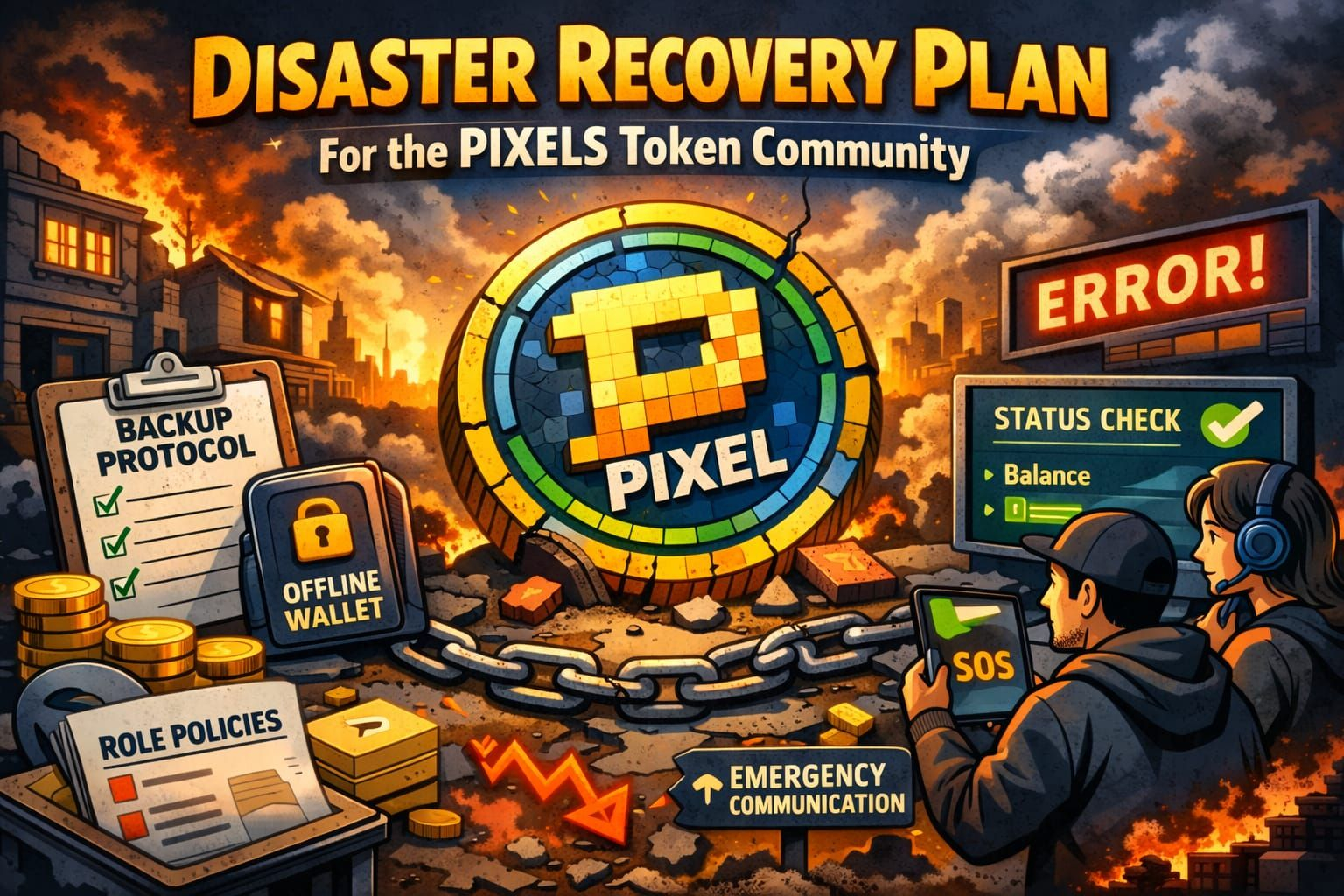
On the surface, a disaster plan sounds like duplicated infrastructure. Underneath, it is a map of which promises must survive a failure. If the main dashboard goes dark, can players still confirm balances, official announcements, and claim windows from a second route published before the crisis. If Discord is compromised, is there a fallback channel, and do moderators have an offline copy of role policies rather than screenshots and memory.
The market is what makes this operational rather than theoretical. Right now PIXEL’s market cap is about $6.58 million, while its 24 hour volume is about $26.2 million, nearly four times larger. That tells me the token is still trading in a fast, thin environment where routing failures can move sentiment faster than governance can explain them.
Another pressure point is timing. CoinG.. shows a scheduled unlock on April 19, 2026 for 91.18 million PIXEL, worth about $784,860, roughly 12 percent of the current market cap. In a setting like that, recovery planning cannot wait for an incident report. A broken announcement channel near an unlock is not merely bad communications. It changes behavior immediately.
Meanwhile the broader market is not giving smaller communities much room for confusion. CoinGecko puts total crypto market cap near $2.68 trillion, with Bitcoin dominance at 57.29 percent and stablecoins at about 11.87 percent of the market. That usually means capital is leaning toward liquidity and perceived safety, not patiently underwriting ambiguity in long tail game tokens.
You can see the same caution in the ETF tape. March brought roughly $1.34 billion of spot Bitcoin ETF inflows, then a later $291 million outflow day pushed year to date flows back to around negative $160 million. I read that as a reminder that trust is conditional almost everywhere. Capital comes back, but it comes back with an exit route already planned.
So the real recovery plan for a pixel token community is less about heroic continuity and more about precommitted boundaries. Publish backup domains before they are needed. Separate emergency read access from spending authority. Keep signer thresholds, moderator succession, and claims dispute rules visible enough that people know what survives a compromise and what does not.
Recovery is where a community proves what it really owns.