I will be honest, That part is almost too easy to focus on. People see the token, the blockchain connection, the Ronin Network, and they start forming opinions before they even look at what the actual experience seems to be. I get that. I usually do the same. You can usually tell when a project wants to be discussed more as an idea than as a place where people actually spend time.
But @Pixels feels a little different when you sit with it for a minute.
On the surface, it is simple enough. It is an open-world game built around farming, exploration, and creation. That does not sound especially new. Games have been using those loops forever. Plant something, gather something, move around, build a routine, come back tomorrow. It is familiar in a very old way. Maybe that is part of why it works. It does not begin by asking the player to understand a system. It begins by giving them something ordinary to do.
And honestly, that matters more than people admit.
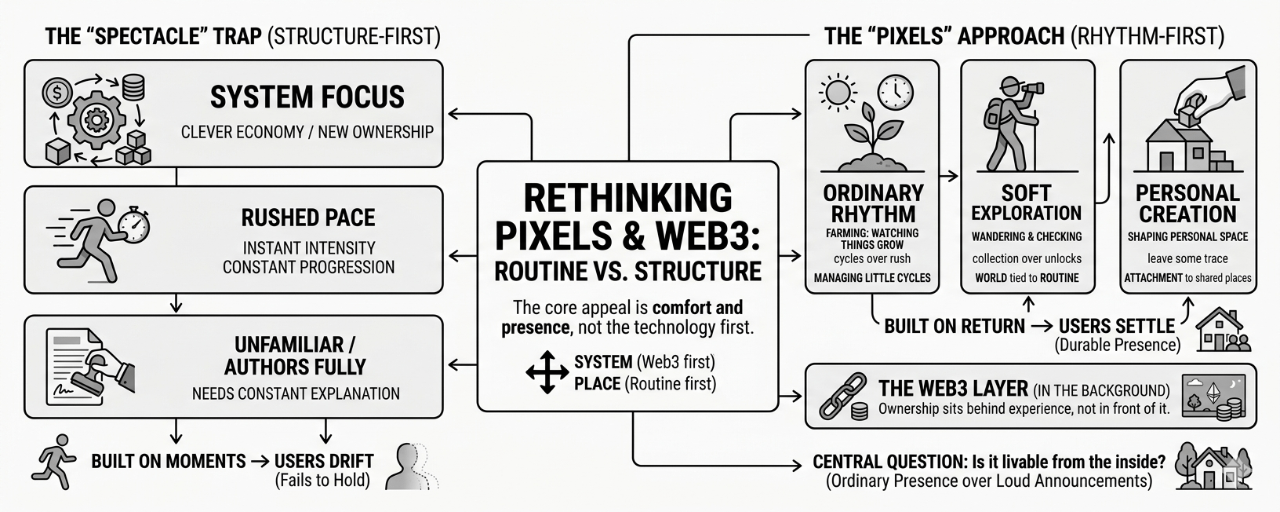
A lot of digital worlds fail because they start from structure instead of rhythm. They think if the economy is clever enough, or the ownership model is new enough, people will stay. But most people do not stay because a system is clever. They stay because it becomes part of their pace. A small task. A little habit. Something that feels easy to return to without having to explain to yourself why you are returning.
That is where things get interesting with Pixels.
The farming part sounds small when you describe it plainly, but it creates a very particular kind of attention. You are not rushing all the time. You are not being pushed into constant intensity. You are watching things grow. You are managing little cycles. You are moving through a world that seems to reward repetition, but not in a dead way. More in the way a garden does. Even in a digital setting, that kind of loop changes the mood. It slows things down. It gives people room to settle into the game instead of feeling like they have to conquer it.
And once that happens, exploration starts to feel different too.
In a lot of games, exploration is really just progress dressed up as curiosity. You move because the game needs you to unlock the next thing. In Pixels, at least from the outside looking in, the movement feels softer than that. It feels tied to wandering, checking, collecting, noticing. The world is not just a backdrop for a faster objective. It becomes part of the routine. It becomes a place you pass through again and again, and because of that, familiarity starts doing some of the work.
It becomes obvious after a while that this kind of game is less about spectacle and more about presence.
That might sound like a small distinction, but it changes a lot. A spectacular game wants to impress you. A present game wants you to remain inside it. Those are different ambitions. One is built around moments. The other is built around return. Pixels seems much more interested in return.
And I think that is why the creation side matters more than it first appears.
Creation in games is often treated as a bonus. A side feature. Something nice to mention. But when a game gives players room to shape their space, or participate in the world in a more personal way, the relationship shifts a little. The world stops feeling fully authored by someone else. It starts feeling shared. Even if the tools are simple, even if the expression is modest, that change matters. People get attached to places where they have left some trace of themselves.
That is true online in general, not just in games.
The web3 part sits underneath all this, but I do not think it is the first thing worth saying. In fact, I think the mistake is usually starting there. Because once you begin with the token or the chain, you risk misunderstanding the real appeal. The appeal is not that Pixels uses web3. The appeal is that it tries to place web3 inside a game loop that already makes emotional sense to people. That is a much harder thing to do.
Most projects connected to blockchain feel like they are asking players to tolerate a game in order to participate in an economy. Pixels seems to be trying, at least in its better moments, to reverse that. Play first. Routine first. World first. Then let the ownership and network layer sit behind the experience instead of standing in front of it.
That does not solve everything, of course.
It still leaves the usual questions. What kind of players stay once the novelty wears off. Whether the economy supports the mood of the game or starts distorting it. Whether the presence of a token quietly changes behavior over time. These things always matter. Once value becomes visible, behavior changes. People optimize. They rush. They compare. They start asking what is efficient instead of what feels good. That is not a flaw unique to Pixels. It is just what happens when play and incentives start touching each other.
So the balance becomes important.
If the farming, exploration, and creation loops stay central, then the world keeps its texture. It keeps that calmer feeling. But if everything starts bending toward extraction, then the tone changes. The softness disappears. What looked like a social world turns into a system people are trying to solve. You can usually tell when that happens. The atmosphere gets thinner. The routines feel forced. The world starts looking less like a place and more like a spreadsheet wearing bright colors.
That is why I think Pixels is more interesting as an experiment in behavior than as a product pitch.
It asks a quiet question. What kind of digital world can hold people through comfort instead of pressure. Not through adrenaline. Not through endless conflict. Just through habit, familiarity, and small acts of care. Farming is part of that. Exploration is part of that. Creation is part of that. Even the social layer grows out of that. People tend to talk more naturally in spaces that do not constantly demand performance from them.
And maybe that is the deeper thing here.
The question changes from whether a web3 game can attract attention to whether it can support ordinary presence. That feels more difficult, and also more real. Anyone can get attention for a while. Building something people fold into daily life is different. That takes patience. It takes a better sense of human behavior than most projects seem to have.
Pixels seems aware of that, at least a little. It feels less obsessed with announcing its importance and more interested in becoming a place people casually return to. I think that is why it stays in my mind. Not because it is loud. Because it is not.
And once you notice that, you start watching it differently. You stop asking whether it looks impressive from a distance. You start asking whether it feels livable from the inside. That is a quieter question. Probably the more important one too.
The answer is never final with games like this. It changes as people enter, stay, leave, and reshape the mood around them. But still, there is something worth noticing in a world built around farming, wandering, and making things slowly. Not everything online has to arrive with urgency. Some things make more sense when they grow at their own pace.
#pixel $PIXEL

Artykuł
What makes Pixels interesting to me is not really the fact that it is a web3 game.
Zastrzeżenie: zawiera opinie stron trzecich. To nie jest porada finansowa. Może zawierać treści sponsorowane. Zobacz Regulamin