
I kept thinking about why most reward systems stop working after a while.
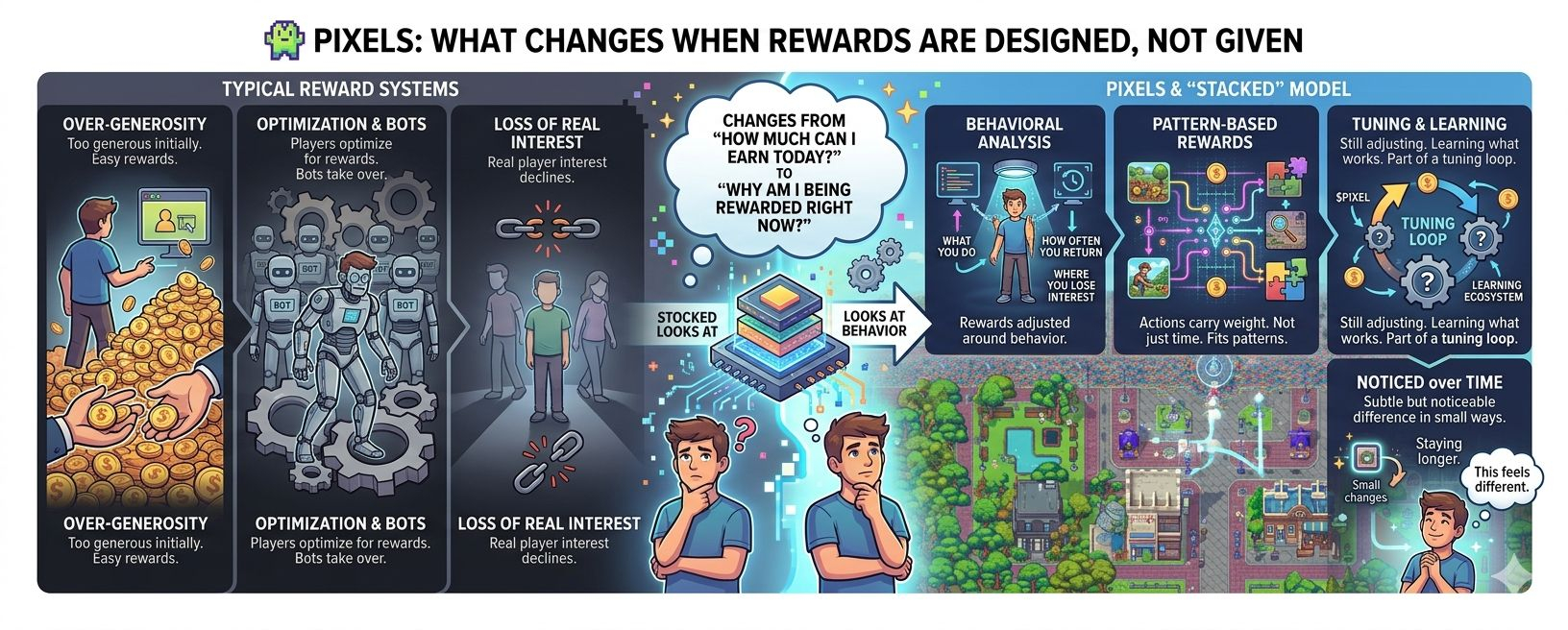
At first, they feel generous. Almost too generous. You log in, do a few simple things, and rewards come easily. But then something shifts. People start optimizing for the reward instead of the game. Bots show up. Real players lose interest.
You can usually tell when a system wasn’t built for the long run.
With Pixels, the feeling is a bit different. It doesn’t try to overwhelm you with rewards early on. In fact, sometimes it feels slower than expected. But after spending some time in it, the structure starts to make more sense.
That’s where Stacked comes in.
Instead of treating every player the same, it looks at behavior. What you do, how often you return, where you lose interest. Then rewards are adjusted around that. Not perfectly, but in a way that feels intentional.
The question changes from “how much can I earn today” to “why am I being rewarded right now”.
That shift is subtle, but it matters.
You start noticing that certain actions seem to carry more weight. Not because they take longer, but because they fit into a bigger pattern the system is tracking. It becomes less about farming everything, and more about doing the things that actually connect.
PIXEL still plays a role here, but it feels less like a simple payout token and more like part of a loop that’s being tuned over time.
And maybe that’s the part that stands out.
It doesn’t feel finished. It feels like something that’s still adjusting itself while people are using it, learning what works and what doesn’t.
You don’t always notice it immediately.
But after a while, the difference starts to show in small ways.