
What makes Pixels feel different to me isn’t just the world, the token, or the farming loops.
If I’m being honest, it’s the fact that the game feels built around maintenance.
That’s not a glamorous word. Most projects avoid it. They prefer terms like creativity, ownership, exploration, freedom, community. Those are easier to sell. Maintenance sounds dull. It sounds like chores-something people do because they have to, not because they want to.
But the more I think about Pixels, the more I feel that “maintenance” is exactly the right word.
And maybe that’s why it stayed with me longer than I expected.
At first, I treated it the way I treat many Web3 games. I looked at the surface, understood the category, and moved on too quickly. Social. Casual. Open world. Ronin. Farming, exploration, creation. Fine. I’ve seen enough combinations of those ideas already. My assumption was that it would work better as a mood board than as a lived space.
That happens often. The description feels calm and inviting, but the experience ends up being a thin set of loops trying very hard to feel alive.
So I didn’t dismiss Pixels aggressively. I just didn’t trust it.
Then I started thinking about who this kind of game is actually for.
Not the idealized player from a trailer-but a real one. Someone who logs in tired. Someone with twenty minutes, maybe less. Someone who doesn’t want intensity every time. Someone who appreciates a bit of order, a bit of progress, a bit of visible change. Someone who doesn’t need every session to feel important, but still wants it to count for something.
From that angle, the whole design starts to make more sense.
Because maintenance is one of the most common ways people build attachment.
Not excitement-attachment.
That difference matters. Excitement is easy. It spikes quickly and fades just as fast. Games are very good at producing it. But attachment grows slowly. It builds when a place depends on your return just enough that you notice your absence. It grows when small tasks stop feeling like interruptions and start feeling like part of your relationship with the world.
That’s where things become interesting.
Farming games have always understood this better than they’re given credit for. The appeal isn’t just planting and harvesting-it’s the rhythm. You do something, you leave, you come back, and something has changed because you were there earlier. That structure turns effort into continuity. It makes care visible.
Pixels takes that idea and stretches it across a broader, social space.
And that’s what makes it more revealing than it first appears. When maintenance becomes social, it stops being a private loop. It becomes a shared condition. Other players are also tending, arranging, collecting, returning. Their presence isn’t just seen in interaction-it’s seen in upkeep.
You see it in the world itself.
That matters more than the word “community” usually captures.
A lot of platforms use “community” to describe activity-posts, comments, reactions, bursts of attention. That creates movement, but not always trust or familiarity. Familiarity comes from something quieter: watching people take care of things over time. Seeing consistent signs that they’re still there, still involved.
In that sense, a farming world can feel more social than much louder platforms.
Because care is visible.
You can see it in repetition. In gradual change. In routines that don’t announce themselves but still leave a trace. A space starts to feel inhabited when effort settles into it-not just when people pass through.
That’s why I think Pixels is better understood as a game about stewardship rather than escape.
Escape suggests leaving life behind. Stewardship suggests bringing parts of life with you-showing up, maintaining, managing small things, taking responsibility for a rhythm. That might sound ordinary, even unexciting, but ordinary isn’t a weakness in design. Sometimes it’s what gives a world durability.
You can usually tell when a game has no relationship with ordinary life. It relies on constant novelty to survive-events, rewards, stimulation. The moment the noise fades, the emptiness becomes obvious.
A maintenance-based world works differently. It can survive quiet. Quiet is part of its structure. It doesn’t always try to impress you-it waits for you to return.
That’s a very different kind of promise.
And honestly, a more realistic one.
Most people don’t stay with a game because it amazes them every day. They stay because it fits into their mood and routine. It becomes somewhere they can return to without friction. Somewhere they already understand how to exist.
Pixels seems designed around that kind of repeatable presence.
That doesn’t automatically make it good-but it makes the intention interesting.
Because maintenance has a double edge. It can be comforting, but it can also become a trap. That’s the risk of any system built on repetition. When players stop feeling like they’re caring for a world and start feeling like they’re servicing it, everything shifts.
What once felt grounding can start to feel draining. What once felt natural can start to feel compulsory.
This is where the Web3 layer makes me more cautious.
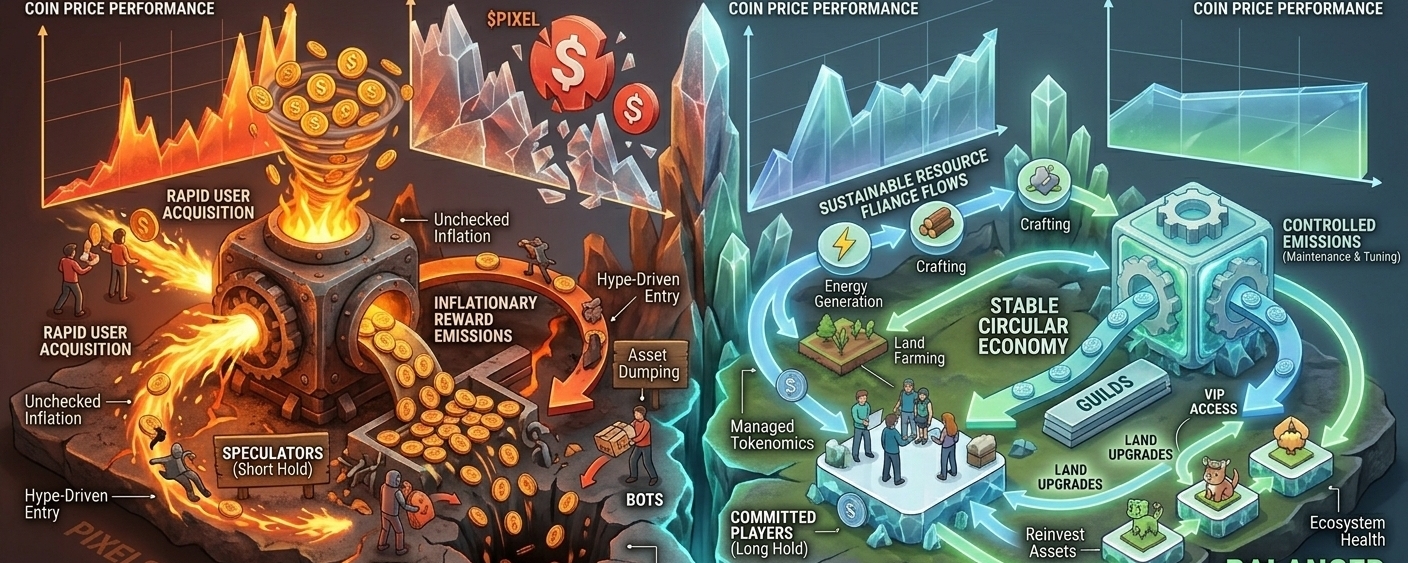
When economic logic becomes visible, even a soft world can harden. Care starts to translate into output. Routine becomes measurable. Time starts to feel priced. A gentle task can suddenly carry a second weight-not just “do I want to do this?” but “am I doing this efficiently?” or “am I missing value by not doing it now?”
That shift is subtle-but important.
A game like Pixels depends heavily on tone. If players feel like they’re tending a place, the tone holds. If they feel like they’re optimizing a system, that tone begins to erode.
The actions don’t change-but the meaning behind them does.
Planting is still planting. Gathering is still gathering. But internally, the question shifts from:
“What am I taking care of?”
to
“What is this system taking from me?”
That’s a sharper question-and one that slower, persistent worlds eventually have to answer.
I don’t think Pixels has an easy solution to that. Probably no game of this type does. But naming the tension clearly matters-especially because so much of its appeal comes from its softness. The low pressure. The calm repetition. The sense that time spent here doesn’t demand constant performance.
That softness isn’t cosmetic-it’s structural.
If it breaks, everything around it shifts.
And that’s ultimately why I find Pixels more interesting now than when I first saw it.
Not because it represents some inevitable future-but because it sits on a very human edge.
The edge between care and labor.
Between routine and obligation.
Between tending a place and working a system.
That tension isn’t unique to games. It exists across digital life. Platforms ask for our regularity. Apps depend on our return. Systems pull us into their rhythms.
What Pixels does-at its best-is make that pattern visible, and a little gentler. It turns maintenance into something you can see, inhabit, and maybe even enjoy for a while.
That doesn’t make it innocent.
But it does make it worth paying attention to.
Because if a world can make small, repeated acts of care feel meaningful-without turning them into pressure-then it has understood something real about how attachment works online.
And if it can’t, that will become visible too.
Either way, the interesting part isn’t just that Pixels lets people farm, build, and explore.
It’s that it quietly asks:
What happens when a digital world is held together not by spectacle-but by people choosing to return, and take care of it?
