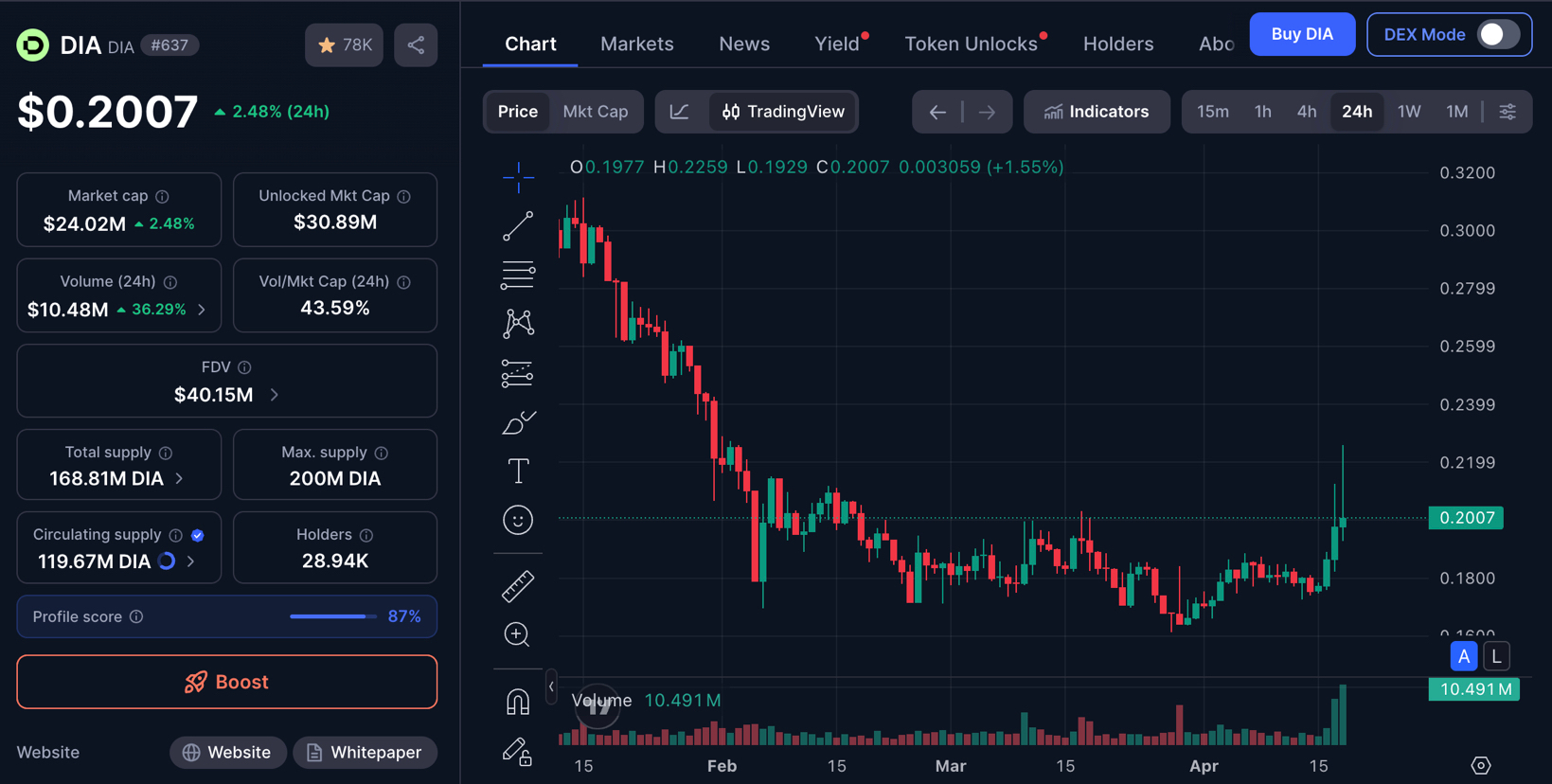
That distinction has always existed in finance. In DeFi, it's becoming a liability.
Markets move fast, often faster than fundamentals. Assets reverse sharply on thin volume. Sentiment overrides structure. And yet, most oracle systems are still built around a single assumption: that price is a sufficient proxy for value. It isn't, and the asset landscape has moved well beyond the point where that assumption holds.
Reserve-backed tokens, yield-bearing vaults, and instruments with value derived directly from on-chain logic all behave differently. Treating them identically through market-based price feeds introduces risk that compounds quietly until conditions tighten.
This is the design gap $DIA is closing.
DIA's hybrid oracle architecture doesn't just report price, it sources inputs contextually, pulling from market data or protocol-level logic depending on the nature of the asset. The result is a system that moves closer to measuring value than simply tracking price.
It's a structural improvement, not a feature. And in volatile markets, structural improvements are exactly what compounds.
$DIA, the infrastructure bet hiding in plain sight.