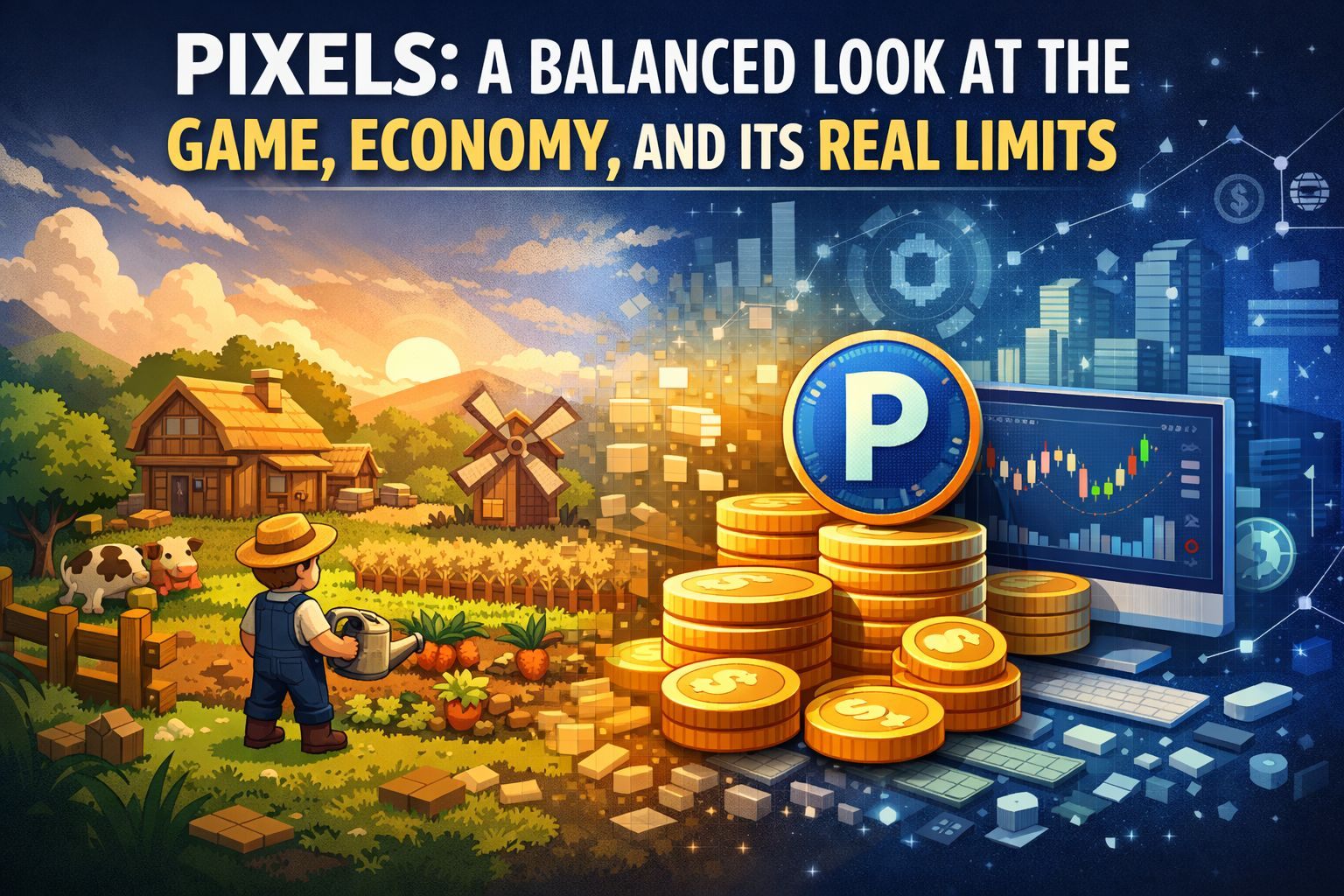

I Will Be Honest.. Initially, Pixels became widely recognized as a simple blockchain-based farming game, but the deeper you look, the more you realize it is not just a game trying to entertain people. It is actually a controlled economic experiment built on top of user behavior, attention flow, and digital ownership. At surface level, it feels light, almost nostalgic, like something you can play casually without pressure. But underneath that simplicity, there is a structured system trying to connect time, effort, and value in a way that is still not fully proven.
And honestly..
What makes Pixels interesting is not just the gameplay loop but the way it tries to merge traditional gaming psychology with on-chain incentives. The idea is straightforward: players do activities, earn rewards, upgrade assets, and become part of a growing digital economy. In theory, this creates a self-sustaining loop where engagement fuels value and value fuels engagement. However, in practice, these systems are extremely sensitive. If rewards are too high, the economy inflates quickly. If rewards are too low, players lose motivation. Pixels sits right in the middle of this tension, trying to balance fun and financial incentive at the same time.
From a technical perspective, the project shows some strong design thinking. The onboarding experience is relatively smooth compared to many blockchain games. It does not immediately overwhelm users with complexity, which is important for adoption. The interaction model is also lightweight, meaning it can potentially scale to a larger audience that is not deeply familiar with crypto infrastructure. This is a smart decision because most Web3 games fail at the entry point itself, where users are forced to understand wallets, gas fees, and token mechanics before even enjoying the game.
But while the accessibility is a strength, it also hides a limitation. The deeper mechanics are still not complex enough to sustain long-term engagement purely from a gameplay perspective. At some point, players start realizing that progression is heavily tied to repetitive actions rather than meaningful strategic depth. This creates a subtle friction. Casual users may not notice it immediately, but long-term players often begin to feel that the experience lacks layers of true gameplay evolution.
Economically, Pixels is even more interesting and also more fragile. The entire system depends on a delicate balance between inflation and utility. Tokens and rewards must circulate in a way that maintains perceived value. But unlike traditional games where developer control all variables, blockchain-based economies are influenced by open market behavior. This introduces unpredictability. If speculation increases too fast, it can distort player motivation. If speculation drops, liquidity and engagement can collapse quickly.
Another key aspect is that Pixels is not just competing with other games, it is competing with attention itself. In the modern digital landscape, users do not stay in one place for long unless there is continuous novelty or emotional engagement. So even if the economic system is well-designed, it still needs strong content evolution to keep users returning. This is where many similar projects struggle, because building an economy is easier than continuously building meaningful experiences on top of it.
There is also a philosophical layer to Pixels that is often overlooked. It tries to redefine what ownership mean in gaming. Traditionally, in-game assets are controlled by centralized systems, but here, ownership is partially shifted to the user through blockchain mechanics. On paper, this sounds empowering. In reality, the actual value of that ownership depends heavily on market perception and system stability. Ownership without sustained demand does not create real power; it only creates theoretical value.
What makes the project both impressive and uncertain is this dual identity. It is trying to be a game, a marketplace, and an economic simulation all at once. Each layer works individually, but the challenge is whether they work together in a way that remains stable over time. Many systems like this initially attract attention because of novelty, but long-term survival depends on whether the core experience remains enjoyable even without financial incentives.
If you step back and look at Pixels objectively, it is neither a failure nor a guaranted success. It sits in a very experimental zone where the outcome is still unfolding. The technical execution shows promise, especially in accessibility and integration of blockchain elements without overwhelming the user. But the economic sustainabilety and gameplay depth still need continuous evolution to avoid stagnation.
In the end, Pixels represents a broader question in the Web3 gaming space. Can a game truly remain fun if it is also an economy? Or does the introduction of financial systems inevitably change the way people play and perceive enjoyment? Pixels does not fully answer this question yet, but it is actively living inside it. and that alone makes it worth observing, not with blind optimism, but with careful and honest attention.. 🤗